October 2026

Understanding the new federal ada accessibility guidelines 2026 is now a critical priority for state and local government entities, public universities, and school districts. The Department of Justice (DOJ) has officially updated Title II of the Americans with Disabilities Act (ADA), establishing strict rules for how public entities must design their digital spaces.
If your website, mobile app, or online course material is hard to use for people with disabilities, you are now facing serious legal risks.
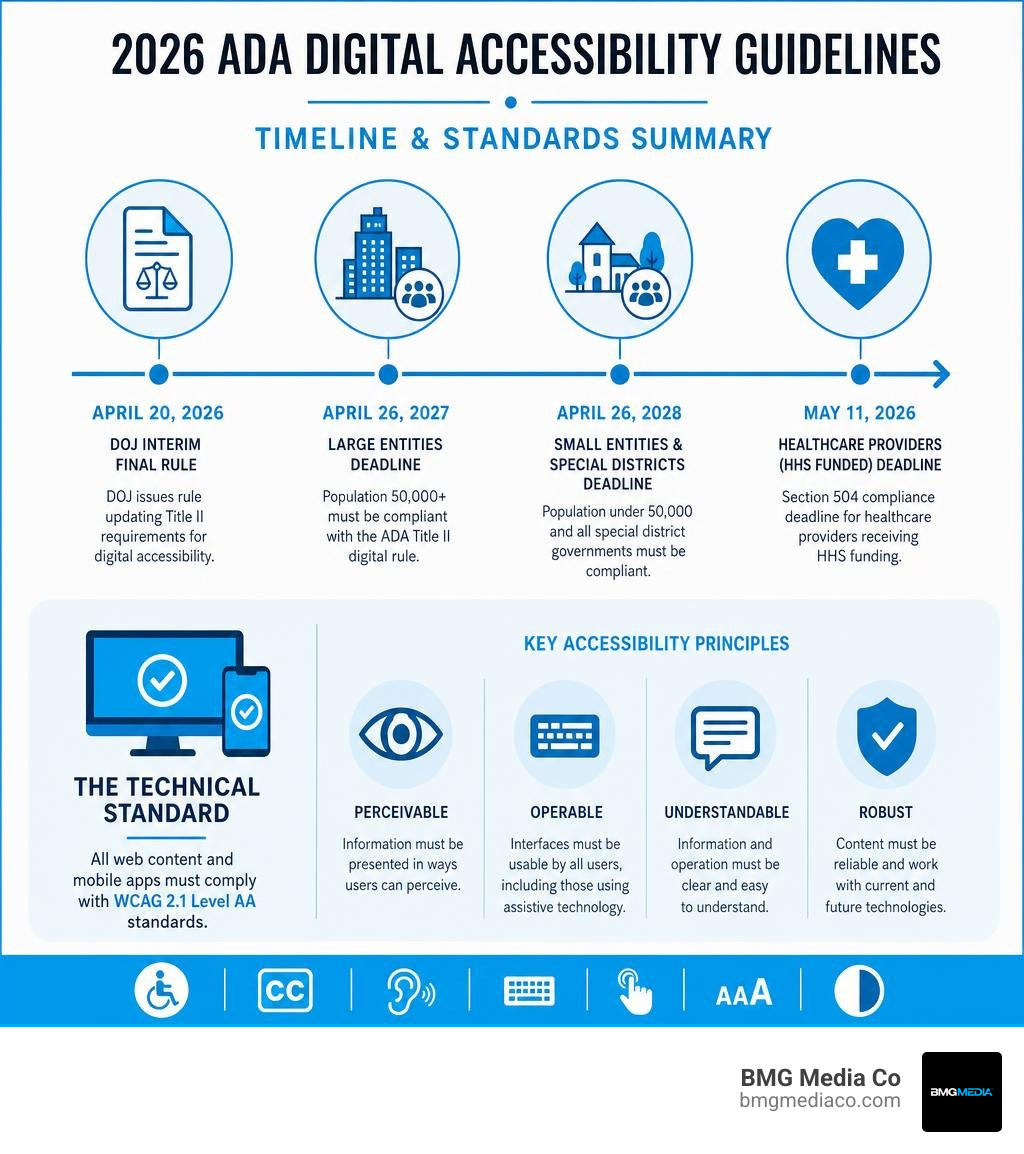
Here is a quick compliance summary to help you understand where your institution stands:
The shift is clear. Just like physical buildings need ramps, your digital products need clean code to ensure equal access. Relying on cheap, automated web templates or quick-fix accessibility widgets will not protect you from non-compliance. You need a proactive strategy to audit, remediate, and maintain your digital assets.
As the founder of BMG Media Co., I’ve spent over 15 years helping organizations build custom digital platforms that naturally align with complex regulations like the ada accessibility guidelines 2026. My team specializes in building clean, hand-crafted web experiences that bypass bloated templates and meet these strict standards natively from day one. Let’s look at exactly what these new rules require and how you can prepare your team for the upcoming deadlines.
To understand why the updated Title II regulations are causing such a massive shift across public sectors, we have to look at how we got here. Historically, the Americans with Disabilities Act (ADA) focused heavily on the physical world—ramps, automatic doors, and braille signage. However, as our daily lives migrated online, the DOJ increasingly interpreted “equal access” to include digital environments.
Title II of the ADA specifically applies to all services, programs, and activities of state and local government entities. This includes public school districts, community colleges, public universities, municipal offices, police departments, local courts, libraries, and public transit agencies. For decades, these entities operated under broad, sometimes vague, mandates to provide “effective communication.”
That vagueness is officially gone. With the codification of the DOJ Title II Web Accessibility Rule, the federal government has established a concrete, measurable technical standard that all public entities must meet.
This rule does not just apply to your homepage. It covers every digital touchpoint your organization provides to the public, students, or staff:
If a student with a visual impairment cannot read a syllabus uploaded to an LMS, or if a resident with a motor disability cannot pay their water bill online, that is now legally equivalent to locking the physical front door of a campus or town hall. To build a digital space that naturally welcomes everyone, public entities must integrate fundamental Web Design Principles You Need to Know directly into their software development lifecycles.
This rule also works in tandem with Section 504 of the Rehabilitation Act of 1973. While Title II covers state and local government entities, Section 504 prohibits discrimination based on disability in any program receiving federal financial assistance. Together, these laws create a comprehensive legal framework where digital accessibility is no longer a polite recommendation—it is a strict civil rights requirement.
The timeline for achieving compliance under the ada accessibility guidelines 2026 was originally structured around a rigid two-year window starting in April 2024. However, recognizing the immense administrative and technical hurdles facing smaller municipalities and public agencies, the DOJ issued an Interim Final Rule that shifted the goalposts.
To help you quickly identify when your organization must achieve full compliance, we have compiled the key deadlines based on population thresholds and entity types below:
| Entity Type / Population Size | Original Deadline | New Compliance Deadline | Governing Regulation |
|---|---|---|---|
| Large Public Entities (Population 50,000+) | April 24, 2026 | April 26, 2027 | DOJ Title II (Interim Final Rule) |
| Small Public Entities (Population < 50,000) | April 26, 2027 | April 26, 2028 | DOJ Title II (Interim Final Rule) |
| Special District Governments (All sizes) | April 26, 2027 | April 26, 2028 | DOJ Title II (Interim Final Rule) |
| Healthcare Organizations (HHS Funded) | May 11, 2026 | May 11, 2026 (Passed) | HHS Section 504 Rule |
This staggered approach ensures that while larger cities, counties, and state agencies face a more immediate deadline, smaller towns and specialized districts have the necessary runway to audit their systems, train staff, and secure the required budget.
On April 20, 2026, the DOJ published an Interim Final Rule that formally extended the compliance deadlines for all Title II entities. This critical regulatory update, detailed in Federal Register 89 FR 31338, threw a lifeline to public entities that were struggling to meet the original April 24, 2026 cutoff.
Under this updated timeline, the population threshold of 50,000 remains the dividing line:
For a deeper dive into how these population brackets are calculated—especially for complex entities like school districts and public university systems—the DOJ has provided a comprehensive Small Entity Compliance Guide.
It is important to note that population sizes are calculated using specific federal datasets, such as the 2020 Decennial Census or the 2022 Small Area Income and Poverty Estimates. If a local neighborhood library branch serves only 2,000 patrons but is funded and operated by a parent county with 80,000 residents, the library must meet the larger county’s deadline of April 26, 2027.
While state and local governments received an extension from the DOJ, healthcare organizations funded by the Department of Health and Human Services (HHS) did not receive the same leniency. The HHS Section 504 rule maintained its rigid compliance deadline of May 11, 2026.
This means that any healthcare provider, hospital system, or medical clinic receiving federal funding (such as Medicare or Medicaid reimbursements) must already comply with WCAG 2.1 Level AA standards. This divergence highlights a critical compliance risk: if your public entity operates a public hospital, community health clinic, or county health department, you cannot wait until the DOJ’s 2027 or 2028 deadlines. Your medical portals, appointment booking systems, and health resources must already be fully compliant.
If you are a healthcare provider navigating these strict standards, we highly recommend reviewing our dedicated resources for the Healthcare Industry to ensure your public portals are fully optimized. Just as securing user data is vital to trust—which you can read about in our guide on What is a Secure Site? Importance of HTTPS for Your Website—providing accessible interfaces is non-negotiable for modern healthcare.

The DOJ has adopted the Web Content Accessibility Guidelines (WCAG) Version 2.1, Level AA as the official technical benchmark for Title II compliance. Developed by the World Wide Web Consortium (W3C), WCAG is the globally recognized standard for digital accessibility.
But what does “Level AA” actually mean in practice? WCAG is divided into three levels of conformance:
To meet WCAG 2.1 Level AA, your digital platforms must conform to several core technical requirements:
Designing a site that hits these marks without sacrificing visual appeal or performance requires a deep understanding of UX vs UI Design: Understanding the Difference and Importance. Furthermore, because your users will access your platforms from a massive variety of devices, your accessibility strategy must be paired with responsive engineering, as outlined in Responsive Design 101: From Mobile-First to SEO-Ready.
The scope of the updated Title II rule is incredibly broad, but the DOJ has established five highly specific, narrow exceptions to prevent public entities from being crushed by the administrative burden of retrofitting decades of inactive digital files.
Understanding what is covered and what is exempt is the first step toward building an efficient, cost-effective remediation plan. To make this easy to digest, let’s explore the five narrow exceptions and how they apply in the real world.
For a detailed breakdown of how municipal organizations are interpreting these rules, you can review the ADA Compliance Update: New Web Accessibility Rules. The five recognized exceptions under the Title II rule include:
This exception covers old, outdated web pages or files that are kept solely for historical research or record-keeping. To qualify, the content must meet all four of these criteria:
Example: A PDF of town meeting minutes from 2011 stored in an archive folder is exempt. However, if a resident requests an accessible copy, you must still provide it under your general “effective communication” obligations.
This applies to common document formats (like PDFs, Word files, Excel sheets, or PowerPoint presentations) that were posted to your website before your official compliance date.
Example: A flyer for a community parade held in 2018 does not need to be retrofitted. However, if you have an active PDF application for a business license that was originally uploaded in 2020, it must be made compliant because residents still use it to access municipal services.
If a member of the public posts content to your digital platforms (such as a comment on a town message board or a review on a community portal), that content is exempt—provided the third party is not posting due to a contract, license, or other arrangement with your entity.
Example: A citizen’s comment on a local police department’s social media page is exempt. However, the social media platform’s interface itself must be accessible, and any content your staff posts must meet WCAG standards.
This exception covers personal documents (like digital utility bills, student grades, or medical records) that are password-protected and sent directly to an individual.
Example: A student’s semester report card stored in a secure portal is exempt from retroactive bulk remediation. However, if that student or their parent has a disability, you must immediately provide an accessible version upon request.
Social media posts shared by your public entity before your compliance deadline are exempt from retroactive remediation.
Example: A tweet or Facebook post from 2022 does not need to be edited to add alt text. However, every single post your organization publishes after your compliance date must feature descriptive alt text, clear captions, and accessible formatting.
When designing your digital platforms to accommodate these content types, optimizing for modern search engines and mobile devices goes hand-in-hand with accessibility. You can read more about this in our guide on Web Design for Mobile-First Indexing: Optimizing for Mobile Search.
Achieving compliance with the ada accessibility guidelines 2026 is not a one-time project; it is an ongoing organizational commitment. To help your team navigate this transition smoothly, we have mapped out a step-by-step digital accessibility workflow:

Appoint a clear leader—such as your ADA Coordinator or Chief Information Officer—to oversee the project. Bring together representatives from IT, procurement, marketing, and legal to ensure every department is aligned.
Catalog every single digital asset your organization owns or uses. Use automated testing tools (like WAVE, Axe, or Siteimprove) to flag immediate technical errors like missing alt text or poor color contrast. However, do not rely solely on automated scans; they only catch about 30% to 40% of accessibility issues. Perform manual testing with screen readers and keyboard-only navigation to find deeper usability barriers.
Prioritize your fixes. Focus on your most heavily trafficked public-facing pages, high-risk transactional portals (like payment systems), and active course materials first. Set clear deadlines for your development team to resolve these errors.
Your organization is legally liable for the accessibility of the third-party software you license. Update your contracts to require all software vendors and web development agencies to prove WCAG 2.1 Level AA compliance before signing.
Provide role-specific training. Your web developers need deep technical training on semantic HTML and ARIA labels, while your marketing team and faculty members need practical training on how to write alt text, caption videos, and format PDFs.
To keep your digital platforms performing beautifully and securely while maintaining these standards, regular maintenance is essential. We explore this concept in depth in our guide on The Significance of Regular Website Updates: How Often Should You Update Your Website?. Additionally, optimizing your site’s underlying code for speed and structure directly improves both user experience and accessibility, as detailed in our analysis of Core Web Vitals Optimization for High-Performance Sites.
Non-compliance carries severe consequences. Public entities face formal Department of Justice investigations, civil lawsuits from disability advocacy groups, and the potential loss of federal funding under Section 504 of the Rehabilitation Act. Beyond the legal and financial risks, maintaining an inaccessible website causes serious reputational damage, signaling to your community that you do not value equal access for all residents or students.
The ACCESS Act of 2026 (H.R. 8396), detailed in the official text of the ACCESS Act of 2026 H.R. 8396, is a proposed bill in Congress designed to establish a structured “notice-and-cure” period before civil lawsuits can be filed for digital barriers.
Under this proposed framework, a plaintiff would have to provide a business with a highly specific written notice detailing the exact URL or mobile app Bundle ID where the barrier exists. The business would then have 60 days to respond with a concrete remediation plan, and another 60 days to resolve the issue or show substantial progress.
Crucially, the bill also directs the Attorney General to study the legal adequacy of automated accessibility widgets and quick-fix plugins. Many overlay widgets claim to make websites instantly compliant with a single line of JavaScript, but in reality, they often interfere with screen readers and make the user experience worse for disabled visitors. This federal study highlights a growing consensus: there are no shortcuts to digital accessibility. True compliance must be engineered directly into your website’s native code.
Yes. If your public entity provides a service to the public through a third-party vendor (such as a private mobile app for paying parking tickets or a third-party portal for registering for classes), your entity remains fully liable. You cannot outsource your legal obligations. Your contract with the vendor must explicitly mandate WCAG 2.1 Level AA compliance, and you should regularly audit their platforms to verify their claims.
The ada accessibility guidelines 2026 represent a massive, necessary step forward for digital inclusion. But for many public entities and organizations, the path to compliance can feel overwhelming.
At BMG Media Co., we believe that digital accessibility should never be treated as a reactive, check-the-box legal chore. Instead, it is an opportunity to build a faster, cleaner, and more intuitive web experience that benefits every single user who visits your site.
Founded in 2009 by Michigan State University graduate and entrepreneur Blake George during the height of the Great Recession, BMG Media Co. was built on a foundation of resilience, resourcefulness, and a commitment to high-performance digital craftsmanship. Over the last 15 years, our team has completed over 1,000 projects for clients across Metro Detroit, Michigan, and nationwide.
Our core philosophy is simple: every single website we build is engineered 100% custom from scratch. We do not use templates. We do not use bloated page builders. We do not use shortcuts.
By writing clean, hand-crafted code, we ensure that your digital platforms meet the highest technical standards of WCAG 2.1 Level AA natively from day one. This custom approach not only future-proofs your site against evolving ADA regulations, but also delivers lightning-fast load times, flawless mobile responsiveness, and exceptional SEO performance.
Don’t let your institution get left in the digital dark ages. Ensure your digital platforms are fully compliant with BMG Media Co. Contact us today to audit your existing digital assets and build a beautiful, accessible custom web presence from the ground up.
