October 2026

Scalable enterprise web development starts with a plan for growth. Map the workflows your business cannot afford to interrupt, the systems your application must connect to, and the traffic it needs to handle. Build around those needs with modular code, secure integrations, clear performance targets, and automated testing. Then test under heavy load and monitor the application after launch.
For businesses in Birmingham and across metro Detroit, the goal is not just a faster site. It is a web application that stays useful as teams, customers, and demands grow.
I’m Blake George, founder of BMG Media Co., where my work in custom web development has included projects for healthcare, manufacturing, and other growing businesses across Michigan. One recent example involved rebuilding a client’s outdated platform into a custom, modular system built to handle higher traffic and more complex workflows without sacrificing speed or reliability. It is one of the 1000+ websites we have built since 2009, each one coded from scratch with no templates or shortcuts. In this guide, I’ll explain the choices that make scalable enterprise web development easier to plan, build, and maintain.
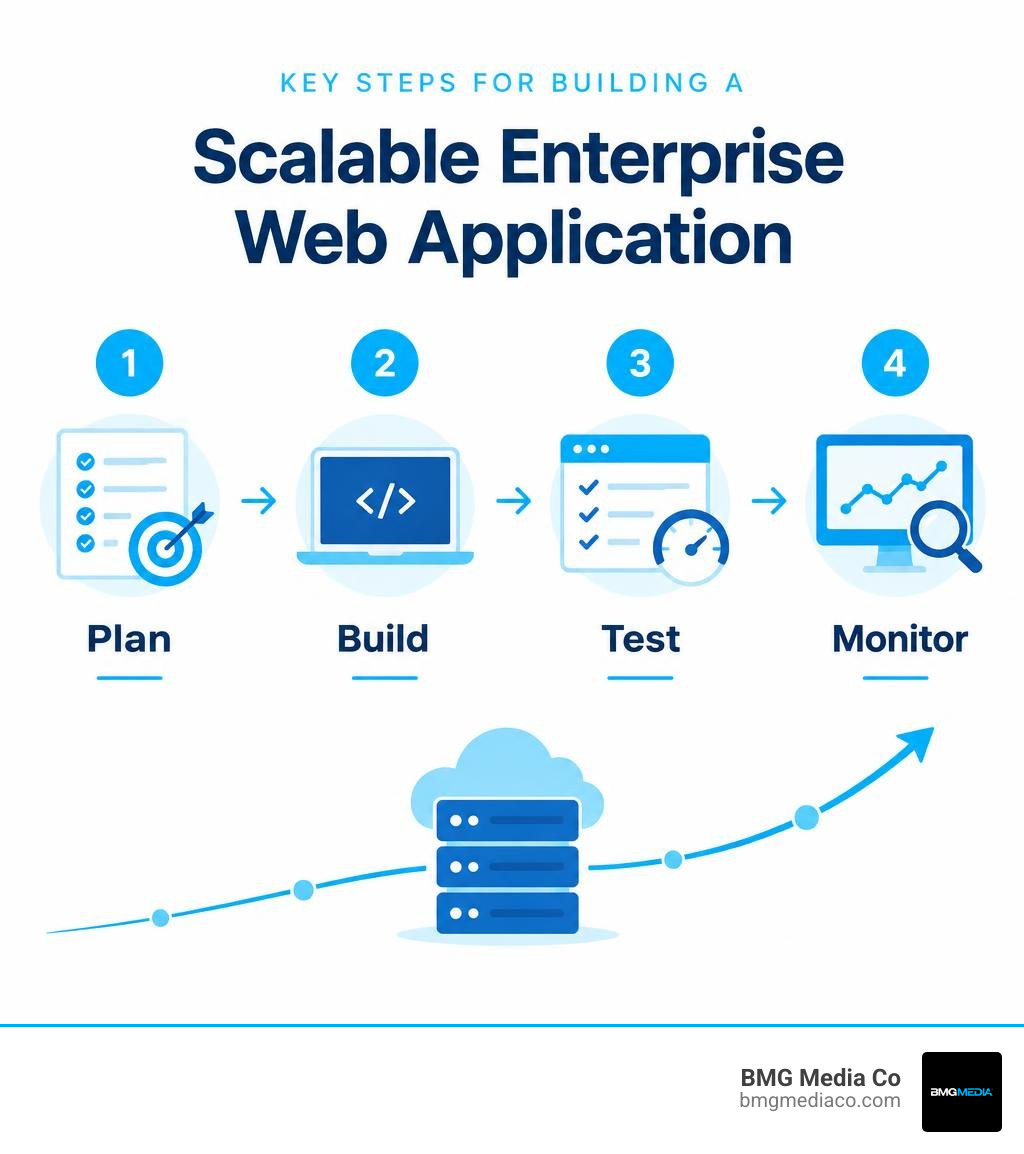
Scalable enterprise web development terms at a glance:
An enterprise web application is the operational backbone of an organization. Unlike standard informational websites, an enterprise-grade platform coordinates intricate internal operations, processes sensitive customer transactions, and integrates with disparate legacy databases without slowing down under load.
Building for this tier requires robust data governance, granular role-based access control, multi-tenant architecture, and ironclad stability. Organizations rely on these systems for revenue generation, supply chain tracking, customer support, and regulatory compliance. When an enterprise platform fails, business halts. Creating reliable custom enterprise software solutions demands intentional architecture, zero reliance on bloated pre-packaged templates, and clean, purpose-built code.
Traditional web applications and standard websites are generally built for straightforward content consumption and linear user journeys. In contrast, enterprise web platforms manage complex, non-linear business logic, massive database operations, and high-concurrency traffic patterns.
Modern enterprise applications must meet strict performance service-level agreements (SLAs). Achieving 99.9% or higher uptime targets requires designing every layer of the tech stack with resilience in mind.
Low latency is essential. Performance bottlenecks directly harm productivity and drive away users. To sustain sub-second response times, systems utilize horizontal auto-scaling, intelligent load balancing, and multi-region failover configurations that automatically route traffic away from degraded server nodes to maintain system health.
Selecting the right architectural pattern establishes how easily your application can scale, pivot, and handle changing market demands. No single design fits every enterprise, but understanding the trade-offs allows engineering leaders to select the ideal structure for their teams and operational workflows.
| Architectural Pattern | Primary Strengths | Main Challenges | Best Enterprise Use Case |
|---|---|---|---|
| Monolithic Architecture | Simple initial deployment, straightforward end-to-end testing, unified codebase. | Difficult to scale independently; single points of failure risk entire system downtime. | Early-stage internal enterprise platforms or tightly coupled workflows with small dev teams. |
| Microservices Architecture | Independent service deployments, granular scaling, fault isolation, tech-stack flexibility. | High operational complexity, data consistency challenges, requires advanced CI/CD and service meshes. | Large-scale, mission-critical platforms handling diverse domain workflows across multiple teams. |
| Micro Frontends | Independent UI releases, team autonomy by feature domain, localized user interface upgrades. | Complex asset orchestration, potential CSS/JS duplication, strict state-sharing governance needed. | Large enterprise web portals with distinct, independently managed business modules (e.g., billing, analytics, CRM). |
| Headless / Composable | Omnichannel content delivery, maximum frontend performance, decoupled presentation layers. | Requires custom API integration management and unified authentication coordination. | High-performance customer portals, enterprise content networks, and unified e-commerce experiences. |
For organizations prioritizing content speed alongside dynamic application features, implementing decoupled headless architecture solutions separates the presentation layer from backend data stores. This decoupling prevents backend database operations from bogging down user interfaces. Enterprises evaluating distributed microservices should review government standards such as the NIST guidelines on Building Secure Microservices-based Applications Using Service-Mesh Architecture to enforce zero-trust policies between services.
As engineering departments grow, monolithic codebases often introduce deployment friction. Domain-driven design helps decompose complex platforms into independent microservices linked via high-throughput API gateways.
Similarly, micro frontends allow frontend teams to build, test, and release discrete UI components without rebuilding the entire web application. When a reporting dashboard requires an update, that module deploys independently while the customer billing portal remains untouched.
Selecting an enterprise technology stack requires balancing developer velocity with long-term ecosystem stability. Teams must weigh framework maturity, community support, security update cadence, and talent availability.
Scalability represents the capacity to handle increased workloads without performance degradation or unexpected downtime. Achieving this requires moving beyond basic vertical scaling (adding CPU and RAM to a single machine) toward dynamic horizontal scaling (distributing traffic across fleets of lightweight, stateless application nodes).

Leading cloud providers such as AWS, Microsoft Azure, and Google Cloud Platform deliver the infrastructure building blocks required for resilient, high-concurrency systems.
Cloud environments allow applications to spin up serverless compute functions or container clusters on demand. During traffic spikes, auto-scaling groups automatically provision additional containers behind elastic load balancers. Once demand subsides, resources de-provision instantly, directly controlling infrastructure overhead. Deploying multi-region failover ensures that even in the rare event of a data center outage, traffic shifts seamlessly to active regions without disrupting end-user operations.
Modern enterprise software teams rely on automated Continuous Integration and Continuous Delivery (CI/CD) pipelines to release code safely and frequently.
By implementing Infrastructure as Code (IaC) with tools like Terraform or AWS CloudFormation, infrastructure configurations become version-controlled, repeatable, and auditable assets. Automated deployment pipelines utilize blue-green releases or canary deployments. These deployment strategies route a fraction of production traffic to the new version first, verifying performance and error metrics before completing the rollout. This approach eliminates maintenance windows and delivers true zero-downtime updates.
Building at enterprise scale requires navigating real-world architectural challenges. Unplanned legacy integrations and creeping technical debt can quickly stall release cycles and elevate security vulnerabilities.
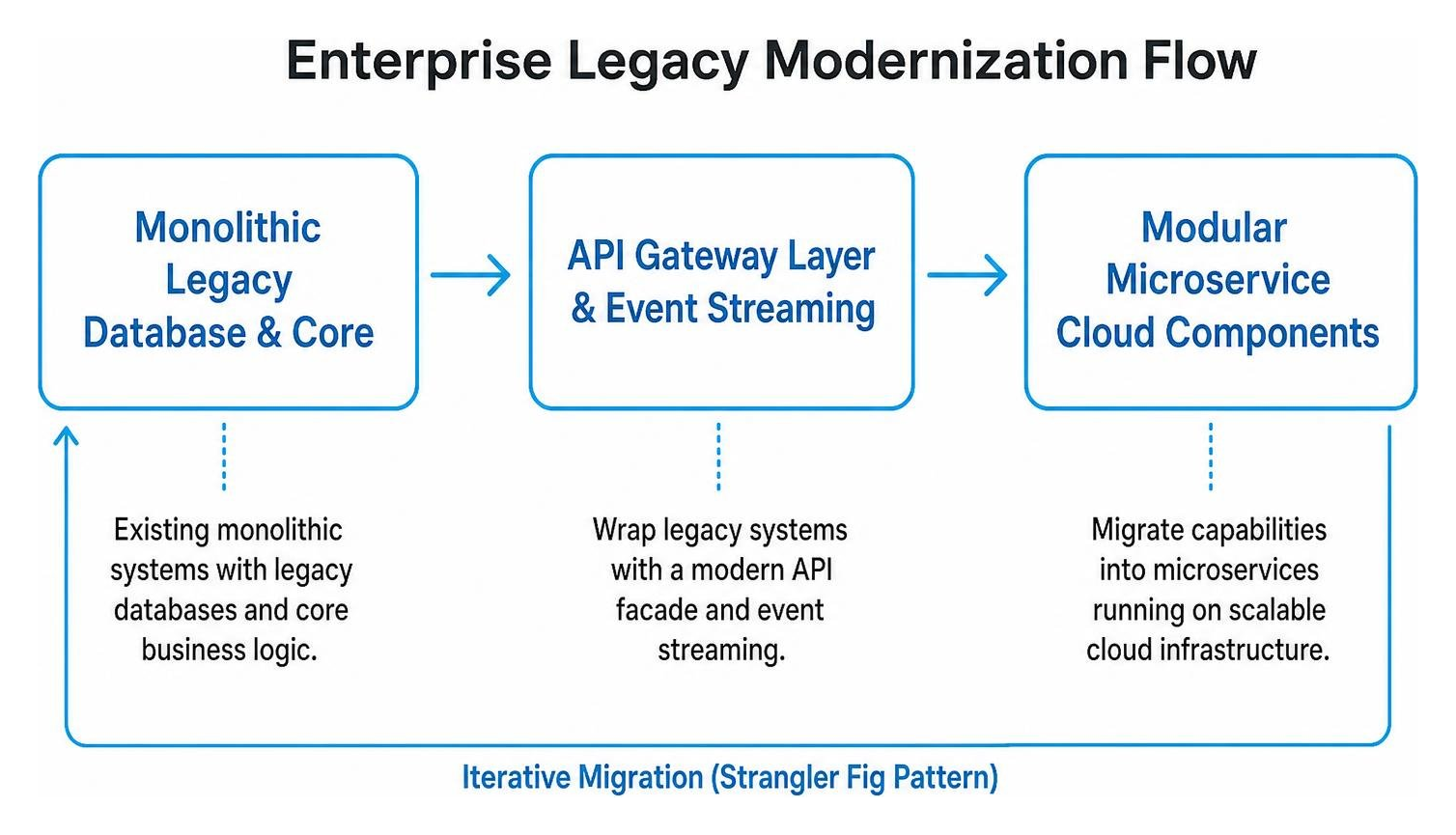
Modernizing older applications does not always require an immediate, high-risk total rewrite. Teams frequently employ the Strangler Fig pattern, wrapping legacy systems in modern API facades and systematically migrating core business capabilities into microservices over time. Integrating these environments requires seamless enterprise software integrations that unify existing CRM, ERP, and customer data platforms. For specialized workflows, partnering with an agency providing enterprise-grade web application development helps bridge legacy systems with cloud ecosystems.
Maintaining engineering velocity across enterprise teams requires strict governance standards:
In an enterprise environment, security cannot be treated as a final checklist item before launch. Organizations must embed security throughout the software development lifecycle (DevSecOps).
Enterprises must adopt a Zero-Trust architecture: verify explicitly, grant least-privilege access, and assume breach. All data must be encrypted both in transit (TLS 1.3) and at rest (AES-256). Automated Static Application Security Testing (SAST) and dynamic dependency scanners must run within every build pipeline to catch vulnerable libraries before production deployment. Applications must also be engineered to comply strictly with regulatory standards, including GDPR, HIPAA for healthcare workflows, and PCI DSS for payment transactions.
A structured development lifecycle protects budgets, aligns cross-functional stakeholders, and ensures predictable project timelines.

Understanding web app development costs from shoestring to enterprise helps decision-makers allocate capital efficiently across architecture planning, development, security verification, and post-launch optimization.
Investing in custom, scalable enterprise web development delivers clear, measurable financial returns over off-the-shelf software or rushed builds.
Transitioning from legacy monolithic setups to modern cloud-native architectures helps businesses eliminate performance bottlenecks, reduce ongoing maintenance overhead, and build sustainable technical capabilities for long-term growth.
Timelines depend on functional scope, integration complexity, and regulatory requirements. Mid-sized enterprise applications generally require 6 to 12 months from initial discovery to production launch. Complex, multi-region enterprise platforms often follow a phased rollout strategy over 12 to 18 months, deploying a high-value minimum viable product first before releasing subsequent functional modules.
Enterprise web applications typically range from $150,000 for focused departmental tools to over $500,000 for complex, highly integrated consumer-facing platforms. Key cost drivers include the volume of third-party system integrations, custom security and compliance certifications, high-concurrency architecture requirements, and bespoke UI/UX workflows.
Modernization becomes urgent when core frameworks reach end-of-support, security patching becomes unmanageable, or technical debt slows new feature development to a crawl. Other critical triggers include frequent system downtime under peak loads and an inability to integrate with modern cloud-based APIs and services.
At BMG Media Co., we engineer high-performance digital systems built to handle mission-critical demands. Headquartered in Birmingham, Michigan, we have completed 1000+ websites since 2009. We build every project 100% custom from scratch—no templates, no page builder bloat, and no shortcuts.
Whether your organization is modernizing an existing enterprise platform or building a new cloud-native application to drive rapid business growth, our team delivers the bespoke design, architectural rigor, and technical expertise your business demands. Explore our custom web design and development services to see how we build for scale, or request a free quote today to discuss your next web application project.
