June 2026
SEO web design packages combine professional website design with built-in search engine optimization – so your site looks great and gets found on Google from day one.
Here’s what they typically include at a glance:
| Component | What It Does |
|---|---|
| Custom or responsive design | Looks great on all devices, especially mobile |
| On-page SEO setup | Meta titles, descriptions, headings, and keywords |
| Technical SEO foundation | Site speed, schema markup, clean URL structure |
| Content optimization | Keyword-mapped pages written for search intent |
| Analytics integration | Google Analytics and Search Console connected at launch |
| Post-launch support | Maintenance, updates, and rank tracking |
Unlike standard web design – which focuses mainly on how a site looks – an SEO-focused package builds the entire site to rank, convert, and grow.
You already know your website isn’t pulling its weight. Visitors land and leave. Leads don’t come in. Competitors show up on Google and you don’t. The frustrating part? The problem usually isn’t your product or service. It’s that your site was built without a search strategy baked in from the start.
More than half of all web traffic now comes from mobile devices, and Google ranks your site based on the mobile experience first. A website that skips technical SEO, ignores mobile performance, or launches without a keyword strategy starts at a serious disadvantage – no matter how good it looks.
I’m Blake George, Founder of BMG Media Co, and over the past 15+ years I’ve led the development of more than 1,000 custom websites where SEO web design packages were central to helping clients in real estate, healthcare, manufacturing, and consumer brands actually rank and convert. In this guide, I’ll break down exactly what these packages include, how the tiers differ, and what separates a strong package from one that wastes your budget.
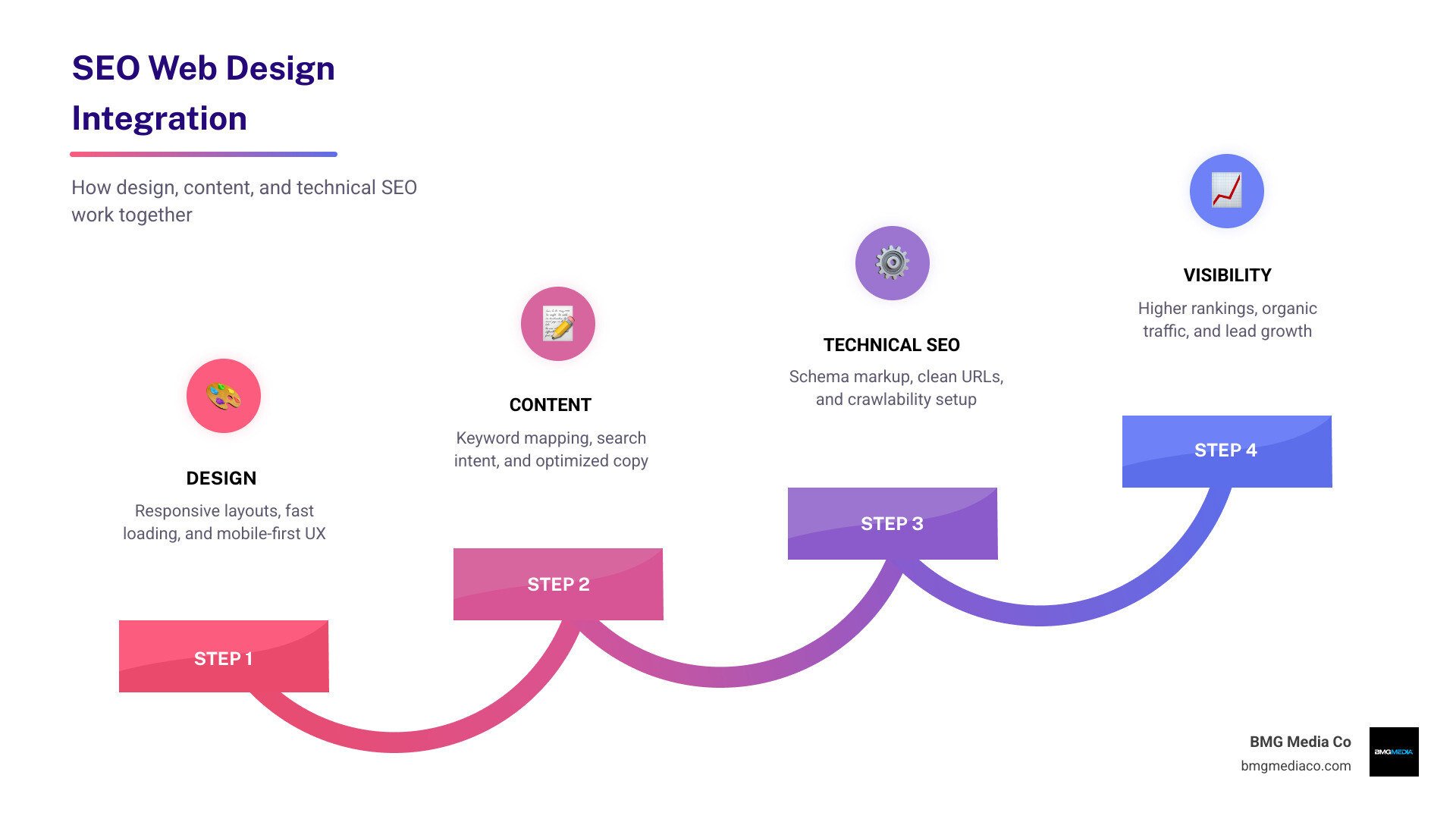
At the simplest level, SEO web design packages are bundled website services that combine design, development, and search optimization into one structured project.
Instead of treating SEO like an afterthought, these packages build it into the site from the beginning. That means your sitemap, page structure, copy, URLs, mobile layout, load speed, and analytics setup are all planned with organic visibility in mind.
A standard web design service may give you a visually appealing site. An SEO-focused package aims to give you a site that can actually be discovered, crawled, understood, and trusted by search engines.
For businesses in Michigan and beyond, that difference matters. A beautiful website hidden on page seven of search results is basically a digital billboard in the desert.
A standard package usually centers on design deliverables like page layouts, branding, contact forms, and CMS setup. Useful, yes. Complete, not always.
A stronger SEO package usually includes:
In other words, standard design asks, “Does this site look good?” SEO design asks, “Will this site perform, rank, and convert?”
These packages make sense for almost any business that depends on online visibility, but they are especially useful for:
If you plan to rely on search traffic, an SEO-first build is usually cheaper than rebuilding a pretty but underperforming website six months later.
Not all packages deserve the label. Some include little more than a homepage, a contact form, and the phrase “SEO friendly” sprinkled around like parsley.
A professional package should include design, technical setup, content structure, and measurement.
The most important features usually include:
Technical SEO is the plumbing. Nobody posts screenshots of plumbing on LinkedIn, but when it’s broken, everybody notices.
Every solid package should cover these basics:
Schema matters more than many businesses realize. It helps search engines understand what your business, pages, services, and FAQs actually are. Depending on the site, schema may include organization, local business, service, FAQ, review, or product markup. If you want a neutral reference point, Google’s own Search Central documentation is a useful baseline for understanding how search engines evaluate crawlability, structure, and on-page signals.
We also recommend asking how performance is tested. “Fast” should mean measured, not guessed. For deeper technical context, see our guides on SEO technical audit services and Core Web Vitals optimization.
Good SEO packages do not stuff keywords into paragraphs like it’s 2009. They build content around intent.
That process usually includes:
For example, a business offering multiple services should not force everything onto one generic page. A stronger package creates focused pages for each service so each page has a clear purpose, keyword target, and conversion path.
That is one of the biggest differences between a site that ranks and a site that just exists politely on the internet.
Responsive design is not optional in 2026. It is foundational.
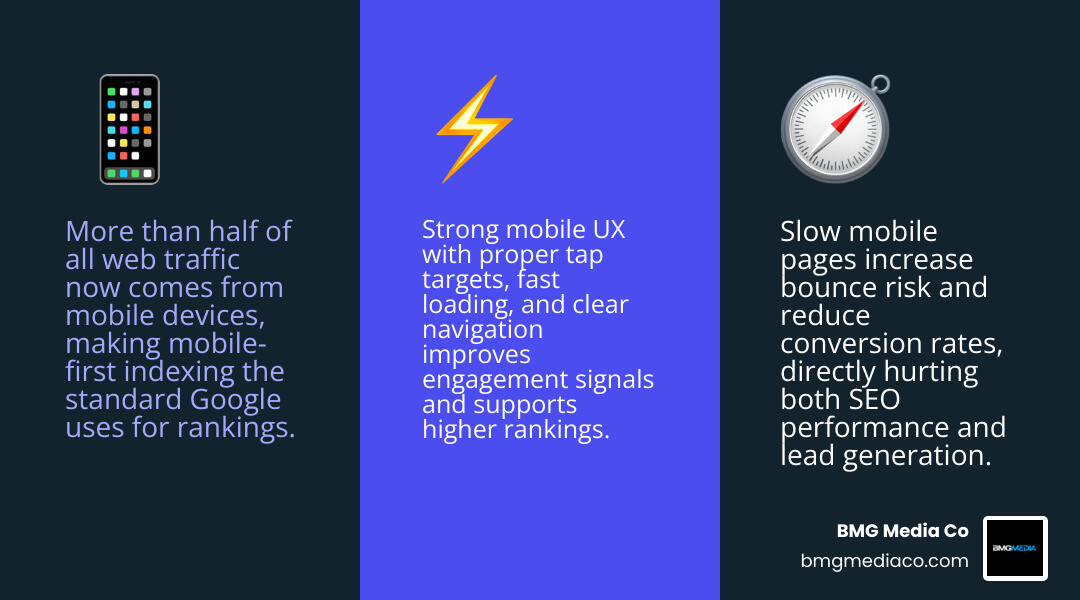
Research consistently shows that more than half of web traffic comes from mobile devices, and mobile internet usage has surpassed desktop usage by a wide margin. Google also evaluates sites using mobile-first indexing, meaning the mobile experience is the primary version that matters for ranking.
That affects SEO in several ways:
A mobile-friendly site supports both ranking potential and lead generation. The best packages account for layout shifts, button sizing, menu behavior, image loading, and content hierarchy on smaller screens – not just whether the site technically “shrinks.”
For more on that, see our resources on mobile-first indexing and responsive design for SEO readiness.
Package tiers usually differ in depth, flexibility, and long-term growth potential.
| Tier | Typical Size | SEO Depth | Best For | Common Limits |
|---|---|---|---|---|
| Starter | Up to 5 pages | Basic setup | New or small local businesses | Limited strategy, lighter customization |
| Business | 10-25 pages | Strong on-page and technical foundation | Growing companies | Fewer enterprise workflows or integrations |
| Enterprise | Large or complex builds | Advanced technical, content, and integration support | Multi-location, ecommerce, or high-growth brands | Higher investment and longer timelines |
Starter packages are often built for businesses that need a quick online presence.
They commonly include:
Typical market pricing for basic web design packages often falls around $500 to $2,000, though scope varies widely.
What is often missing:
Starter packages can work for early-stage businesses, but they may hit a ceiling quickly if your market is competitive.
For many companies, the business tier is where value and performance finally shake hands.
These packages often include:
Typical standard package pricing across the market often lands between $2,000 and $5,000, while more custom or premium builds frequently start at $5,000 and go upward.
This is usually the right level for businesses that want a site built for ranking, lead capture, and future expansion – not just a digital brochure.
Enterprise packages are designed for complexity.
They may include:
Timelines are longer and costs are higher, but so is the level of planning. For a larger organization, this prevents painful issues like traffic loss, duplicate content, broken URLs, or messy department-by-department sprawl.
Price questions are fair. “It depends” is true, but it is also the least satisfying sentence in web design.

Based on the research and broader market norms, here is a reasonable way to think about pricing in 2026:
For ongoing SEO, monthly retainers can range from a few hundred dollars to several thousand dollars per month depending on deliverables and competition. Maintenance plans often begin around $100 per month for essentials like updates, backups, and monitoring.
The main drivers of price are:
If a package sounds suspiciously cheap, ask what is not included. That is often where the real invoice is hiding.
Most website projects take about 4 to 6 weeks when scope is moderate and content moves quickly. More custom WordPress websites often take 6 to 12 weeks depending on size, features, and review cycles.
A typical timeline looks like this:
What causes delays?
A good package should include a launch checklist covering analytics, redirects, forms, indexing settings, schema, and performance. For more on that final stretch, read The No Nonsense Guide to High Performance Web Launches.
Launch is not the finish line. It is opening day.
Post-launch support may include:
This matters because SEO is not one-and-done. The launch package creates the foundation. Ongoing support helps the site build authority, improve content, and adapt to changes in search behavior.
The right provider should understand both search strategy and real web development. If they only know design, SEO gets bolted on. If they only know SEO, the site may look like it was assembled by a committee of spreadsheets.
A strong partner should be able to explain:
Before you commit, ask questions like:
If the answers are fuzzy, the results usually are too.
Watch for these warning signs:
Guaranteed rankings are usually a red flag, not a feature. Google did not appoint anyone the king of page one.
Strong providers tend to work differently from the start.
They usually offer:
That is the approach we believe in at BMG Media Co. We build fully custom, high-performance websites with search visibility in mind from day one. For a deeper look, see How to Scale with Advanced SEO Web Optimization and Custom WordPress Development.
Yes – especially for small businesses that cannot afford to waste budget on a site that looks good but never gets found.
A good package gives small businesses:
For local businesses, even a modest SEO foundation can make a meaningful difference if it helps the right pages rank for local service searches.
They include the foundation for results, not instant rankings.
A launch package can set up:
But ongoing SEO is usually needed for stronger results over time. Monthly optimization, content creation, local SEO work, and authority building are what turn a good foundation into meaningful growth.
In general, meaningful ranking improvements often take 3 to 6 months, with broader ROI becoming clearer over 6 to 12 months depending on market competition.
Absolutely. In many cases, redesigning an existing site is smarter than starting blind from scratch.
A proper SEO redesign should include:
The goal is not just to make the site prettier. It is to improve structure, speed, mobile UX, and search visibility without accidentally wiping out existing equity.
The real secret behind SEO web design packages is not that they include more stuff. It is that they connect the right stuff in the right order – strategy, design, content, technical SEO, and post-launch support.
When those pieces work together, you get a website that does more than sit there looking expensive. You get a website that is built to rank, convert, and scale.
That is exactly how we approach projects at BMG Media Co. We create custom, high-performance websites for Michigan businesses and brands that need more than a template and a hope. If you want to explore a smarter foundation for your next site, learn more about our custom web design and development services and custom web design.

