June 2026

Choosing a business name is the first real brand decision you make — and it follows you everywhere: your storefront, your website, your legal filings, and every customer’s first impression.
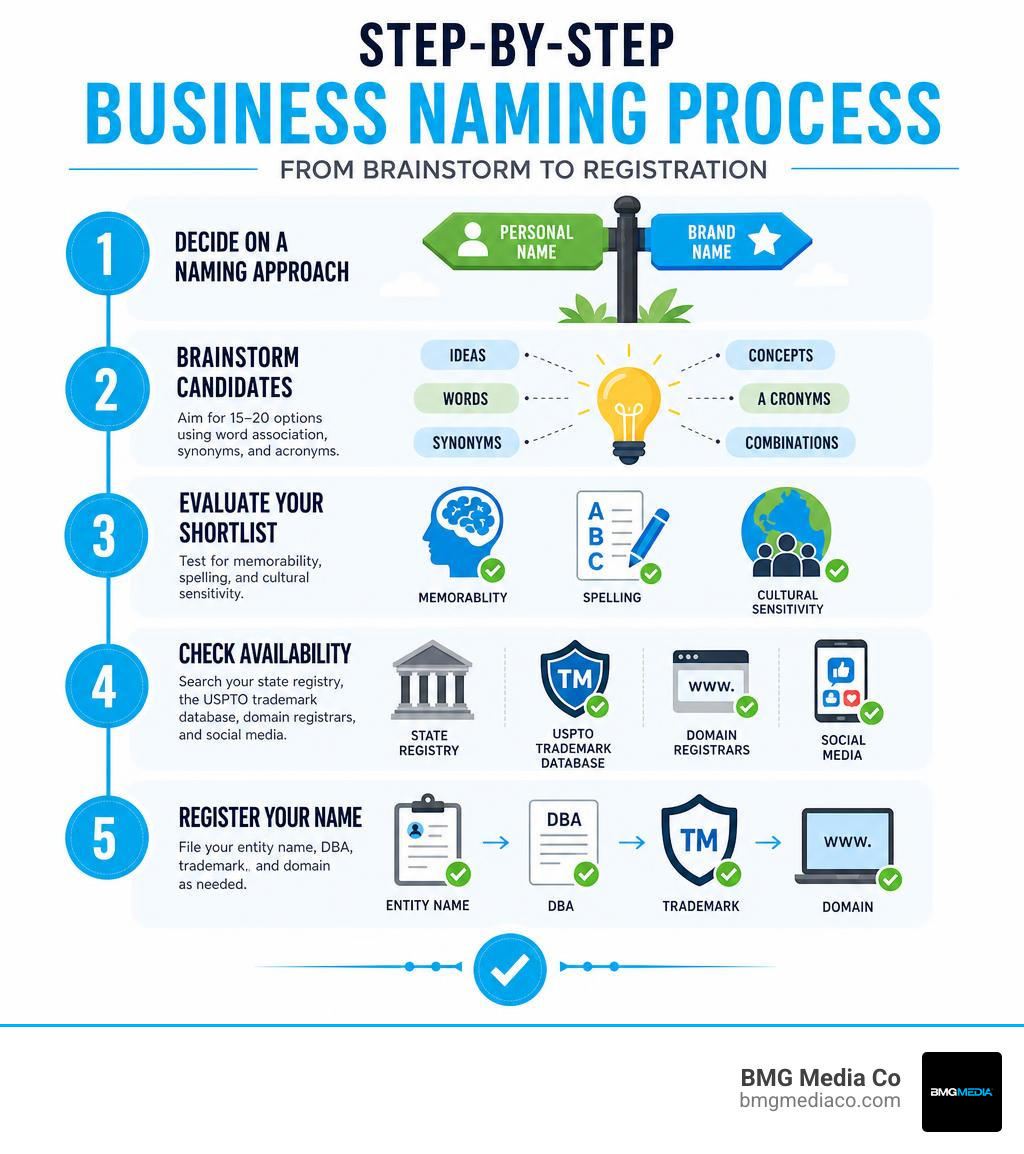
Here’s a quick overview of how to choose a business name:
A strong name does real work for your business. Research shows it can increase brand recall by up to 80% and that short, memorable names are twice as likely to stick in a customer’s mind. Companies that invest in a strong brand name also see up to 23% higher revenue growth than those that don’t.
But the process trips up a lot of business owners. State laws restrict certain words. Trademark conflicts can force a costly rebrand. And a name that sounds great in the room can fall flat in a Google search.
This guide walks you through every step — from the first brainstorm to filing your registration — so you can move forward with confidence.
I’m Blake George, founder of BMG MEDIA, a nationally recognized web design and branding agency where I’ve spent over a decade helping startups and established companies build brand identities that convert — and choosing a business name is always where that work begins. Having guided hundreds of businesses through branding strategy, I’ll share what actually works, not just theory.
Before you grab a notebook or open an AI tool, you need a solid strategic foundation. A business name isn’t just a label; it’s the cornerstone of your entire brand strategy. It must speak directly to your target market, set expectations for what you deliver, and remain flexible enough to grow with you over time.
When choosing a business name, you are laying down the tracks for your future marketing efforts. If your name is too narrow, you might box yourself in. If it’s too generic, you’ll blend into the background. A great name works on multiple levels: it triggers an emotional response, hints at your core values, and is structurally built for high brand recall.
To help you decide which path fits your vision, let’s look at the two primary directions: using your own personal name versus building a separate brand name.
| Feature | Personal Name | Brand Name |
|---|---|---|
| Best For | Solopreneurs, consultants, creative service providers | Scalable startups, e-commerce, product-based companies |
| Trust Building | Immediate and highly personal | Built over time through marketing and customer experience |
| Scalability | Harder to scale or sell without your direct involvement | Unlimited; easily transitions to new owners or partners |
| SEO Advantage | High authority for your personal name; lower for industry keywords | Great for targeting specific industry and product keywords |
| Naming Effort | Low (it’s already yours!) | High (requires extensive brainstorming and vetting) |
As outlined by the How to Choose a Business Name | CO- by US Chamber of Commerce, balancing your immediate marketing needs with your long-term business goals is crucial during this initial phase.
One of the first crossroads you’ll face is deciding whether to build a personal brand or a distinct corporate identity.
Using your own name (e.g., Jane Doe Consulting) is a popular route for solopreneurs, freelance designers, coaches, and service businesses. It has a major advantage: it allows your business to scale and pivot without requiring a complete rebrand. If Jane Doe starts in graphic design but later expands into business coaching, her name still fits perfectly. It also humanizes your business from day one, which can build trust quickly.
However, as highlighted in An Unconventional Guide to Naming Your New Business, there are clear drawbacks. If you ever plan to sell your business, having your personal name on the building makes a clean exit incredibly difficult. Buyers are hesitant to acquire a company whose value is entirely tied to the founder’s personal identity.
A separate brand name (e.g., Apex Creative) provides a blank slate. It allows you to build an entity that stands completely on its own, hire a team that represents the brand, and position the company for an eventual sale or expansion.
If you decide to go with a separate brand name, your ideas will generally fall into one of four distinct categories:
According to the strategic playbook What’s in a Name? A Lot, Actually. Here’s How to Pick the Right One For Your Company, a bad name won’t necessarily kill a great company, but a great name becomes iconic over time as you build brand equity around it.

With your strategic direction set, it’s time to unleash your creative thinking. Brainstorming isn’t about finding the single perfect name on your first try; it’s about generating a high volume of ideas so you can filter down to the gold. When we sit down with clients at BMG Media Co, we emphasize that quantity breeds quality.
To help jumpstart this phase, you can look into how specialized agencies approach naming by reading about The Top Brand Naming Agencies According to New Report.
The best brainstorming sessions are structured yet free-flowing. Grab a notebook, set a timer for 30 minutes, and try these proven techniques:
For more hands-on guidance, the resource on How to come up with a business name | Xero US suggests focusing on your unique value proposition to ensure your brainstormed names align directly with your customer’s expectations.
Once you have a list of 15 to 20 candidates, you need to ruthlessly narrow them down. This is where you transition from creative thinking to objective testing.
First, run a memorability test. Share your top three names with a small group of trusted friends or target customers. Ask them about the names the next day to see which ones actually stuck in their minds.
Second, perform a pronunciation and spelling check. If you have to spell out your business name every time you say it over the phone, it’s going to cause friction.
Third, conduct linguistic and cultural sensitivity checks. Ensure your name doesn’t have an unintended double meaning or sound offensive in another language, especially if you plan to scale globally.
To see how professional branding experts evaluate these elements, check out The Top Branding Agencies for Small Businesses According to New Report.
A creative name is completely useless if you can’t legally own it. Navigating the legal compliance landscape early prevents devastating trademark disputes and rejected state filings down the road.
Before you fall in love with a name, you must ensure it meets all regulatory standards, as detailed in 12 tips for naming your LLC or corporation – Wolters Kluwer.
If you are forming a formal business entity like an LLC or a Corporation, your name must comply with specific state regulations. In Michigan, the Department of Licensing and Regulatory Affairs (LARA) handles these guidelines.
For exact guidelines on Michigan entity formation, review the official resource on Naming a Limited Liability Company – State of Michigan.

To verify that your chosen name is actually available, you must conduct a thorough four-step check:
.com domain is available. If it’s taken, look into high-quality alternatives, but avoid domains that are easily confused with an existing competitor.For a comprehensive breakdown of this verification process, refer to the Choose your business name | U.S. Small Business Administration guide.
Once your chosen name passes all availability checks, you need to secure your legal rights to it. Many entrepreneurs mistakenly believe that registering a domain name or a local business license gives them exclusive ownership. In reality, protecting your brand requires a multi-layered approach.
For international context on how name registration operates across different jurisdictions, you can consult Choose a business name | business.gov.au.
Understanding the differences between these four registration types is crucial for proper brand protection:
To learn more about how to structure these protections, read Business Name – How To Name A Business.
Securing your business name involves several distinct steps and fees:
For localized legal insights on this process, check out The Legal Aspects of Choosing a Name for Your Michigan Business.
Yes, but only under specific conditions. Two businesses can share a name if they operate in completely different geographic regions and neither holds a federal trademark. Additionally, they can co-exist if they operate in entirely different industry classes where there is zero chance of market confusion (for example, Delta Air Lines and Delta Faucets). However, if one business holds a federal trademark, they have national priority within their industry.
While it is entirely possible to rebrand, changing your business name down the road is a complex and costly process. It requires filing formal amendments with your state, updating your registrations with the IRS and local tax authorities, revising bank accounts, and completely rebuilding your website, signage, and marketing collateral. It also risks losing the brand equity and SEO authority you have worked hard to build.
Choosing a business name is the exciting bridge between your initial business idea and your future brand identity. It’s a decision that requires a careful balance of creative inspiration, strategic positioning, and strict legal compliance.
At BMG Media Co, we believe that your name is only the beginning. Once you have secured the perfect name, the real magic happens when you bring it to life through a stunning, custom-built website, cohesive branding, and a high-performance digital presence. We specialize in crafting fully custom WordPress sites, web apps, and SEO strategies designed from scratch—no templates, ever—to ensure your new brand stands out from day one.
If you are ready to turn your brand name into an award-winning digital experience, we’re here to help you build it. Learn more about how to take your next steps by reading our guide on How to Pick the Best Naming Companies for Your Next Big Idea.
