March 2026

Responsive doctor website design is the practice of building a medical website that automatically adjusts its layout, images, and content to look and work great on any device — phone, tablet, or desktop.
Here’s a quick overview of what it involves:
Think about how patients find doctors today. More than half of all internet users search for health information online, and a growing majority do it from their phones. If your medical website isn’t built to work on mobile, you’re losing patients before they ever walk through your door.
The stakes are real. Research shows that 80% of patients judge a practice’s credibility based on its website design. A slow, hard-to-navigate, or visually broken mobile site doesn’t just frustrate visitors — it signals that your practice is behind the times.
And it’s not just about looks. Patients now expect to book appointments, read provider bios, and access health resources entirely online. A site that can’t deliver that frictionless experience hands those patients to a competitor who can.
I’m Blake George, founder of BMG Media Co, a web design agency with over a decade of experience building high-performance websites across healthcare and other industries — including award-winning responsive doctor website design work recognized by Clutch. In this guide, I’ll walk you through exactly how to build a mobile-friendly medical site that earns trust, ranks in search, and turns visitors into booked patients.
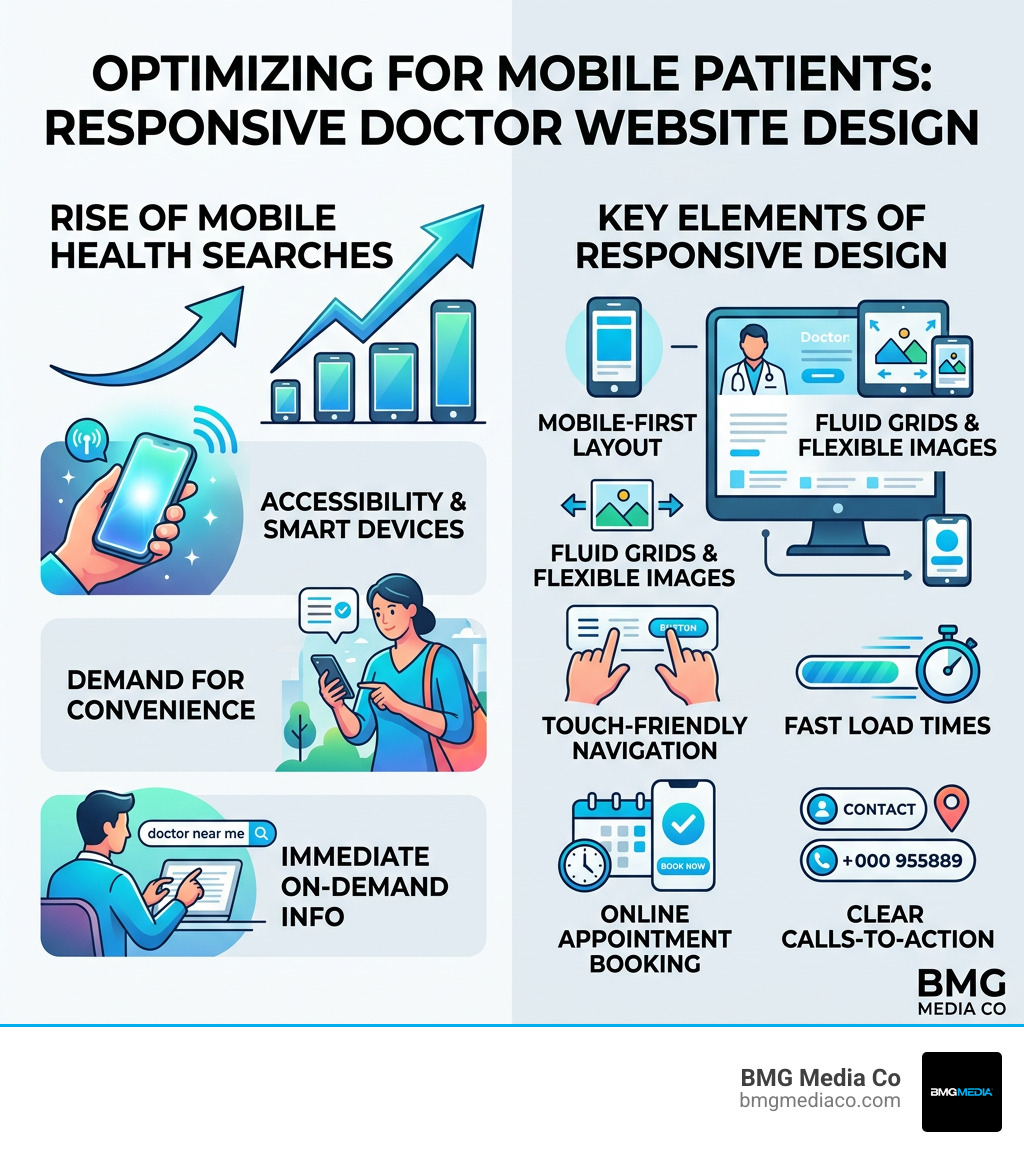
When we talk about responsive doctor website design, we aren’t just talking about making things smaller so they fit on a phone screen. We are talking about an architectural shift in how information is presented. A truly responsive site uses fluid grids and flexible images to ensure that whether a patient is on a 27-inch iMac or a 5-inch iPhone, the experience feels intentional.
The foundation of this approach lies in Web Design Principles You Need to Know. In the medical field, these principles center on accessibility and clarity. Patients visiting a doctor’s site are often stressed, in pain, or looking for urgent answers. They don’t want to hunt through a complex menu to find your office hours.
According to scientific research on health-related internet searches, more than half of all internet users search online for health-related information. This means your website is often the very first point of clinical contact. If the navigation isn’t intuitive, or if the “Call Now” button is buried under three layers of sub-menus, the user experience (UX) fails, and the patient moves on to the next search result.
A mobile-friendly site is your best tool for increasing conversion rates. When a site is responsive, it reduces “friction”—the digital hurdles that stop a patient from taking action. One of the most effective ways to reduce friction is through a prominent “click-to-call” button that only appears on mobile devices.
Consider these online appointment scheduling statistics: approximately 80% of patients now prefer to schedule their appointments online rather than over the phone. If your booking form is a nightmare to fill out on a touchscreen, you are effectively closing your doors to 80% of your potential market. By implementing responsive doctor website design, you ensure that booking an appointment is as easy as sending a text message, directly leading to higher patient engagement and more filled slots on your calendar.
Building a site that works is one thing; building a site that excels is another. Since Google has moved to Web Design for Mobile-First Indexing: Optimizing for Mobile Search, your mobile site is actually the primary version Google uses to determine your ranking.
To meet modern technical standards, we focus on:
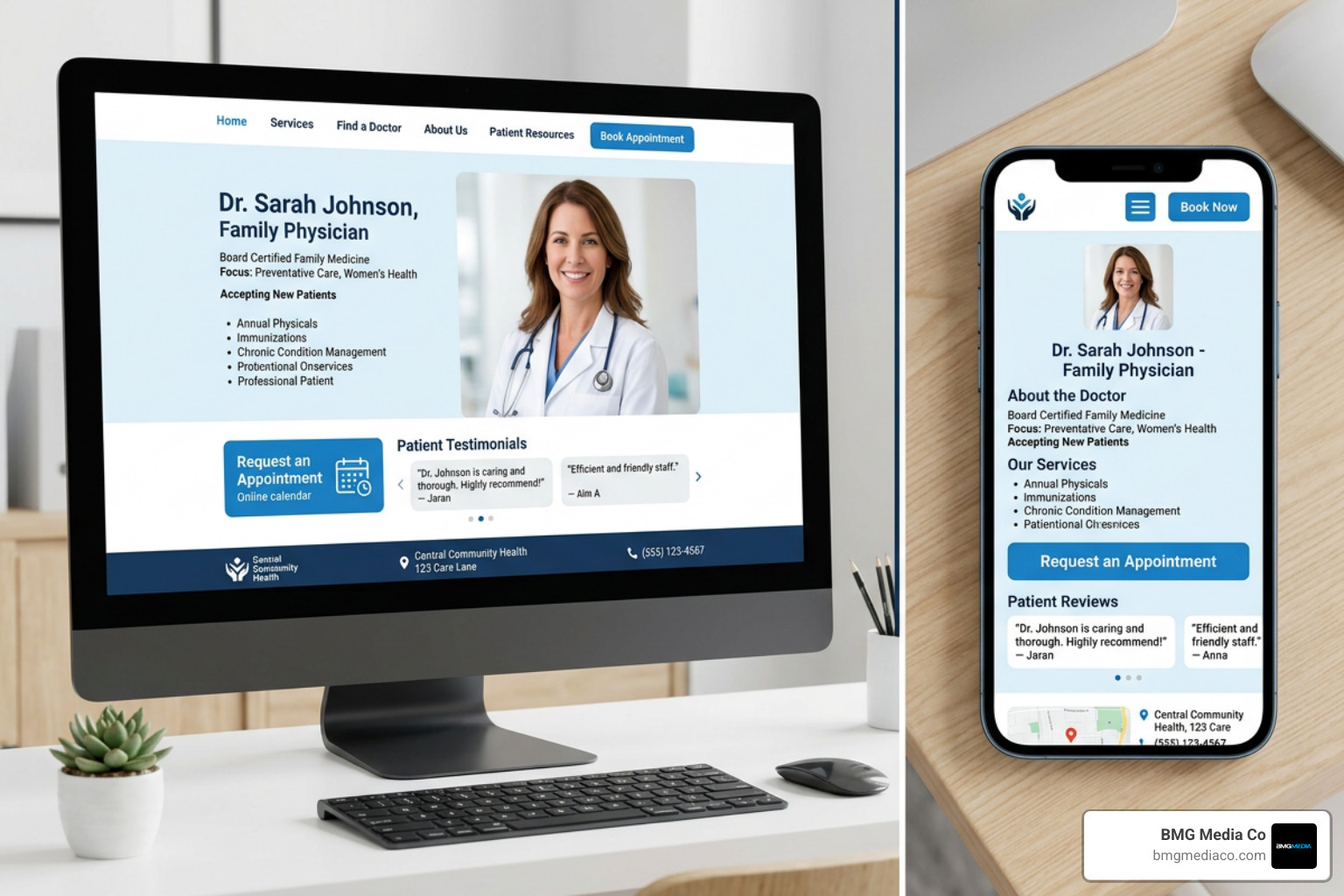
A medical website needs to be more than a digital brochure. It should be a functional extension of your office. This starts with understanding What Should a Website Include? Business Websites Must-Haves, such as clear contact information, a list of services, and patient resources.
Many practices make the mistake of using generic, “one-size-fits-all” templates. While these might seem cost-effective initially, they often lack the specialized functionality required for a professional medical presence.
| Feature | Custom Design (BMG Media) | Generic Templates |
|---|---|---|
| Performance | High-speed, optimized code | Often bloated and slow |
| Scalability | Built to grow with your practice | Limited by template constraints |
| SEO | Built-in local SEO strategy | Basic or non-existent |
| Security | HIPAA-compliant integrations | Varies; often requires third-party plugins |
| Uniqueness | 100% unique brand identity | Looks like every other clinic |
One of the biggest time-wasters in a medical office is the “clipboard and pen” routine. By integrating HIPAA-compliant forms directly into your responsive doctor website design, you allow patients to complete their intake paperwork from the comfort of their own home.
This doesn’t just save paper; it improves data security and reduces wait times in your lobby. These forms can be designed to sync directly with your Healthcare electronic medical records (EMR), ensuring that patient data is handled accurately and securely from the moment it’s submitted.
Patients don’t choose a clinic; they choose a doctor. Your provider bio page is often the most-visited page on your site after the homepage. To build trust, these sections should include:
In the medical world, trust is the primary currency. If your website looks like it hasn’t been updated since 2005, patients may wonder if your medical equipment is similarly outdated. We help practices showcase their excellence through badges and awards, such as when BMG Media Earns Clutch Leader Award for Top Web Designers in the Healthcare Space.
Reputation management is also a key component of responsive doctor website design. Your site should serve as a hub for your professional achievements, making it easy for patients to see why you are the right choice for their care.
Research shows that around 94% of patients check online reviews when evaluating healthcare providers. While Google reviews are great, hosting testimonials on your own site allows you to curate stories that highlight specific treatment outcomes.
The most effective testimonials are detailed. Instead of just saying “Great doctor!”, look for reviews that describe the treatment process and the final result. Video reviews are even more powerful, as they provide an authentic, human element that text simply cannot match. By strategically placing these trust signals throughout your site, you provide the social proof necessary to convert a skeptic into a patient.
When we build for the Medical Healthcare Web, security isn’t an afterthought—it’s the foundation. HIPAA compliance is mandatory for any site that collects patient information. This involves:
Failing to prioritize these elements can lead to massive fines and, more importantly, a total loss of patient trust.
You could have the most beautiful responsive doctor website design in Michigan, but it won’t matter if no one can find it. Local SEO is the engine that drives new patient acquisition. This starts with Google Business Profile optimization. Your profile is often the first thing people see in a “doctor near me” search.
Maintaining NAP consistency (Name, Address, Phone number) across the web is vital. If your website says you’re on Maple Rd in Birmingham, but your Google listing says something else, Google’s algorithm will get confused and drop your ranking. This is a critical step in any Website Redesign Checklist: Key Considerations for a Successful Revamp.
According to Google’s healthcare consumer insights, more than 60% of healthcare searches happen on mobile devices. This makes mobile optimization fundamental. We focus on capturing this traffic by:
Staying ahead of the curve also means looking at the Top 5 Web Design Trends 2024, which includes AI-driven search features and voice search optimization—both of which are heavily used by mobile users.
The cost of a medical website can vary wildly. A basic template-based site might cost between $2,000 and $5,000, but these often lack the performance and security a growing practice needs. A fully custom, high-performance site from BMG Media Co—designed specifically for your practice with no templates—typically ranges from $5,000 to $15,000 depending on the complexity and number of pages. While it’s a larger upfront investment, the increase in patient bookings often pays for the site within the first few months.
Yes, provided it is implemented correctly. We use HIPAA-compliant scheduling tools that encrypt patient data and integrate seamlessly with your practice management software. This ensures that the patient’s privacy is protected while giving them the convenience they expect.
At a minimum, you should update your content (like staff bios or new services) once a quarter. However, from a technical standpoint, a full redesign is usually recommended every 2 to 3 years to keep up with changing mobile standards, security requirements, and Google’s ranking algorithms.
Building a mobile-friendly site isn’t just a technical “to-do” list; it’s about providing the best possible care for your patients before they even step foot in your office. A responsive doctor website design ensures that your practice is accessible, trustworthy, and professional on every screen.
At BMG Media Co, we specialize in creating custom, high-performance websites for the healthcare industry. Based in Birmingham, Michigan, our award-winning team has completed over 1,000 sites, and we never use templates. Every site we build is a unique reflection of the practice it represents, designed to rank high and convert visitors into patients.
If your current website is turning patients away, it’s time for a change. We can help you build a digital presence that works as hard as you do. For more info about medical healthcare web services, reach out to us today and let’s start building a site your patients will love.
