April 2026

Local SEO for contractors is the process of optimizing your online presence so homeowners and property managers in your area find you — not your competitors — when they search Google for services like yours.
Here’s a quick breakdown of what it involves:
| Step | What It Means |
|---|---|
| Google Business Profile | Claim, verify, and fully optimize your free GBP listing |
| NAP Consistency | Keep your Name, Address, and Phone number identical everywhere online |
| Service & Location Pages | Build dedicated pages for each service and city you serve |
| Reviews | Collect fresh Google reviews consistently, every month |
| Local Citations | Get listed on trusted directories like BBB, Yelp, and Houzz |
| Technical SEO | Make your site fast, mobile-friendly, and easy to crawl |
| Content & Links | Publish useful local content and earn links from local sources |
Think about this: 87% of consumers start their buying journey online. Google alone handled 5 trillion searches in 2024. When a homeowner’s roof is leaking or their HVAC fails in the middle of summer, they aren’t asking around — they’re pulling out their phone and searching. The contractors who show up in those moments get the call. The ones who don’t, don’t.
The problem isn’t the quality of your work. Most contractors who struggle with online visibility do great work. The problem is a process gap — your digital presence isn’t built to match how customers actually search.
That’s exactly what local SEO fixes.
I’m Blake George, founder of BMG Media Co, and over the past 15+ years building high-performance websites and digital strategies for businesses across industries, I’ve seen how a well-executed approach to local SEO for contractors can transform an empty pipeline into a consistent flow of high-value leads. In this guide, I’ll walk you through exactly how to make that happen.
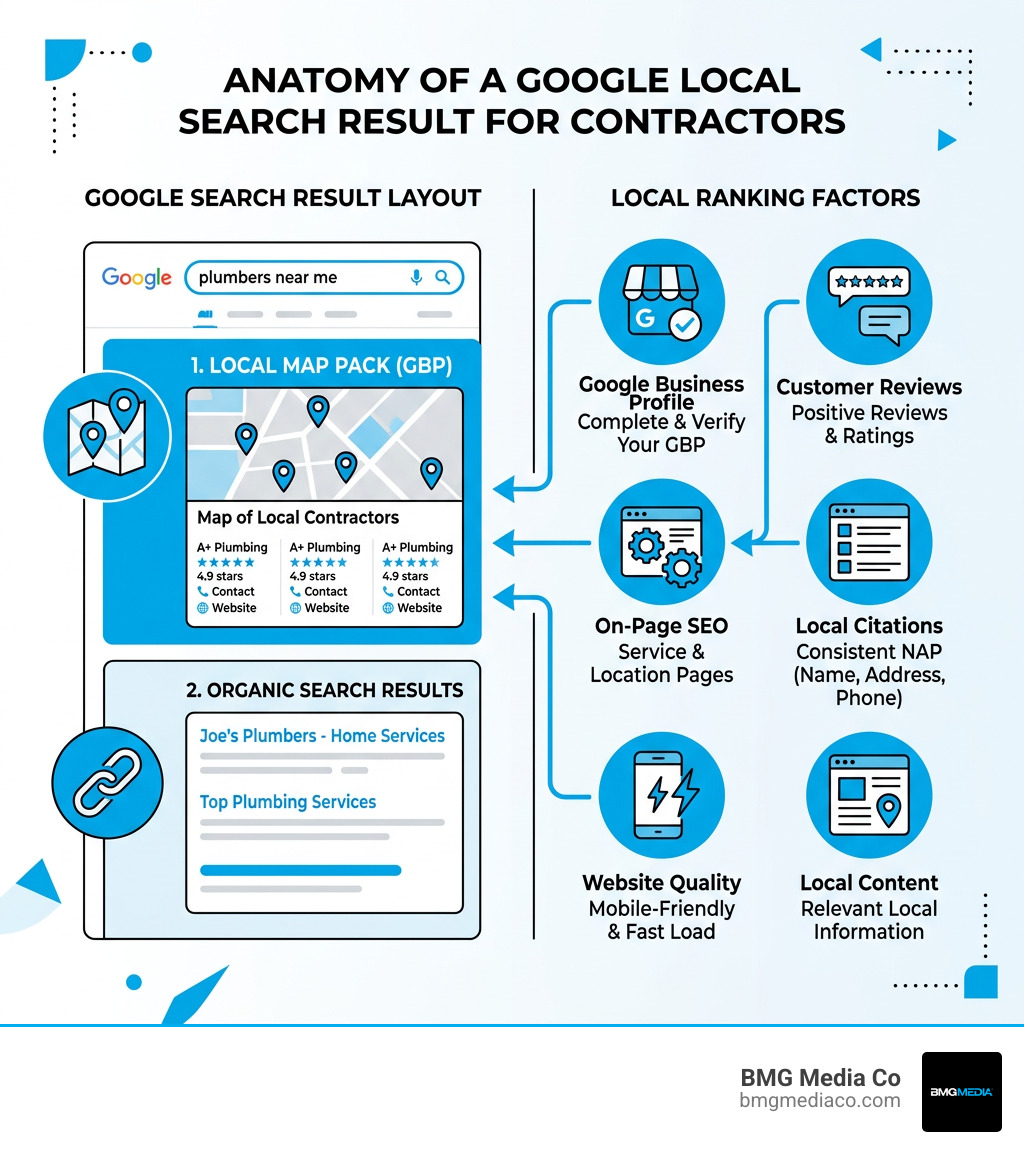
Simple guide to local seo for contractors:
To dominate the local market, we first have to understand how Google decides which contractor to recommend. It isn’t random. Google acts like a digital “local guide,” trying to suggest the most trustworthy, relevant, and nearby business to a user. If you aren’t appearing in the search results, it’s usually because one of the three core pillars is missing: Relevance, Distance, or Prominence.
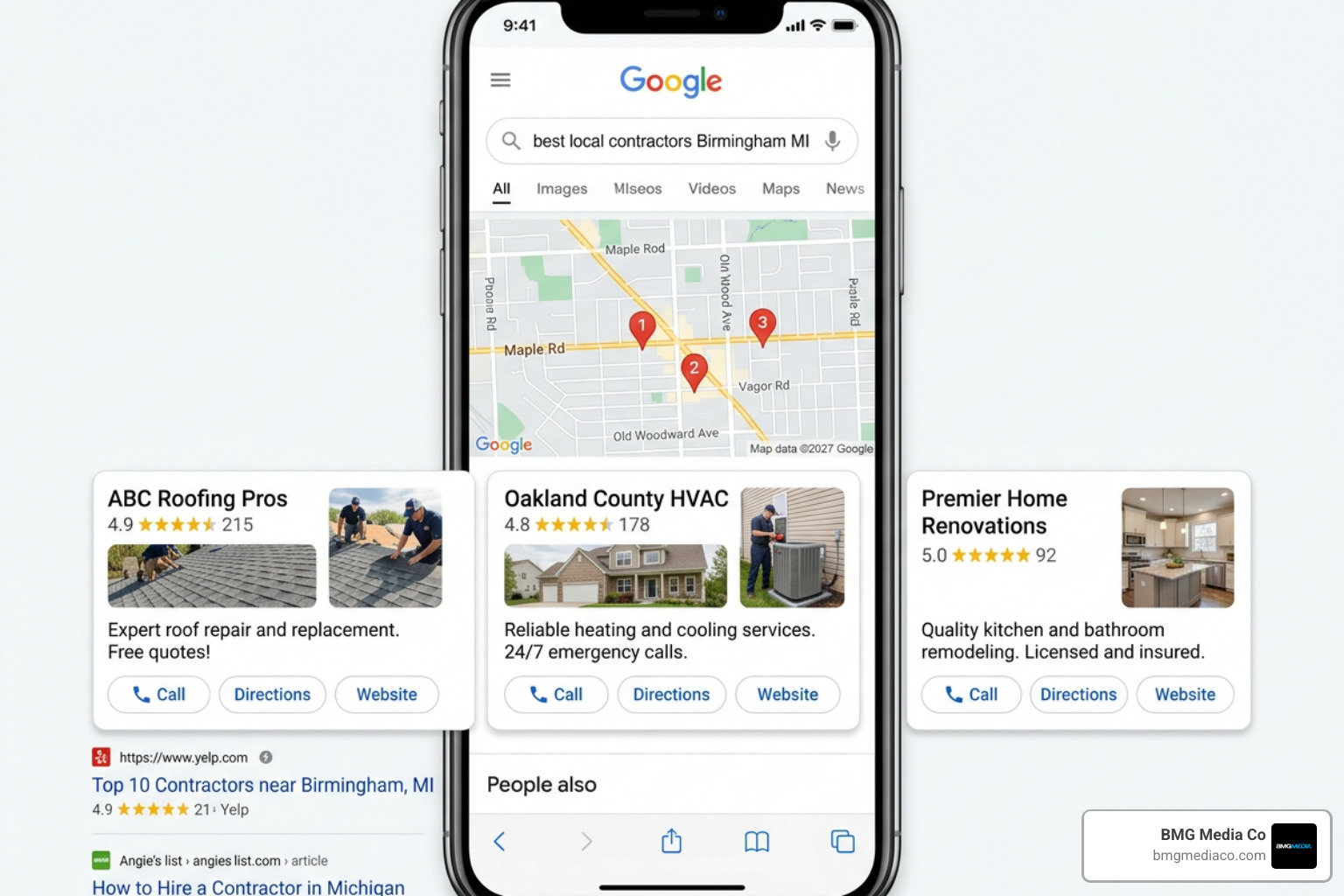
Relevance is how well your business matches what the user is looking for. If someone searches for “custom kitchen remodeling in Birmingham, MI,” and your website only mentions “general contracting,” you might lose out to a competitor who has a dedicated kitchen page. Distance is simply how close you are to the person searching—something we can’t change, but we can influence through service area settings. Prominence is how well-known and trusted you are online, driven by reviews, links, and citations.
One of the most staggering statistics in our industry is that 64% of buyers have used Google Business Profile to find businesses’ contact information. If your “NAP” (Name, Address, Phone number) isn’t consistent across the web, Google gets confused. If Yelp says you’re at “123 Main St” but your website says “123 Main Street, Suite A,” Google might view those as two different businesses, hurting your prominence.
| Feature | Google Map Pack (The “3-Pack”) | Local Organic Search (The Blue Links) |
|---|---|---|
| Primary Driver | Google Business Profile (GBP) | Website Content & Technical SEO |
| Click Share | ~44% of all local clicks | ~30-40% of clicks |
| Key Factors | Proximity, Reviews, GBP Categories | Backlinks, On-page keywords, Site Speed |
| Visuals | Star ratings, Map pin, Phone button | Meta titles and descriptions |
Your Google Business Profile (GBP) is the heart of your local presence. For many contractors, it is actually more important than their website for generating immediate phone calls. In 2026, simply “having” a profile isn’t enough; you need to treat it like a micro-website.
The first step is your Primary Category. This is the single most important ranking factor for the Map Pack. If 70% of your revenue comes from roofing, your category should be “Roofing Contractor,” not just “General Contractor.” Being specific tells Google exactly what you do.
Next, focus on your Review Strategy. Research shows that 72% of people use Google reviews to find a company. But here is the secret: Google cares more about recency and velocity than the total number. A roofer with 150 reviews from the last six months will often outrank a competitor with 500 reviews from three years ago. We recommend aiming for 2-4 new reviews every single week.
To stay ahead, you should also:
Citations are mentions of your business name, address, and phone number on other websites. Think of them as “digital votes” of legitimacy. If your business appears on the top citation sites for contractors, Google feels more confident that you are a real, operating business in Michigan.
We categorize these into tiers. Tier 1 includes the heavy hitters: Google, Bing, Apple Maps, and Facebook. Tier 2 includes industry-specific sites like Houzz, Angi, and the Better Business Bureau. Tier 3 involves local Michigan connections, such as your local Chamber of Commerce or regional business directories.
Consistency is king here. If you’ve recently moved or changed your phone number, you must audit these listings. Using an SEO tool for keyword monitoring can help you see where you’re ranking and ensure your data remains synchronized across the web.
While your GBP gets the phone ringing, your website is where you close the deal for high-value contracts. A homeowner looking for a $50,000 kitchen remodel is going to scrutinize your site. If it looks like a template from 2010 or takes five seconds to load on a phone, they’re gone.
At BMG Media Co, we specialize in AEC Web Design, focusing on high-performance, custom builds that reflect the quality of your craftsmanship. Technical SEO is the foundation of this. With 287.1 million mobile internet users in the U.S., your site must be mobile-first. Google now penalizes sites that aren’t optimized for portable devices.
We also pull insights from other high-stakes industries, like Medical Healthcare Web design, to ensure your site establishes immediate trust and authority. This means having clear navigation, fast load speeds (under 3 seconds), and prominent “Request a Quote” buttons.
One of the biggest mistakes contractors make is having one single “Services” page with a bulleted list of everything they do. Google doesn’t rank “lists”; it ranks “answers.” If you want to rank for “Bathroom Remodeling in Royal Oak,” you need a dedicated page for that specific service in that specific city.
These location pages should not be carbon copies of each other. Google hates “doorway pages” with duplicate content. Instead, weave in local details:
This strategy is how we help businesses dominate multiple markets, similar to how we approach Chicago Web Design and Development Services, New York Web Design Development Services, or Milwaukee Web Design and Development Services. By creating hyper-local content, you signal to Google that you aren’t just a “general” contractor, but a local expert.
In the construction world, a picture is worth a thousand leads. Your website should serve as a digital portfolio that proves you can do the work you claim. Instead of a simple “Gallery” page, we recommend creating “Project Pages.”
A project page is a mini case study. It should include:
This level of detail is common in Real Estate Web Marketing and Manufacturing Web Design, where the goal is to demonstrate complex capabilities through visual proof. When Google sees you consistently finishing projects in specific zip codes, your local authority skyrockets.
As we move through 2026, the local SEO landscape is shifting toward “Answer Engine Optimization.” Google’s AI Overviews (SGE) and tools like ChatGPT are now the “front door” for many homeowners. They aren’t just looking for a list of contractors; they’re asking questions like, “Who is the best-rated deck builder in Birmingham, Michigan?”
To win here, you need a sophisticated review management strategy. It’s not just about the stars; it’s about the content of the reviews. When a customer mentions a specific service (“The best roof repair I’ve ever had”) and a location (“here in Troy”), it feeds the AI the data it needs to recommend you. Using an SEO data tracking service allows you to monitor these conversational trends and adjust your content accordingly.
Voice search and AI demand directness. When someone asks their phone, “How much does a kitchen remodel cost in Michigan?”, Google looks for content that provides a clear, structured answer.
We recommend implementing FAQ Schema Markup on your service pages. This is a bit of code that tells Google, “Here is a question, and here is the answer.” Aim for 40-60 word direct responses to common homeowner questions. This strategy, often used in Finance Web Marketing, ensures your business is the one chosen by AI “Answer Engines.”
Link building for contractors isn’t about getting links from random blogs in Europe. It’s about being woven into the fabric of your Michigan community. A single link from a local high school sports sponsorship or the Birmingham Chamber of Commerce is worth more than a hundred low-quality directory links.
Consider these local link-building tactics:
This localized approach is exactly how we build authority for clients in specific regions, such as Sussex Web Design Development Services or Denver Web Design Development Services. It’s about being a recognized local brand.
Local SEO is a compounding investment. You will typically see Google Business Profile improvements (more calls and map visibility) within 2 to 4 weeks. However, ranking your website for competitive “money keywords” in organic search usually takes 3 to 6 months. By the 12-month mark, the cost per lead usually drops significantly as your organic authority takes over.
The most common reasons are:
Yes, but only for your “top-tier” revenue cities. You don’t need a page for every tiny hamlet, but for the major Michigan cities where you want to win the most jobs, a dedicated, unique page with local landmarks and building codes is essential for ranking 3-5x higher than a generic page.
In the competitive world of construction, doing great work is only half the battle. The other half is ensuring that when a homeowner is ready to spend their hard-earned money, your name is the first one they see. Local SEO for contractors isn’t a one-time “hack”—it’s a process of building trust, authority, and visibility that pays off for years.
At BMG Media Co, we don’t believe in templates or “one-size-fits-all” marketing. We build custom, high-performance websites and award-winning SEO strategies designed specifically to turn searches into signatures on a contract. Based right here in Birmingham, Michigan, we’ve completed over 1,000 projects, helping businesses like yours dominate their local markets.
Ready to stop losing leads to the guy down the street? Let’s build something that lasts. Explore our Web Design Services and let’s get your phone ringing.
