May 2026
If your business is evaluating agencies that deliver award winning website design, here’s a quick snapshot of what that actually means and who does it well:
What makes a website “award winning”?
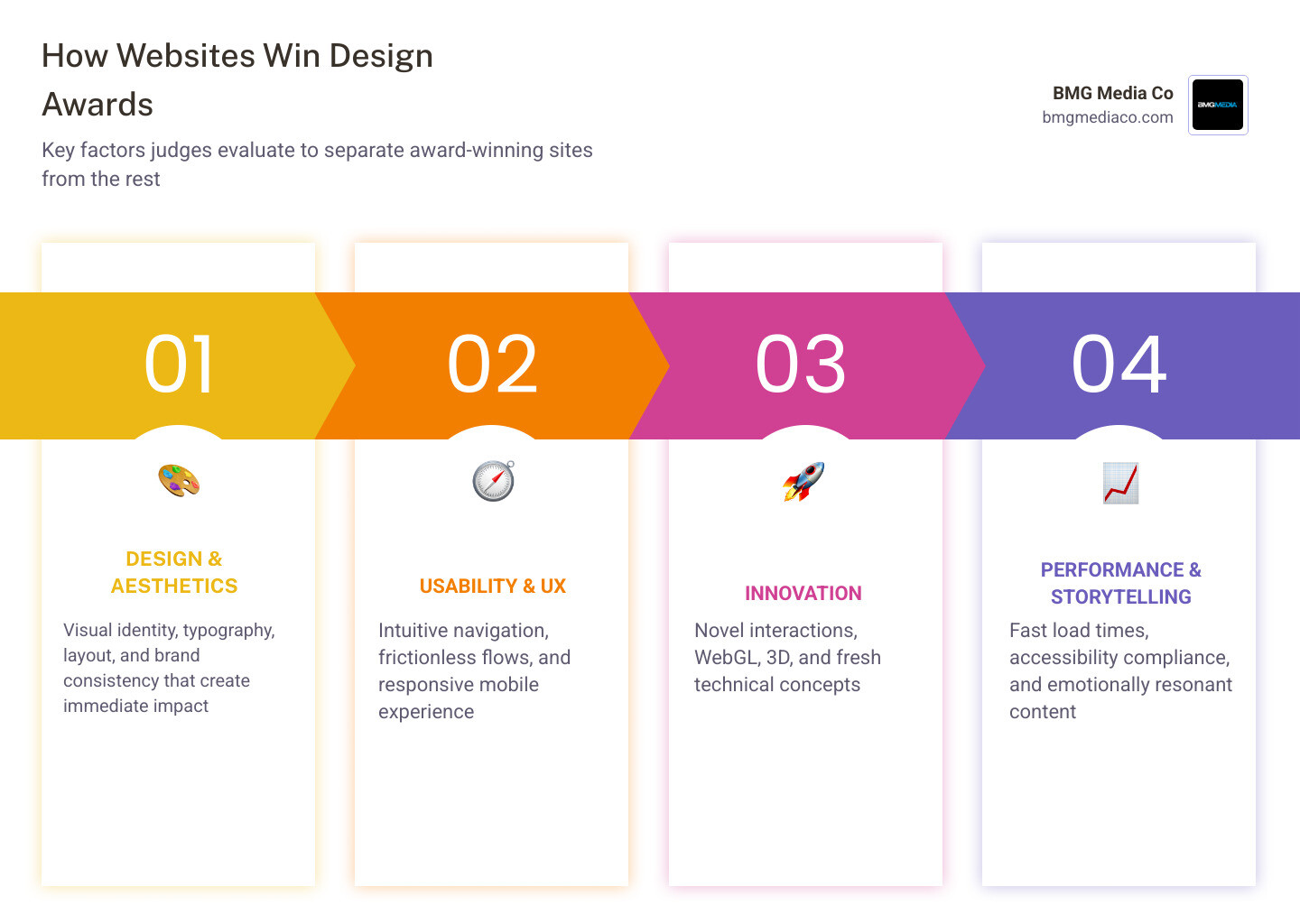
| Factor | What Judges Look For |
|---|---|
| Design & Aesthetics | Visual identity, typography, layout, brand consistency |
| Usability (UX/UI) | Intuitive navigation, frictionless user flows, mobile responsiveness |
| Innovation | Novel interactions, advanced tech (WebGL, 3D, animation), fresh concepts |
| Performance | Fast load times, Core Web Vitals, accessibility compliance |
| Content & Storytelling | Clear messaging, emotional resonance, mission-driven narrative |
Top award bodies to know:
The stakes are real. A well-executed, award-caliber redesign of a major artist’s official website generated over $1.2 million in revenue from more than 22,000 transactions in a single month, with add-to-cart rates jumping 128% and average order values rising 55%. That’s not a vanity metric — that’s what happens when design, technology, and storytelling come together at the highest level.
Most business websites don’t come close to that standard. They’re built from templates, skip performance testing, and treat mobile users as an afterthought — even though mobile devices now account for nearly 60% of all global web traffic.
The good news? The gap between an average site and an award-winning one is bridgeable. But only if you hire the right team.
I’m Blake George, founder of BMG MEDIA, and over the past 15+ years I’ve led the development of more than 1,000 custom websites for brands across real estate, healthcare, manufacturing, and beyond — many built to the same standards that award winning website design judges score on. Below, I’ve broken down exactly what separates the best agencies from the rest so you can make a confident hiring decision.
In 2026, award winning website design is not just about looking expensive, cinematic, or “cool enough to make your marketing team cry happy tears.” It is about combining design excellence with usability, accessibility, performance, storytelling, and technical execution.
The best winners from 2025-2026 share a few traits:
That balance matters because award judges are not only reacting emotionally. They are benchmarking execution.
Major platforms each have their own scoring framework, but they overlap more than people think.
On Awwwards, judges score websites using weighted categories:
Awwwards also publishes detailed page-level considerations on many winners, including accessibility, semantics/SEO, responsive design, animations, transitions, markup, and WPO. You can see that level of breakdown on examples like Bright Biotech – Awwwards SOTD and Kultiveret – Awwwards SOTD.
On CSS Design Awards – Website Awards – Best Web Design …, judges rate:
Each category is scored out of 10, which makes comparisons very transparent.
At Websites and Mobile Sites 2026 – The Webby Awards, selection includes both expert judging and, in many categories, public voting through the People’s Voice Awards. That means a winning site often succeeds on two fronts:
Another useful benchmark comes from broader web award directories, where winners are evaluated on weighted criteria such as craft and execution, concept, aesthetic, usability, and innovation. In other words, pretty visuals alone do not carry the trophy home.
The scoring data tells us something important: winners are excellent, but they are not perfect.
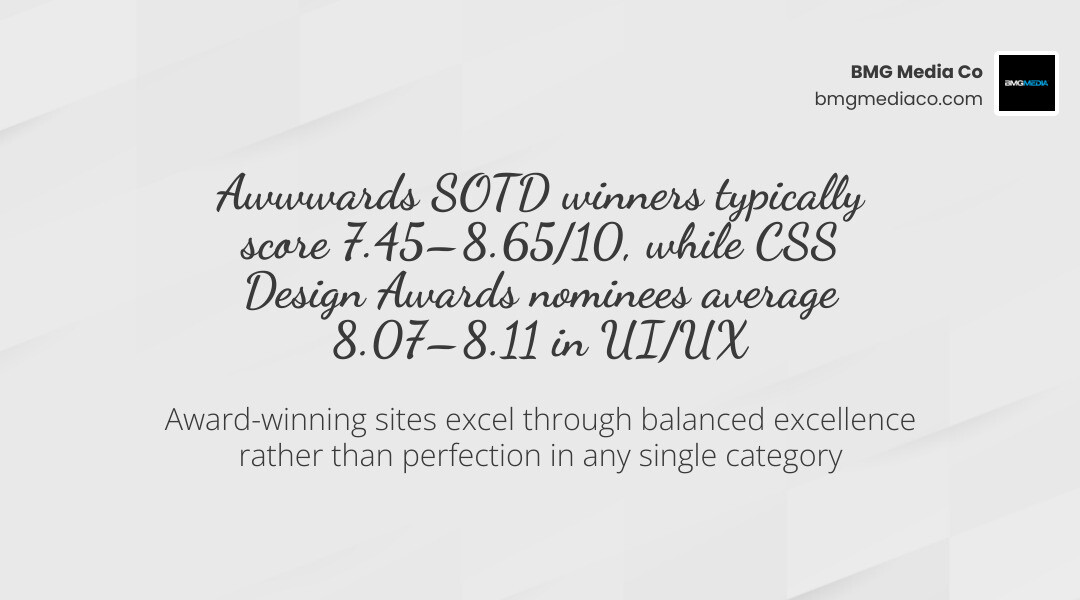
Recent Awwwards Sites of the Day have ranged roughly from 7.45 to 8.65 out of 10. CSS Design Awards nominees in 2026 have averaged around 8.07 to 8.11 in key categories like UI and UX.
That transparency is helpful for buyers because it shows that award winners are judged on tradeoffs:
This is the part many agencies leave out of the pitch deck.
A website can have jaw-dropping animation and still lose points if:
The best winners treat creativity as a tool, not a costume. They pair expressive visuals with:
That is exactly how we think about custom builds at BMG Media Co. Awards are great, but the site still has to sell, educate, convert, recruit, or generate leads after the applause ends.
When evaluating agencies, we recommend looking beyond homepage visuals and asking what services actually support award-level outcomes.
The strongest teams usually offer:
If an agency only shows mockups and says “trust the vibe,” proceed carefully.
Award-winning sites usually begin with strong positioning, not strong gradients.
We look for strategy services such as:
Why does this matter? Because emotional connection is one of the clearest patterns across recent winners. Whether the site is selling products, presenting a portfolio, or explaining a scientific mission, the best experiences make visitors feel something while still knowing what to do next.
Strong storytelling services help shape:
Some of the most memorable 2025-2026 winners use advanced technology well:
A major entertainment website redesign, for example, used WebGL and Three.js to power a countdown experience with custom shaders. Another immersive editorial project combined WebGL with HTML and React elements, plus custom animation orchestration, to blend 2D and 3D storytelling smoothly.
When we evaluate agency capability here, we ask:
Advanced build services should feel intentional, not like a GPU stress test disguised as branding.
This is where real expertise shows.
Mobile traffic accounted for 59% of global web traffic in Q4 2022, and that importance has only continued. Any agency offering award winning website design should have a real process for:
We would also expect them to discuss:
If an agency talks endlessly about motion but never mentions accessibility or WPO, that is not award-level maturity. That is just expensive enthusiasm.
Award winners are not all carbon copies, but they do repeat certain patterns.
Common design elements include:
These trends appear often in Awwwards – Website Awards – Best Web Design Trends, but the strongest sites use them with restraint. Trendy features are seasoning, not the main course.
Recent winners often use interactivity to turn visitors from observers into participants.
Common high-performing features include:
For example, some winning sites use 3D terrain models built from real-world data. Others use immersive retail interactions that let users inspect products, shift mood lighting, or trigger sound. Cultural and experiential projects often thread hotspots through the page to guide exploration.
The key lesson is that interaction should reward curiosity. If every hover effect is screaming for attention, users get tired fast.
This is one of the smartest lessons from recent winners.
The best sites do not render everything at full complexity all the time. They stay fast by using techniques like:
In other words, great immersive sites are engineered, not just designed.
A site can feel rich without loading every possible asset upfront. That is how you get the “wow” without making users stare at a spinner long enough to question their life choices.
One of the biggest shifts in top-tier web design is that sites now act more like experiences.
Recent winners use storytelling patterns such as:
This works across industries. A biotech site can turn complex science into a clear scroll story. A cultural travel site can use transitions and atmosphere to create a sense of place. An editorial experience can transform research and data into a guided journey.
The common thread is simple: the visitor feels invited in, not talked at.
Different industries win for different reasons. The smartest agencies understand the nuance.
The best e-commerce winners prove that conversion-first does not mean boring.
They typically combine:
A notable 2025 redesign in entertainment commerce showed what is possible when those elements align:
That is the business case for investing in design quality.
| Priority | What Top E-commerce Winners Do |
|---|---|
| Storytelling | Connect products to identity, fandom, lifestyle, or brand heritage |
| UX | Keep navigation, filtering, and checkout friction low |
| Conversion | Use trust cues, merchandising strategy, and strong mobile flows |
| Performance | Optimize product media so rich visuals do not crush speed |
Portfolio and experiential websites often take more creative risks because their job is to express point of view.
Top examples usually stand out through:
That said, the best of these sites still preserve orientation. Users can always tell:
That balance between surprise and clarity is harder than it looks, and it is one of the clearest separators between serious agencies and style-only shops.
This category has produced some of the most innovative winners lately.
Why? Because the challenge is bigger than selling a product. These sites often need to explain complex ideas, create emotional connection, and make visitors care.
Patterns we see include:
For inspiration, it is worth studying examples like Bright Biotech – Awwwards SOTD and Kultiveret – Awwwards SOTD. Each shows how rich interaction can support a focused narrative rather than distract from it.
If you are buying award winning website design services, do not just ask who has awards. Ask how they work.
A reliable evaluation framework includes:
Ask direct questions like:
Good agencies will answer clearly. Great ones will answer with examples, process, and numbers.
Watch for these warning signs:
A beautiful Dribbble-style mockup is not the same thing as a working, scalable, high-performing website.
For Michigan businesses, local fit matters too.
Working with a Michigan-based agency can improve:
If you are comparing options, resources like Top Web Design Agencies in Michigan – May 2026 Rankings – Clutch can help you research the broader market. At the same time, the right partner should be judged less by directory placement and more by whether they offer truly custom strategy, design, development, and support.
That is one reason we emphasize fully custom work at BMG Media Co. No templates, no boxed-in themes, no “let’s just swap the stock photo and call it innovation.”
Usually, yes, if the investment goes into the right things.
The return comes from:
The strongest proof in the research is the revenue impact seen in major redesigns where storytelling, UX, and commerce were tightly integrated. For lead gen brands, the equivalent gains often show up in better form completions, stronger perceived credibility, and more qualified inbound leads.
Absolutely. In fact, it should be.
The best winners already show that immersive design can coexist with:
Award judges increasingly look at these fundamentals, and users definitely do. If the site is beautiful but frustrating, the beauty wears off quickly.
At minimum, you should expect:
If the agency cannot support both creativity and execution, it is not offering real award winning website design services. It is offering decoration.
The best award winning website design services do not chase trophies for their own sake. They use the same standards behind top awards to build sites that perform in the real world: stronger storytelling, better UX, faster performance, smarter technology, and clearer conversion paths.
At BMG Media Co, that is exactly how we work. We build fully custom websites, WordPress sites, web apps, branding systems, and high-performance digital experiences with no templates and no shortcuts. With 1,000+ sites completed and a Michigan-based team in Birmingham, we focus on what actually matters after launch: growth, usability, speed, and long-term flexibility.
If you are ready to evaluate what a custom, performance-first website could look like for your brand, explore our More info about web design services.

