April 2026

Custom SaaS app development is the process of designing and building a cloud-based software platform tailored specifically to your business — rather than adapting your workflows to fit a generic tool.
Here’s a quick breakdown of what it involves and why it matters:
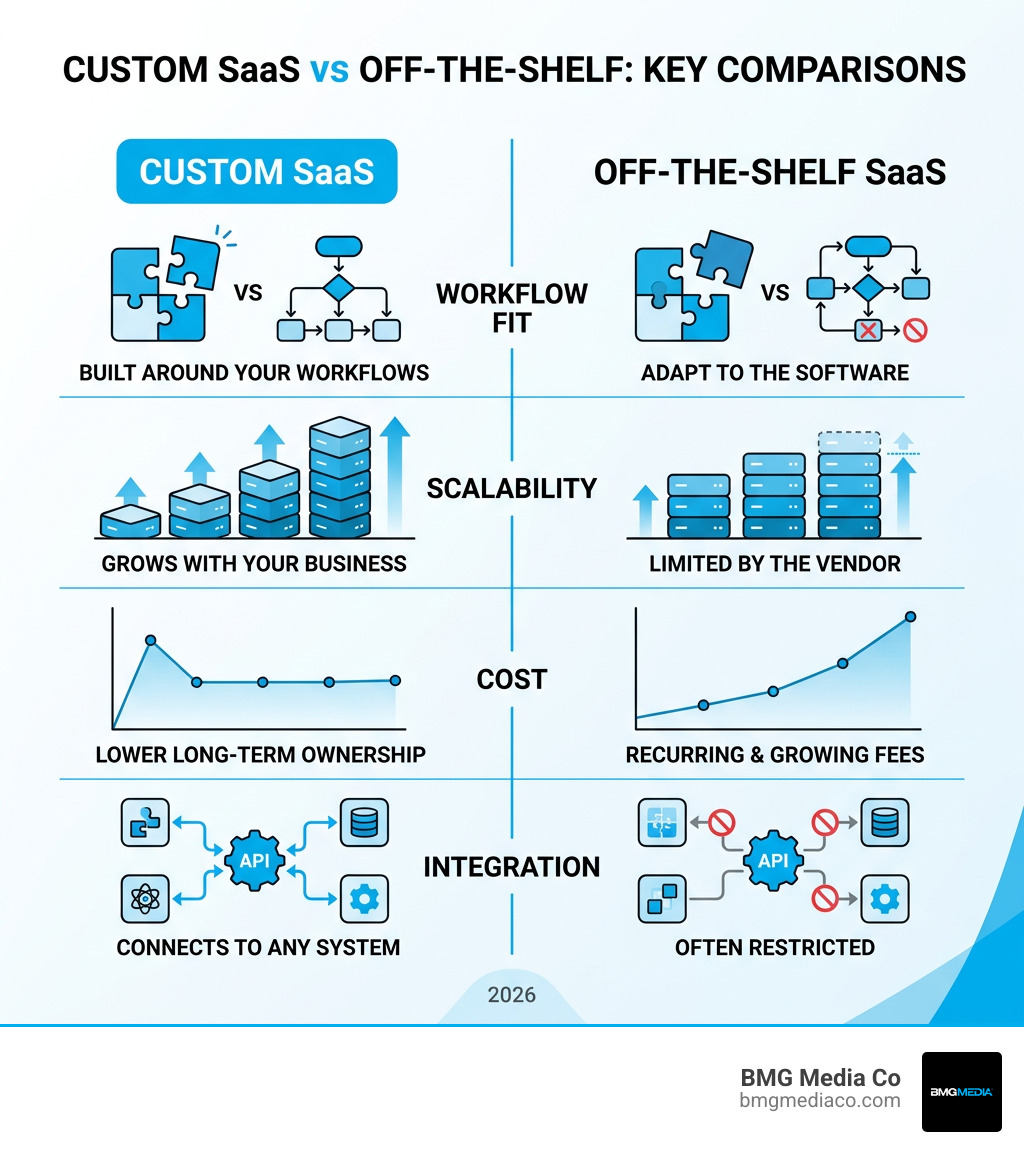
| Factor | Custom SaaS | Off-the-Shelf SaaS |
|---|---|---|
| Fit | Built around your workflows | You adapt to the software |
| Scalability | Grows with your business | Limited by the vendor |
| Integration | Connects to any system via API | Often restricted |
| Security | Tailored to your compliance needs | Vendor-controlled |
| Cost (long-term) | Lower total cost of ownership | Recurring fees that grow with users |
| Competitive edge | Unique to your business | Available to everyone |
By 2025, up to 99% of companies are expected to use at least one SaaS solution. But there’s a growing gap between businesses using generic platforms and those building custom ones that fit their exact needs.
Generic platforms like Salesforce or HubSpot work well for many businesses. But when your processes are specialized — think healthcare workflows, manufacturing operations, or real estate pipelines — off-the-shelf tools force you to work around their limitations instead of powering through them.
The result? Wasted time, missed opportunities, and software that never quite fits.
I’m Blake George, founder of BMG Media Co, and over the past decade I’ve helped hundreds of businesses — from startups to multi-billion-dollar enterprises — move beyond template-based tools into custom SaaS app development that actually drives growth. Below, I’ll walk you through everything you need to know to make a smart decision for your business.
Custom saas app development vocab explained:
When we talk about custom SaaS app development, we are talking about digital sovereignty. When 81% of organizations have already automated at least one business process using SaaS, the question isn’t whether you’ll use the cloud—it’s whether you’ll own the engine or just rent a seat on the bus.
Off-the-shelf solutions are built for the “average” user. They are rigid by design so they can serve millions of people simultaneously. This leads to “vendor lock-in,” where your data and processes are held hostage by a provider’s roadmap. If they decide to remove a feature or hike prices, you’re stuck.
Custom builds provide full source code ownership. This means you have total control over the data isolation protocols and the user experience. Instead of a generic dashboard, you get a high-performance interface designed for your specific KPIs. Whether you need a specialized Custom Software solution for internal logistics or a customer-facing portal, the “custom” route ensures the software mimics your best-performing manual processes, not the other way around.
One of the biggest myths is that custom software is harder to scale. In reality, it’s the opposite. Off-the-shelf tools often hit a “performance ceiling” where adding more users or data causes lag or requires an exponential jump in subscription costs.
With custom SaaS app development, we build for “elasticity.” This means the architecture is cloud-native from day one, using high workload capacity frameworks. We often utilize ReactJS for the frontend to ensure a snappy, app-like feel, and pair it with a robust Python backend for data processing. This combination allows your platform to handle a sudden influx of thousands of users without breaking a sweat, ensuring high availability through redundancy and failover systems.
In today’s regulatory environment, “good enough” security doesn’t exist. Generic SaaS platforms are massive targets for hackers because one breach can expose millions of tenants. Custom applications, however, allow for “security by design.”
We implement tailored security measures that match your industry’s specific needs:
Building a custom platform isn’t just a technical upgrade; it’s a strategic move. Research shows that clients using tailored SaaS solutions achieve up to 25% gains in efficiency and growth. Why? Because the software removes the “friction” of jumping between different tools.
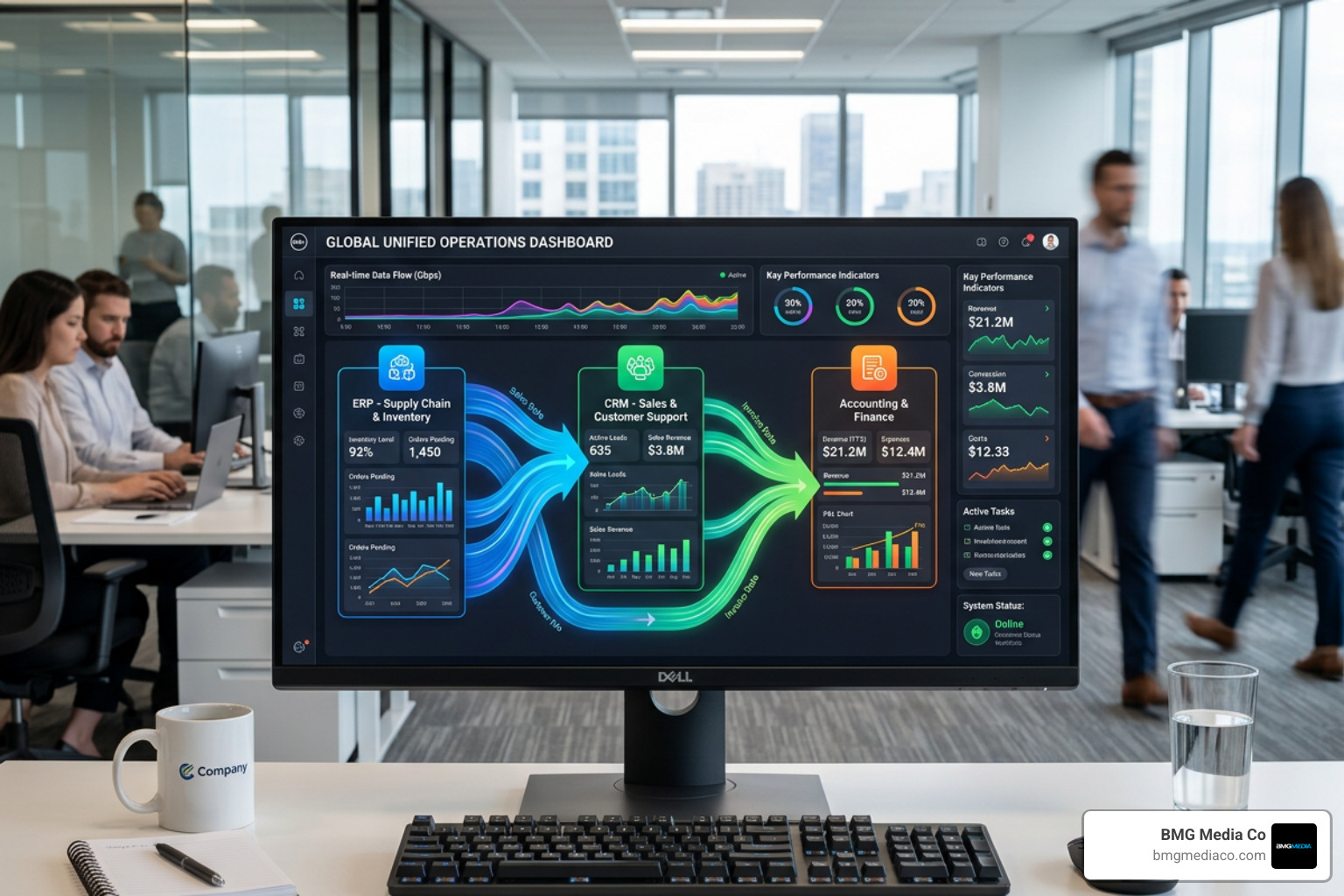
When you invest in custom SaaS app development, you are creating a sustainable competitive advantage. You own the proprietary data leverage—the insights gathered from your unique workflows that your competitors simply can’t access because they’re using the same generic tools as everyone else. This is where Custom Web Design meets deep functional utility.
Your business likely already uses a mix of tools: an ERP for inventory, a CRM for sales, and perhaps QuickBooks for accounting. A major headache with off-the-shelf software is getting these “islands of data” to talk to each other.
Custom SaaS apps act as the “connective tissue” for your business. By utilizing JavaScript and frameworks like Angular, we can build custom APIs that sync data in real-time. Imagine an order placed in your custom ecommerce build automatically updating your warehouse inventory and notifying your sales team in the CRM—no manual data entry required.
Speed to market is everything. Modern custom SaaS app development doesn’t have to take years. By focusing on rapid prototyping and MVP (Minimum Viable Product) development, we help businesses launch core features quickly to gather real-world user feedback.
This iterative approach is especially vital for our Startup Web & Digital partners. It allows you to validate your business model with a functional product, then scale based on what your users actually want, rather than what you think they want.
Building a SaaS is a journey, not a single event. We follow an Agile development process that ensures transparency and quality at every turn.
Before we write a single line of code, we have to ask: “What problem are we solving?” This phase involves:
In some cases, we even explore using WordPress as a “headless CMS,” using its powerful backend to manage content while a custom frontend handles the heavy lifting of the SaaS application.
Once the roadmap is set, we move into sprint-based coding. This means you see progress every week. We don’t disappear for six months and come back with a finished product; we provide weekly demos and incorporate your feedback in real-time.
Our process includes:
This approach is standard across the Software & Technology industry because it reduces risk and ensures the final product is exactly what the business needs.
Let’s talk numbers. Transparency is key in custom SaaS app development. While every project is unique, here are the industry benchmarks for investment and time:
| Project Type | Estimated Cost | Typical Timeline |
|---|---|---|
| Simple SaaS MVP | $25k – $50k | 6 – 12 Weeks |
| Mid-Sized Platform | $50k – $150k | 4 – 6 Months |
| Enterprise-Grade | $150k+ | 6 – 12+ Months |
The Tech Stack: We choose the tools based on your goals. For high-speed APIs, we might use FastAPI or Node.js. For the frontend, Vue or React offer the best user experience.
Total Cost of Ownership (TCO): While the upfront cost of custom development is higher than a $99/month subscription, the TCO is often lower over 3–5 years. You stop paying “per-user” fees that penalize you for growing, and you stop paying for “bloatware” features you never use.
A functional MVP usually takes between 3 to 6 months to build and launch. The timeline depends heavily on the complexity of your core features and the number of third-party integrations (like payment processors or external databases) required. Our goal is always to get a “Minimum Lovable Product” into the hands of users as quickly as possible to begin the feedback loop.
Absolutely. In fact, this is one of the primary reasons businesses choose custom builds. We can build seamless connections to Salesforce, QuickBooks, HubSpot, or any industry-specific tool that offers an API. If a legacy system doesn’t have a modern API, we can often build “custom middleware” to bridge the gap and ensure data flows smoothly across your entire organization.
The three biggest factors are:
At BMG Media Co, we don’t just build software; we build revenue engines. We understand that for a Michigan-based business or a global enterprise, the goal is the same: a long-term ROI and a sustainable competitive moat.
With over 1,000 completed sites and an award-winning team, we specialize in moving businesses away from the limitations of templates and into the unlimited potential of custom builds. Whether you need a sophisticated internal tool or the next big market-disrupting platform, we have the expertise to bring it to life.
Ready to stop renting your software and start owning your future? Get started with Custom Web Design and Development Services
