July 2026

3D product rendering is the process of creating photorealistic images of a product using computer software — no physical product, no photo studio required.
Quick answer: What is 3D product rendering?
| What it is | Computer-generated, photorealistic images created from a 3D digital model |
| How it works | A 3D model is built, textured, lit, and rendered into a final image using rendering software |
| Who uses it | E-commerce brands, manufacturers, furniture companies, packaging designers, and more |
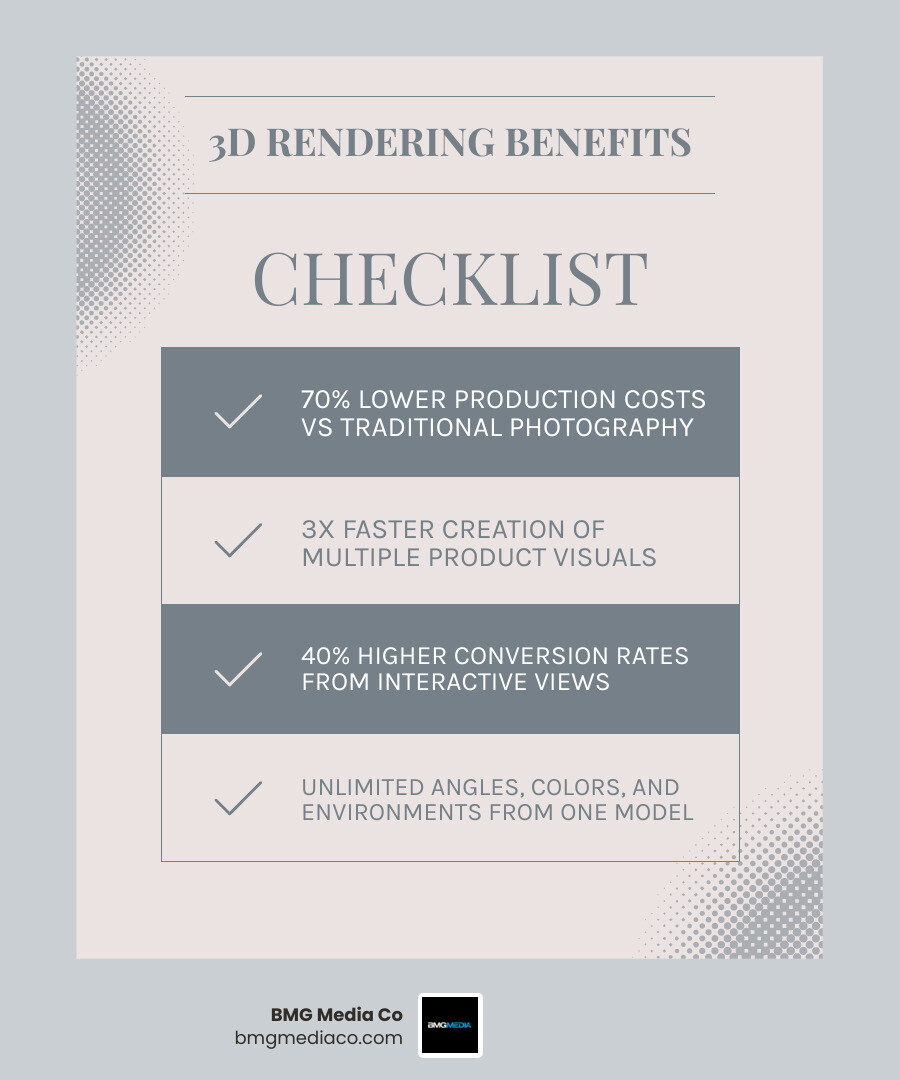
| Key benefits | Up to 70% lower cost than traditional photography, 3x faster content creation, 40% higher conversion rates |
| vs. photography | No physical samples needed, unlimited lighting/environment control, infinitely scalable |
If you sell physical products online, the way you show them matters more than almost anything else. Customers can’t touch, hold, or try your product — so your visuals have to do all the heavy lifting.
Traditional product photography is expensive, slow, and hard to scale. Shooting one product in multiple colors, environments, or configurations means booking studios, shipping samples, and waiting weeks for edits.
3D rendering changes that equation entirely. One digital model can generate hundreds of images — studio shots, lifestyle scenes, close-ups — in a fraction of the time and cost.
IKEA, for example, is well known for using CGI and 3D visualization to produce the majority of its product imagery at scale. What once required massive physical setups is now done digitally.
I’m Blake George, founder of BMG Media Co, a web design and digital strategy agency with over a decade of experience helping consumer brands, manufacturers, and e-commerce businesses build high-performing digital presences — including integrating 3D product rendering into conversion-focused product pages. In the sections below, I’ll walk you through exactly how 3D rendering works, why it matters, and how to use it to grow your business.
At its core, 3D product rendering is the mathematical and artistic process of translating a three-dimensional digital file into a highly detailed, two-dimensional image. Think of it as virtual photography. Instead of placing a physical object on a physical table under physical lights, we build the object, the table, and the lights inside a virtual environment.
This computer-generated imagery (CGI) starts with Computer-Aided Design (CAD) models. These are the highly detailed engineering files used to manufacture the product. If those don’t exist, a 3D artist can build the model from scratch using simple reference photos or sketches.
Once the digital geometry of the product is established, we apply digital materials, textures, and lighting. The rendering software then calculates how light bounces off different surfaces—whether it is the brushed aluminum of a premium kitchen appliance, the soft leather of a luxury sofa, or the transparent glass of a perfume bottle. The result is a level of photorealism so precise that it is virtually impossible for the human eye to distinguish the digital render from a traditional photograph.
By shifting your visual asset creation into a virtual space, you remove the physical constraints of the real world. You can place your product on top of a mountain, inside a hyper-modern penthouse, or floating in a zero-gravity studio environment with a single click.
Learn more about product rendering services for photorealistic results to see how this technology elevates your brand’s digital presentation.
The benefits of 3D product rendering begin long before a product ever lands on an e-commerce storefront. In the industrial design and manufacturing worlds, rendering has completely revolutionized the product development lifecycle.
Historically, the design phase was defined by a slow, expensive cycle of trial and error. Designers drew sketches, engineers built CAD files, and factories produced physical prototypes. If a physical prototype revealed a design flaw, or if a stakeholder disliked a material choice, the team had to go back to the drawing board, modify the designs, and wait weeks for a new physical sample to be manufactured and shipped. This process could easily cost thousands of dollars per iteration and delay product launches by months.
With modern 3D CAD Rendering Software, this bottleneck is completely eliminated. Designers can import their CAD models directly into a browser-based rendering engine to perform real-time design validation.
Want to see how a new outdoor grill looks in brushed steel versus matte black? Want to test how a glass bottle refracts light when filled with different colored liquids? You can swap materials, adjust dimensions, and experiment with textures instantly.
This rapid visualization makes stakeholder communication incredibly simple. Instead of asking executives or investors to interpret flat 2D blueprints or raw engineering files, you can present them with a photorealistic digital twin of the finished product. Decisions can be made confidently and collaboratively in real time, drastically shortening the runway required to bring a product to market.
To understand how a photorealistic image is constructed from nothing, it helps to look at the step-by-step workflow that 3D artists follow. The process is highly logical and mirrors the steps of real-world manufacturing and photography.
The foundation of any render is the 3D model. This is the digital skeleton of your product, constructed of polygons, vertices, and lines. If your engineering team already has CAD files, we can import them directly into our software, preserving the exact geometric proportions of the physical product. If CAD files aren’t available, we can construct the model manually using high-resolution reference photos, measurements, or physical sketches.
Once the geometry is locked in, the product looks like a gray clay model. The next step is texturing, which defines how the surface looks and feels. Using advanced texture maps, we simulate realistic surface details like microscopic bumps, brushed metal grain, fabric weaves, and even tiny imperfections like dust or subtle scratches. This step is critical; without these subtle real-world imperfections, a 3D model looks “too perfect” and loses its photorealistic quality.
Just like in a physical photo studio, lighting is what brings a scene to life. In a virtual studio, we place digital light sources—such as spotlights, softboxes, and ambient environmental lights—to highlight the product’s form and contours. We can control the exact intensity, color temperature, and angle of every light ray to create dramatic shadows and realistic reflections.
Finally, we position a virtual camera. We can adjust the lens focal length, depth of field, aperture, and camera angle just like a real photographer. Once the composition is perfect, we hit “render.”
Using advanced 3D Rendering and AI Visualization Software, the computer calculates the physics of light bouncing off the textured surfaces to generate the final high-resolution 2D image.
If you are running an e-commerce brand or managing a product catalog in May 2026, relying solely on traditional photography is a massive competitive disadvantage. Today’s consumers expect immersive, highly interactive, and crystal-clear visual experiences when shopping online.
The business case for adopting 3D product rendering is backed by undeniable data:
When you present your customers with hyper-realistic 3D visuals, you build immediate trust. They can inspect every stitch of a shoe, see how a piece of furniture looks in different fabrics, and view the product from every conceivable angle. This transparency maximizes the perceived value of your products and gives buyers the confidence they need to hit the “Add to Cart” button. To explore how to integrate these immersive assets into your digital storefront, you can Showcase Products in 3D and Build Buyer Confidence.
While almost any business selling physical goods can benefit from CGI, certain industries have made 3D product rendering an absolute cornerstone of their operations.
Furniture is notoriously difficult and expensive to photograph. Shipping heavy sofas, dining tables, and bed frames to a physical studio requires massive logistics, and staging realistic room environments (kitchens, living rooms, bedrooms) is incredibly costly.
With furniture rendering, we can build beautiful, photorealistic lifestyle scenes digitally. Furthermore, furniture brands can easily show a single armchair in dozens of different fabrics, leathers, and wood finishes without ever having to manufacture a single physical variant.
Electronics require flawless, ultra-crisp imagery that highlights premium materials, port placements, and internal engineering. 3D rendering allows brands to create exploded views that show the inner workings of a device, or high-end animations that demonstrate how a folding screen or hinge mechanism operates in real life.
For consumer packaged goods (CPG) and cosmetics, packaging design is everything. Rendering allows designers to see exactly how metallic foils, matte plastics, and glossy glass bottles interact under retail store lighting. It also enables brands to generate perfectly consistent, uniform product line images for retail catalogs and Amazon stores.
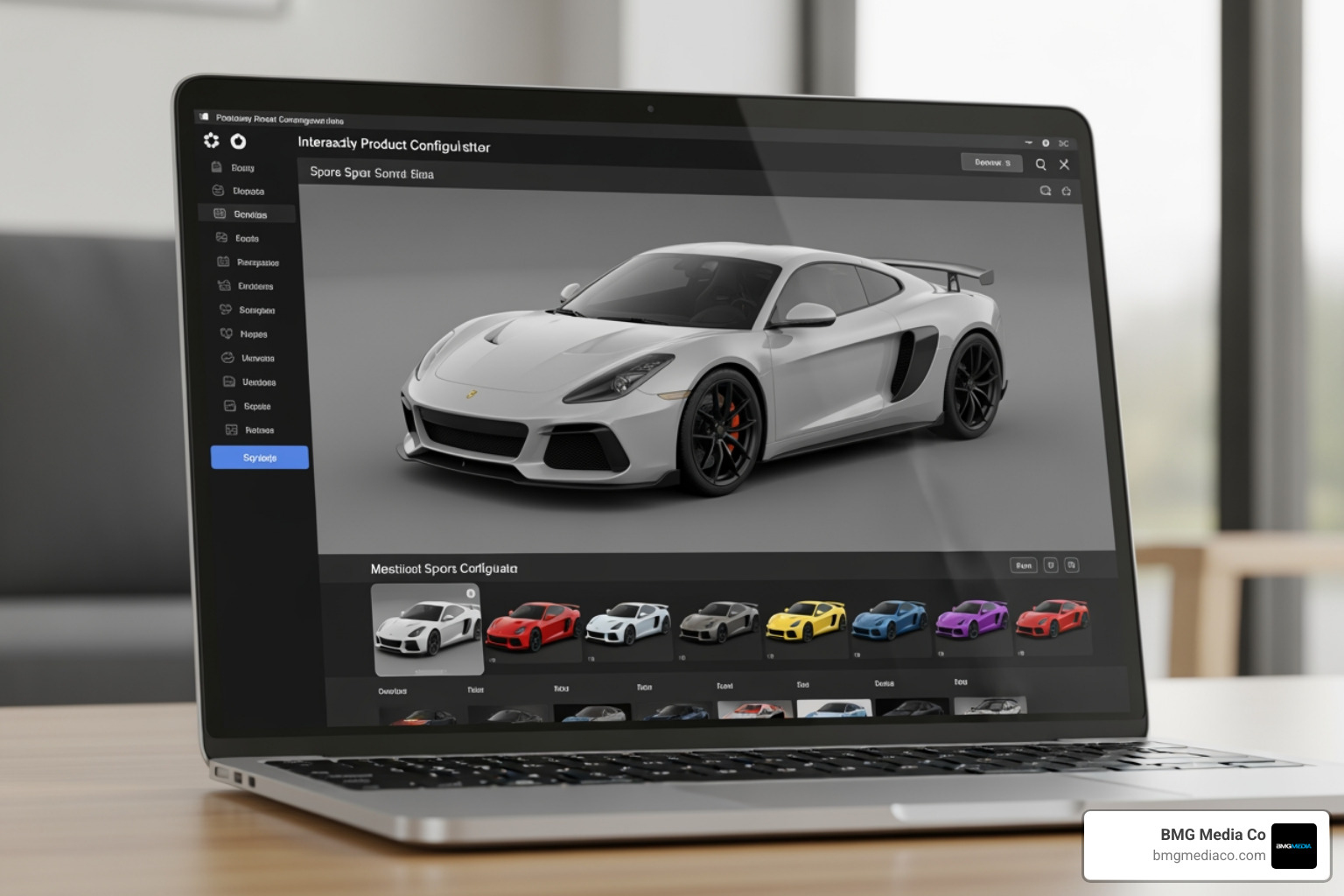
Automotive companies have long abandoned traditional photography for their marketing materials. Car configurators allow buyers to customize paint colors, wheel designs, and interior trims in real time. Similarly, heavy industrial equipment manufacturers use digital twins and 3D animations to demonstrate complex machinery to B2B buyers without needing to transport multi-ton equipment to trade shows.
If you are looking to scale your e-commerce visuals, check out these strategies for deploying 3D Models for E-Commerce Platforms to drive engagement and sales.
To help you decide which approach is right for your brand’s budget and workflow, let’s look at a direct head-to-head comparison of traditional product photography versus modern 3D rendering.
| Feature | Traditional Product Photography | 3D Product Rendering |
|---|---|---|
| Physical Samples | Required. Must be manufactured and shipped to the studio. | Not required. Can be built entirely from CAD files or photos. |
| Flexibility | Extremely low. Changing a color or angle requires a re-shoot. | Infinite. Alter colors, materials, lighting, or angles in seconds. |
| Turnaround Time | Slow. Weeks of prep, shooting, and post-production retouching. | Fast. Renders can be generated in days or even hours. |
| Consistency | Hard to maintain across high-SKU catalogs due to lighting shifts. | Perfect. The exact same digital camera and lighting are reused. |
| Cost Scale | Costs scale linearly with every new product variation or shoot. | One-time modeling cost; unlimited variations are highly affordable. |
| Interactivity | Limited to static images or basic 360 spin videos. | Supports interactive configurators, AR, and custom animations. |
The differences in scalability are profound. If you have a product line of water bottles that comes in 15 different colors and 3 different sizes, a traditional photographer has to shoot 45 individual physical items, manually adjusting the lights and tripod for each shot. If you decide to add a 16th color next season, you have to book another shoot and try to perfectly replicate the original lighting setup.
With 3D rendering, we set up the digital camera and lighting once. We then swap the digital texture 45 times and hit export. Adding a new color down the road takes minutes, ensuring 100% visual consistency across your entire website.
To learn how to bring these highly flexible digital assets directly onto your website to create an interactive user experience, you can read our guide on how to Make your website dimensionally gifted with these 3D tools.
As we navigate May 2026, the landscape of 3D product rendering is evolving at a breakneck pace, driven by two major technological forces: Artificial Intelligence (AI) and real-time browser-based graphics.
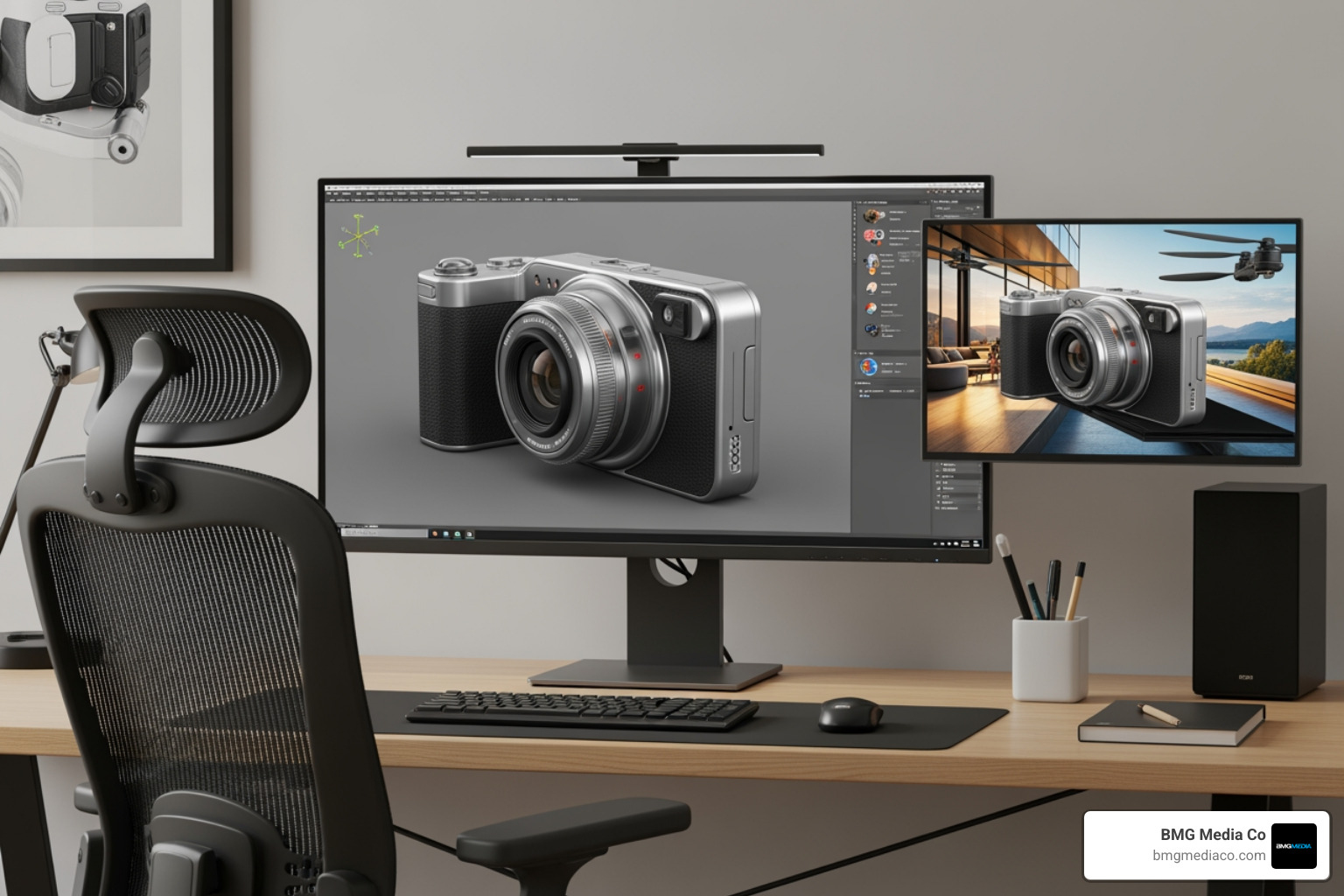
The most exciting development is the rise of Hybrid AI + 3D workflows. While raw, generative AI image tools have become incredibly popular, they often fail when it comes to professional product visualization because they lack precision. If you ask a generic AI tool to place your specific product in a kitchen, it will often hallucinate details, distorting your logo, changing the product’s proportions, or altering its design.
To solve this, modern rendering studios utilize a hybrid approach. We use precise 3D modeling to maintain a 100% accurate digital twin of the product, ensuring that the dimensions, branding, and materials are technically perfect. We then pair this master 3D model with AI-driven environment generators to craft rich, atmospheric lifestyle backgrounds. This gives brands the absolute best of both worlds: the emotional storytelling and speed of AI, backed by the technical precision and control of 3D.
Additionally, the adoption of open, lightweight file standards has made real-time 3D interactive web experiences incredibly accessible. To understand how these file formats are standardized across the web, you can explore the Open Standards for 3D Assets maintained by the Khronos Group.
With these optimized files, e-commerce websites can run full, interactive 3D configurators directly inside any mobile web browser without slowing down page load times. This is paving the way for a future where static product photos are completely replaced by real-time digital sandboxes. For a deeper look at how cutting-edge graphics processing is transforming digital assets, check out the latest updates on Generative AI and 3D Graphics.
If you are ready to transition your product catalog into the digital era, choosing the right partner is critical. Not all rendering services are created equal, and the quality of your visual assets will directly reflect your brand’s reputation.
When evaluating potential rendering partners, consider the following key factors:
At BMG Media Co, we don’t believe in generic templates or cookie-cutter solutions. We provide fully custom web design, development, and high-performance rendering services tailored to your exact brand identity. Based in Birmingham, Michigan, our award-winning team has completed over 1,000 custom websites. We build the stunning 3D visual assets your brand needs, and then seamlessly integrate them into a beautiful, high-performing digital experience that turns casual visitors into loyal customers.
To see how we can bring your products to life, explore BMG Media Co’s 3D Product Rendering Services.
Traditional photoshoots require you to manufacture physical product prototypes, pay for shipping and logistics, hire professional photographers, rent a physical studio space, purchase props, and pay for extensive post-production retouching. If you have multiple product variations (colors, materials, sizes), these costs multiply quickly.
3D rendering eliminates almost all of these physical overhead costs. Once a master 3D digital model is created, generating new colorways, lighting environments, and lifestyle scenes is entirely digital, fast, and highly cost-effective.
No, physical samples are not required. A skilled 3D artist can build a photorealistic digital model using existing CAD files from your engineering team. If you don’t have CAD files, we can construct the 3D model from simple reference photos, dimension sheets, or even hand-drawn sketches. This allows you to generate stunning marketing materials and start taking pre-orders before your physical inventory has even been manufactured.
When implemented correctly, no. While high-resolution 4K static renders are no heavier than traditional JPEG photos, interactive 3D elements (like 360-degree viewers or product configurators) do require optimization.
By utilizing modern, lightweight 3D file formats (such as GLTF or GLB) and lazy-loading scripts, we can ensure that your interactive 3D assets load instantly and run smoothly on all devices, including mobile phones, without hurting your site’s SEO or loading speeds.
In May 2026, the digital marketplace is more crowded and competitive than ever before. To capture your audience’s attention, build instant buyer confidence, and scale your business efficiently, your visual assets must be top-tier.
3D product rendering is no longer a futuristic luxury reserved for tech giants — it is an essential, highly practical business tool that saves you money, accelerates your design workflows, and dramatically increases your e-commerce conversion rates.
At BMG Media Co, we specialize in helping businesses bridge the gap between physical products and digital perfection. We are a fully custom web design and digital creative agency based in Birmingham, Michigan. We don’t use cheap templates or cut corners; we design and develop award-winning, high-performance websites and custom interactive 3D visualizations built to scale your brand.
Whether you need photorealistic studio shots of a new product line, immersive lifestyle renders, or a fully custom interactive 3D configurator built directly into your online store, our team has the expertise to make it happen.
Let’s build something incredible together. Get started with BMG Media Co’s Web Design Services: 3D Renderings today and take your brand’s digital presence to the next dimension.
