June 2026
Custom IoT development is the process of building connected device systems — hardware, firmware, cloud platforms, and applications — engineered specifically around your business requirements, rather than adapting a generic off-the-shelf platform to fit your needs.
Here’s the quick answer if you’re evaluating your options:
| Question | Answer |
|---|---|
| What is it? | End-to-end design and build of connected devices, firmware, cloud infrastructure, and dashboards tailored to your exact use case |
| Who needs it? | Companies with specialized data needs, legacy systems, scaling device fleets, or industry compliance requirements |
| How is it different from AWS IoT or Azure IoT? | Those are managed infrastructure you configure. Custom IoT builds the entire platform specifically for your product |
| How long does it take? | 3–6 months for an MVP; 6–12 months for a full production platform |
| What does it cost? | From ~$50,000 for simple prototypes to several million for complex systems |
| When should you migrate from a generic platform? | When device fleets grow, costs rise, integrations get complex, or you need full data ownership |
The numbers tell a compelling story. The global IoT market is projected to reach $1.8 trillion by 2028. Yet over 50% of IoT projects fail when built on off-the-shelf platforms — due to integration failures, security gaps, or scalability ceilings. Meanwhile, companies that invest in custom-built solutions report 25–40% reductions in operational costs and up to 50% less unplanned downtime through predictive maintenance.
Generic platforms work fine for simple, low-scale use cases. But the moment your device fleet grows, your integrations get complex, or your industry demands regulatory compliance, those platforms become a ceiling — not a foundation.
That tension is exactly what this guide addresses.
I’m Blake George, founder of BMG Media Co. and a technology entrepreneur with 15+ years of experience building custom digital products across industries — including custom software and connected system integrations that sit at the heart of custom IoT development strategy. This guide draws on that experience to give you a clear, practical roadmap.
Custom iot development terms to know:
At its core, custom IoT development is the engineering of a connected ecosystem where every single layer is designed to solve a specific business problem. Unlike generic systems that force you to adapt your operations to their pre-built data structures, a custom solution starts with your workflow and builds the technology around it.
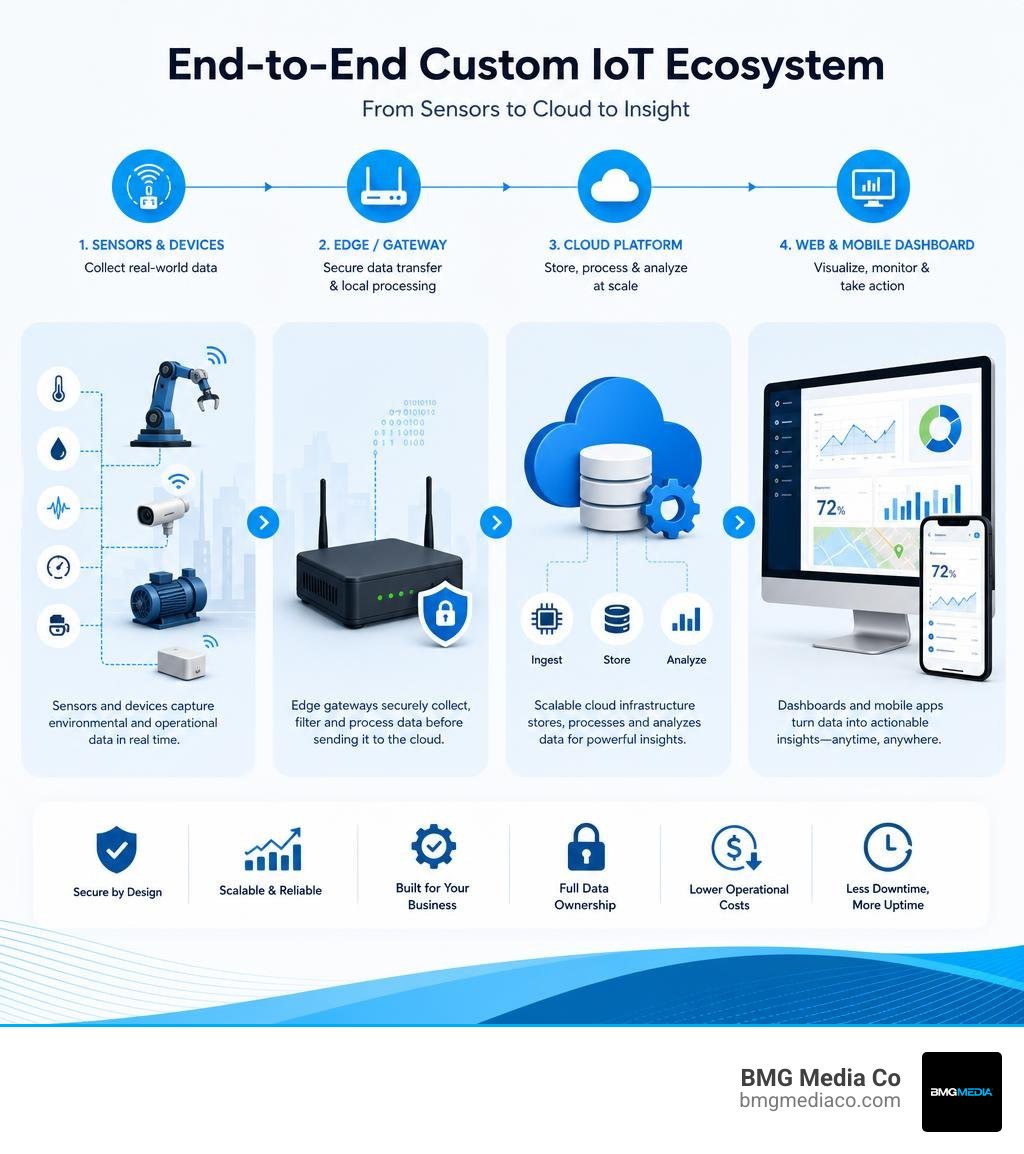
An end-to-end custom IoT architecture consists of several tightly integrated layers:
When you build a custom system, you aren’t starting completely from scratch. In fact, research shows that about 70% of the IoT stack in custom development comes from pre-built platforms and low-code tools. This allows engineers to focus the remaining 30% of their efforts entirely on your unique business logic, proprietary algorithms, and custom user experiences. To understand the foundational phases of this process, you can explore the What Is Custom IoT Development? Complete Guide (2026).
For modern enterprises operating in competitive landscapes, off-the-shelf software is a commodity. True competitive advantage comes from proprietary capability. When you invest in custom IoT, you are building a proprietary asset that belongs exclusively to your balance sheet.
This brings several strategic advantages:
To understand how custom engineering drives long-term asset value, read more in The Complete Guide to Custom Software Developers.
The classic “make vs. buy” dilemma is highly pronounced in IoT. While generic platforms promise quick deployment and low upfront costs, they often lead to architectural dead-ends.
Here is how custom IoT development stacks up against generic SaaS platforms:
| Feature | Generic IoT Platforms | Custom IoT Development |
|---|---|---|
| Upfront Cost | Low subscription fees | Moderate to high initial investment |
| Long-Term Cost | Scales aggressively with device count and data volume | Highly cost-efficient at scale with zero licensing fees |
| Data Ownership | Data often stored in vendor-managed silos | 100% data sovereignty and direct database control |
| Customization | Limited to platform templates and basic APIs | Unlimited customization of hardware, firmware, and UI |
| Legacy Integration | Requires complex middleware or is entirely unsupported | Native integration built directly into existing ERP/MES systems |
| Vendor Lock-in | High; migrating away requires rebuilding from scratch | None; complete platform control and portability |
While pre-built frameworks like What makes Connhex better than custom projects | Connhex or turnkey design models like IoT ODM: custom connected products built on OmnIoT offer middle-ground solutions for specific device volumes, true enterprise-scale performance and cost control ultimately point toward custom development.

A successful custom IoT solution functions like a highly coordinated symphony. If one instrument is out of tune — whether it is a poorly written line of firmware or an unstable cloud database — the entire system falls apart.
Everything starts in the physical world. Custom hardware engineering involves designing printed circuit boards (PCBs), choosing the right microcontrollers, and integrating specialized sensors.
In industrial and commercial settings, microcontrollers like the ESP32 or STM32 are highly favored for their balance of power, processing capability, and built-in wireless connectivity. Hardware design must account for the physical realities of the deployment site. For example, a sensor deployed in a damp agricultural field requires a highly rated IP67 enclosure and optimized battery management, while a controller on a factory floor in Oakland County requires optical isolation to handle electromagnetic interference.
Calibrating these sensors to ensure clean, accurate data ingestion is critical. If your hardware is sending noisy or inaccurate data, your cloud analytics will be useless. For deep insights into designing software that coordinates with specialized hardware, check out our Custom Manufacturing Software Tips for Precision and Profit and explore hardware options like Customised Product Development Services for Industrial IoT.
Firmware is the translation layer between the physical hardware and the digital cloud. It is low-level code written directly onto microcontrollers to manage hardware resources, read sensor values, and execute local logic.
One of the most important trends in 2026 is edge processing. Instead of streaming massive volumes of raw sensor data directly to the cloud — which clogs network bandwidth and spikes cloud storage bills — custom firmware can process data locally. For example, an edge-enabled vibration sensor on a conveyor belt can monitor machinery continuously but only transmit data when it detects an anomalous pattern that signals a potential breakdown. This reduces latency, lowers data transmission costs, and ensures the system can still function even during temporary network outages.
Once data is processed at the edge, it needs a reliable path to the cloud. Custom IoT development allows you to select and optimize the exact communication protocol for your environment:
At the cloud layer, this data is ingested into time-series databases designed to handle millions of sequential data points per second. Here, custom-built web and mobile portals display real-time visualizations, send automated alerts, and provide deep analytics. For examples of customized industrial controllers supporting these protocols, see Customised IoT Devices for Industrial Applications.
When businesses scale, they quickly run into the limitations of generic SaaS platforms. While those platforms are easy to set up for a pilot project with ten devices, managing ten thousand devices is an entirely different story.
Over 50% of IoT projects fail when companies try to force off-the-shelf platforms to do heavy enterprise lifting. Custom development solves the core integration, scaling, and security challenges that generic platforms simply cannot address. You can learn more about these decision factors in the Custom IoT Development Guide 2025 – NORVI Controllers.
One of the largest hurdles in enterprise digital transformation is the presence of legacy equipment. A manufacturing plant may rely on heavy machinery built decades ago that uses proprietary communication protocols.
Generic platforms expect modern, clean APIs. They struggle to speak to older Programmable Logic Controllers (PLCs) or interface with proprietary Manufacturing Execution Systems (MES) and Enterprise Resource Planning (ERP) platforms.
Custom IoT development bridges this gap natively. By building custom adapters and APIs, we can connect modern IoT sensors directly to your existing systems, routing real-time operational data directly into your core business software without requiring expensive equipment overhauls. Discover how custom web and system architectures handle these complex integrations in our guide to Custom Site Development for Complex Manufacturing Needs.
Security cannot be an afterthought in IoT. A compromised smart device is not just a data leak hazard — it is a physical entry point into your corporate network.
Custom IoT systems allow you to build security directly into the hardware and software architecture from day one:

Building a custom IoT solution requires a structured, multi-disciplinary approach. Because you are dealing with physical hardware as well as digital software, the development lifecycle must be meticulously managed to avoid costly physical manufacturing mistakes.
To bring a connected product to market successfully, we follow a proven, iterative lifecycle:
By keeping these phases aligned, you minimize development friction and ensure a faster, more reliable path to launch. Learn why a tailored approach to this lifecycle is essential for your business in Why Your Business Deserves Custom Web Development Solutions.
A typical custom IoT project moves in phases. Building a functional Proof of Concept (PoC) or Minimum Viable Product (MVP) to validate your hardware and data pipeline usually takes 3 to 6 months. Transitioning from an MVP to a fully scaled, production-ready enterprise platform with custom PCB manufacturing, regulatory certifications (like FCC or CE), and deep system integrations typically takes 6 to 12 months.
While custom IoT development requires a higher initial capital investment compared to buying a subscription-based platform, the long-term Total Cost of Ownership (TCO) is drastically lower. Custom systems eliminate the scaling subscription fees that charge you per device or per message. Furthermore, by utilizing modern low-code tools and pre-integrated frameworks for up to 70% of the standard IoT architecture, custom development can deliver up to 11x lower total cost of ownership over a 5-year lifecycle.
Not necessarily. Many successful custom IoT deployments begin by utilizing reliable, industry-standard reference platforms or industrial PLCs. You can start collecting and analyzing data immediately using simulated data or standard hardware. As your product matures and your volume increases, you can transition to designing custom, proprietary PCBs to reduce unit manufacturing costs and optimize the physical footprint of your devices.
The future of business is connected, but generic platforms are no longer enough to win in a highly competitive market. Whether you are looking to optimize complex manufacturing operations, launch a smart product, or gain unprecedented visibility into your supply chain, custom IoT development gives you the control, security, and scalability you need to succeed.
At BMG Media Co., we don’t believe in templates, shortcuts, or one-size-fits-all solutions. Headquartered in Birmingham, Michigan, our globally distributed team has spent over 15 years bringing premium, 100% custom digital products to life. We combine enterprise-grade engineering with founder-direct attention to build connected systems that drive real, measurable ROI.
Ready to turn your connected product vision into a powerful business asset? Explore our Web Design and Custom Software Services and let’s build something exceptional together.
