June 2026

Custom web development solutions are websites and web applications built from scratch to fit your exact business needs — not adapted from a template someone else designed for a different company in a different industry.
Quick answer: What are custom web development solutions?
| Feature | What it means for your business |
|---|---|
| Built from scratch | No template limits, no plugin bloat |
| Tailored functionality | Does exactly what your workflows need |
| Full code ownership | No vendor lock-in, no recurring platform fees |
| Scalable architecture | Grows with your traffic, users, and features |
| SEO and performance control | Clean code, fast load times, Core Web Vitals ready |
| System integrations | Connects to your CRM, ERP, payments, and more |
If your website was built on a drag-and-drop builder or a recycled theme, you’ve probably already hit its ceiling. Pages load slowly. You can’t add the features you need. The design looks like three other companies in your industry. And leads? They bounce.
Businesses in real estate, healthcare, manufacturing, and consumer brands are especially vulnerable to this. Their needs are complex. Their customers expect a seamless, credible experience. And off-the-shelf tools simply weren’t built with those needs in mind.
The good news: a custom-built site isn’t just a luxury for enterprise companies anymore. It’s one of the smartest long-term investments a growing business can make.
I’m Blake George, founder of BMG MEDIA and a digital strategist with over a decade of experience delivering custom web development solutions for more than 1,000 businesses across industries including real estate, healthcare, and manufacturing. In this guide, I’ll walk you through everything you need to know to decide if custom development is right for your business — and what to do next.
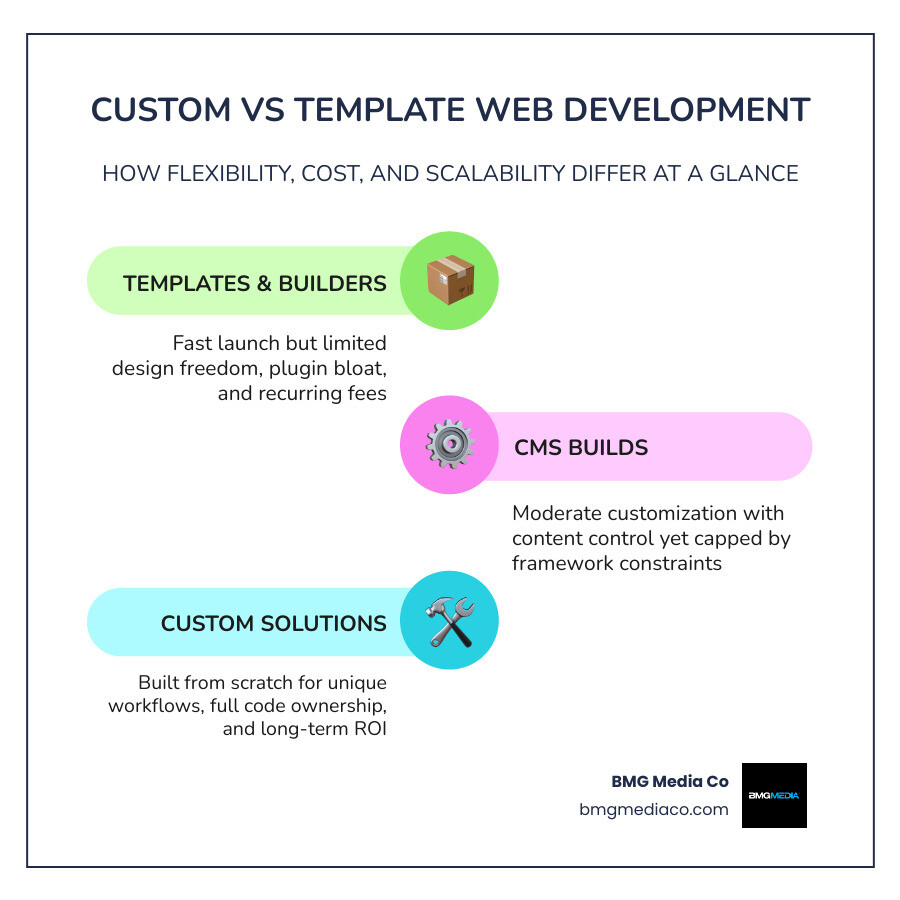
When we talk about custom web development solutions, we aren’t just talking about changing the colors on a theme. We are talking about engineering a digital product from the ground up. This involves a comprehensive approach to the “front end” (what your users see and interact with), the “back end” (the server-side logic and database management), and the infrastructure that holds it all together, including secure hosting and automated workflows.
Unlike a standard website, a custom build is like a tailored suit. It’s designed to fit your business’s specific measurements, whether you need a complex database to synchronize with your accounting software or a secure portal for healthcare patients to access records.
The allure of templates and page builders like Wix or Squarespace is undeniable: they are cheap and fast. However, they come with a “technical tax.” These platforms use generic code designed to accommodate every possible user, which leads to “plugin bloat” and heavy scripts that slow down your site.
In contrast, custom development provides clean, minimal, and performance-driven code. You own the code entirely, meaning you aren’t “renting” your business’s digital home from a platform that could change its terms or pricing tomorrow.
| Aspect | Template / Page Builder | Custom Web Development |
|---|---|---|
| Design | Limited to pre-set layouts | 100% unique to your brand |
| Performance | Often slow due to heavy code | Optimized for speed and Core Web Vitals |
| Scalability | Hard to add complex features later | Built to grow with your business |
| Ownership | Locked into the platform | You own the source code and IP |
| Security | Dependent on platform updates | Hardened, bespoke security protocols |
We often see businesses use these terms interchangeably, but there is a big difference. A website is primarily informational—think of a marketing site that showcases services and a “Contact Us” page.
A web application, however, is interactive software. It manages data, automates tasks, and processes transactions. If you need a dashboard for your sales team, a multi-step portal for client onboarding, or a system that automates inventory across multiple locations, you are looking for a web application. Custom solutions excel here because they can be built to handle specific user roles and complex business logic that off-the-shelf software simply can’t touch.
How do you know if you need to go custom? If your business relies on a specific buyer journey that requires more than just a “Buy Now” button, custom is the way to go. This is especially true for:
Why your business needs a custom website design and development strategy
Choosing custom web development solutions isn’t just about aesthetics; it’s about building a high-performance engine for your business. When you move away from generic builds, you gain control over the variables that actually drive revenue: speed, security, and brand authority.
Google’s Core Web Vitals are now a major ranking factor. Templates often fail these tests because they load unnecessary CSS and JavaScript. Custom sites are built with “crawlability” in mind, using clean HTML and proper schema markup that helps search engines understand exactly what you do.
Beyond SEO, speed kills conversions. Research shows that even a one-second delay in page load time can lead to a significant drop in sales. By eliminating bloat, we ensure your site is mobile-responsive and lightning-fast, creating a friction-less path to conversion.
The no-nonsense guide to high performance web launches
Your brand is more than just a logo; it’s the voice of your company. Custom development allows us to create tailor-made sites that fit your brand like a glove. This uniqueness helps you find your business voice through custom design, standing out in a sea of “cookie-cutter” competitors.
Furthermore, the long-term ROI is often much higher. While the initial cost is greater, you save money on recurring “pro” plugin fees, platform subscriptions, and the eventual cost of having to rebuild a limited site when it inevitably breaks under the weight of your growth.
While any business can benefit, certain industries find custom web development solutions essential for survival:

To build a site that lasts, you need a modern “tech stack.” We don’t just use whatever is trendy; we choose the tools that provide the best balance of speed, security, and maintainability for your specific project.
We often utilize powerful libraries and frameworks like React or Next.js for the front end to create snappy, responsive user interfaces. For the back end, we might use Node.js, PHP (Laravel), or Python to handle the heavy lifting of business logic and authentication. Your data is typically stored in robust databases like PostgreSQL or MongoDB, and the entire system is usually hosted on scalable cloud infrastructure like AWS.
You shouldn’t need a developer just to change a blog post. We often build custom CMS or ecommerce builds that give your team total control without the risk of breaking the site.
We also specialize in Progressive Web Apps (PWAs). These are websites that act like native mobile apps—they can work offline, send push notifications, and load instantly, all without requiring the user to download anything from an app store.
In May 2026, AI isn’t just a buzzword; it’s a core component of modern web solutions. We can integrate AI to provide:
A custom project is a journey. It requires a structured process to ensure that the final product matches your vision and stays within budget.
The ultimate guide to picking a web app partner
Timelines vary based on complexity, but here is a general guide:
Building a custom digital tool is an investment. Based on industry standards and project complexity, costs typically fall into these tiers:
Factors that influence these numbers include the depth of design, the number of third-party integrations, and specific compliance requirements (like HIPAA or PCI).
The biggest threat to a project is “scope creep”—adding new features halfway through that weren’t in the original plan. We avoid this through clear documentation and a “discovery first” approach. We also prioritize managing “technical debt” by writing clean code from day one, ensuring your site doesn’t become a nightmare to update two years from now.
A website is never “done.” It needs to be a living, breathing part of your business that can adapt to new threats and opportunities.
We don’t “bolt on” security at the end. We follow OWASP best practices, implement end-to-end encryption, and use Role-Based Access Control (RBAC) to ensure only the right people see sensitive data. We also ensure your site is accessible to everyone, following WCAG 2.2 AA standards, which isn’t just a good thing to do—it’s often a legal requirement.
Your website shouldn’t be an island. One of the greatest strengths of custom web development solutions is the ability to create seamless custom software integrations. Whether you need to sync your site with Salesforce, Microsoft Dynamics, or a custom legacy database, we build the “middleware” that allows data to flow automatically, reducing manual work and human error.
Once your site is live, we provide SLA-backed support. This includes:
When choosing a partner, look for transparency. Do they have a senior-led team? Do they provide full documentation? Most importantly, do they have a portfolio that shows they can handle the complexity of your industry? At BMG Media Co, we pride ourselves on our 98% on-time delivery rate and our experience delivering over 1,000 custom projects.
By using modular, well-documented code and a custom-tailored CMS, your team can manage content easily. Because we don’t rely on dozens of third-party plugins that constantly break, the technical maintenance is actually much lower than a standard WordPress site.
Absolutely. We use cloud-native architecture that allows your site to handle a surge from 100 to 100,000 users without needing a full rebuild. We build for where your business is going, not just where it is today.
We always start with a site audit. If your current foundation is solid, we might suggest a “refactor” or specific integration upgrades. However, if you are fighting your current platform every day, a full custom rebuild is usually the most cost-effective path forward.
Your business is unique, and your digital presence should reflect that. Generic templates might get you started, but custom web development solutions are what will carry you across the finish line. From 3.6x faster operations to a 40% reduction in manual costs, the data is clear: custom builds are a competitive advantage.
Ready to stop fighting your website and start growing your business? Let’s build something that actually works for you.

