April 2026

No template website design means building a website from scratch using hand-written HTML, CSS, and JavaScript — with no pre-built themes, no bloated frameworks, and no code you didn’t write yourself.
Here’s a quick breakdown of what that means in practice:
| Feature | Template-Based Site | No Template Design |
|---|---|---|
| Code bloat | High — unused CSS/JS loaded | Minimal — only what you need |
| Page speed | Often slowed by framework overhead | Fast — native, lean code |
| Customization | Limited to theme options | Unlimited |
| SEO control | Partial — theme may add junk markup | Full — clean semantic HTML |
| Code ownership | Tied to platform or theme | 100% yours |
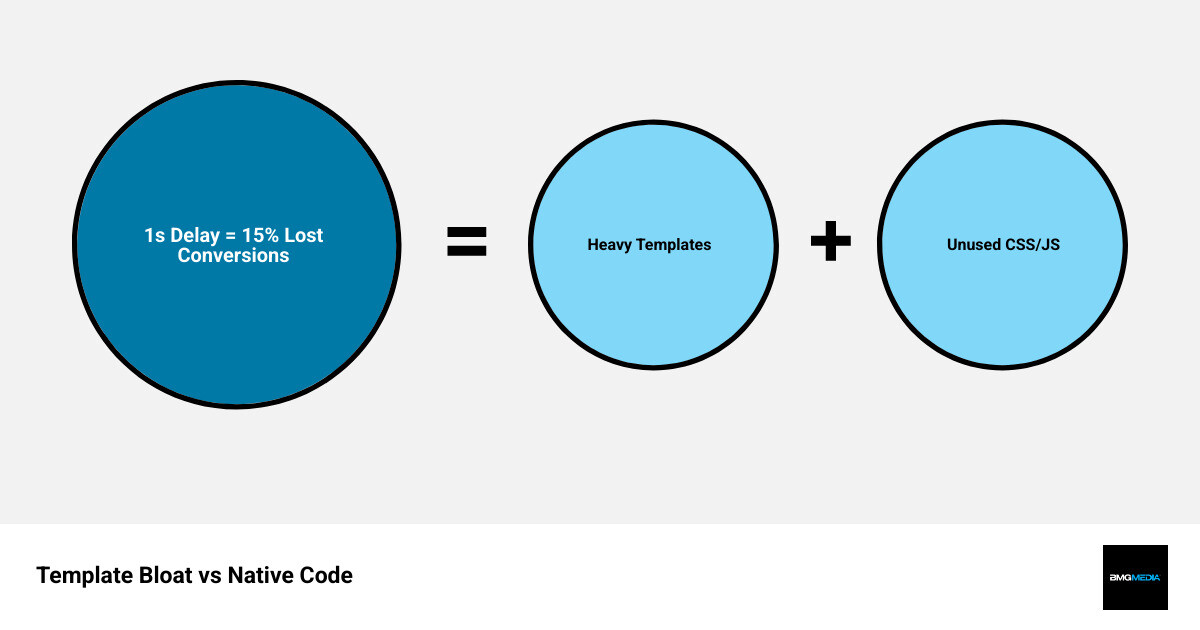
For business owners, this matters more than it sounds. A 1-second delay in page load speed can cost you 15% of your conversions. Template sites carry that risk by default.
Modern templates — even “minimal” ones — tend to ship with Bootstrap, heavy JavaScript libraries, and CSS you’ll never use. The result is slower load times, messier code, and a site that’s harder to rank and harder to trust.
Building without a template sidesteps all of that. You get a site that’s fast, clean, and built exactly for your goals — nothing more, nothing less.
I’m Blake George, founder of BMG MEDIA, and over the past 15+ years I’ve built more than 1,000 custom websites using a no template website design approach for clients across real estate, healthcare, manufacturing, and beyond. In this guide, I’ll walk you through exactly how to do it yourself.
No template website design terms to remember:
When we talk about no template website design, we are talking about returning to the fundamentals of the web. It is the practice of using native web code—pure HTML, CSS, and JavaScript—to build a digital experience from the ground up. When most sites are “assembled” using pre-made blocks or themes that look like everyone else’s, this approach is a breath of fresh air.
Think of a template like a pre-packaged frozen dinner. It’s quick, it’s easy, and it gets the job done, but you can’t easily change the ingredients if you have an allergy or a specific taste. A Custom Web Design is like a five-course meal prepared by a chef in Birmingham, Michigan. Every ingredient is chosen for a reason, and there is absolutely zero filler.
The core of this philosophy is often reflected in movements like the HTML Only Manifesto, which argues that modern web standards should serve people, not frameworks. By focusing on code quality and native functionality, we eliminate “div soup”—that messy, nested code that builders often generate—and replace it with lean, semantic markup.
When you opt for Custom Web Design and Development Services, you gain full ownership. You aren’t “renting” your design from a theme developer who might stop updating their code next year. You own every line, every asset, and every interaction. This framework-free approach ensures that your site isn’t just a “shiny toy,” but a high-performance business tool.
Performance isn’t just a technical metric; it’s a business requirement. If your site takes longer to load than a Lord of the Rings extended edition marathon, your users will leave. Research shows that sites built with native code can achieve 100/100 performance scores on both desktop and mobile devices.
The secret lies in the lack of “bloat.” Most templates load massive CSS and JavaScript files just to display a simple button. In a no template website design, we only ship the code that is actually used.
| Metric | Typical Template Site | Custom Native Code |
|---|---|---|
| Google PageSpeed Score | 40-60 (Mobile) | 90-100 (Mobile) |
| JavaScript Weight | 250kb+ | < 10kb |
| Uptime Guarantee | Varies by host | 99.99% (on AWS) |
| Time to Interactive | 3.5 seconds | < 1 second |
Scientific research on page load impact confirms that speed is the number one factor in user retention. By utilizing Web Design Services that prioritize native code, you ensure that your site is lightweight and lightning-fast.
One of the biggest myths is that you need a framework like Bootstrap or Tailwind to make a site responsive. In reality, modern CSS features like Grid and Flexbox make it easier than ever to build fluid layouts without the extra weight.
When we look at our Portfolio, you’ll see sites that adapt perfectly to every screen size. We use a mobile-first approach, defining breakpoints that make sense for the content, not just for specific devices. This ensures a user-focused design where the layout shifts gracefully from a smartphone to a 4K monitor. Because we aren’t fighting against a template’s pre-defined grid, we have the freedom to create unique, asymmetrical, or overlapping designs that still function flawlessly.
SEO is about more than just keywords; it’s about how search engines perceive the structure and speed of your site. Clean, semantic HTML is like a well-organized map for Google’s crawlers.
When you check our Blog, you’ll see we often discuss how custom redesigns lead to dramatic growth in organic keywords and referring domains. In fact, websites built with a focus on optimization frequently achieve Google Optimization scores of 90/100 or higher.
Without the “junk markup” often found in themes, your content takes center stage. This leads to:
Building without templates doesn’t mean you have to write every single character from scratch every time. We use smart tools that help us maintain speed and quality without introducing bloat.
One of our favorite methodologies involves Static Site Generators (SSGs) like Eleventy. Eleventy is fantastic because it’s “corporate-free”—it doesn’t force you into a specific ecosystem or framework. It simply takes your content and turns it into fast, static HTML files.
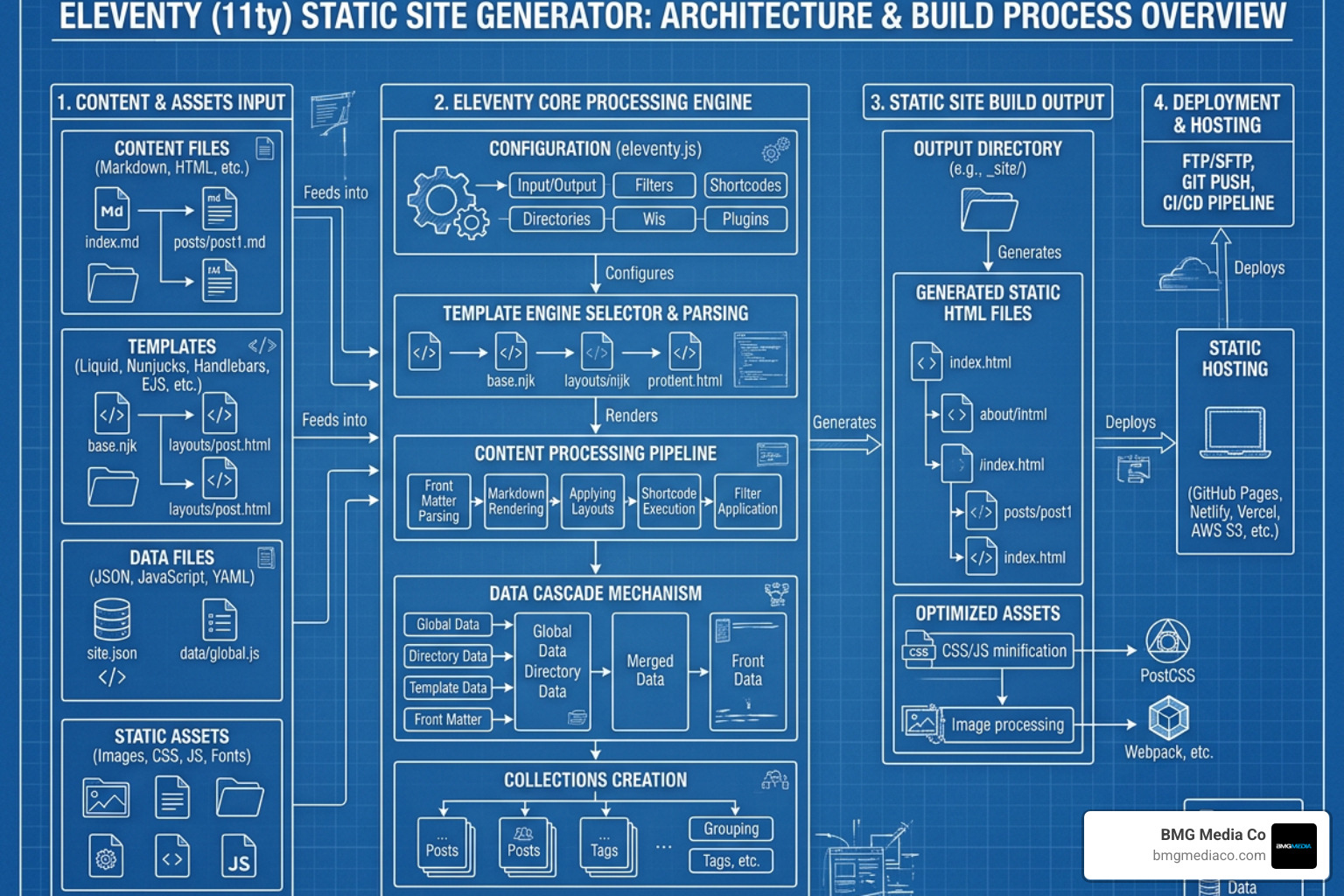
To get up to speed quickly, we often use starter projects like ZeroPoint. ZeroPoint is designed to be a “zero-bloat” foundation. It uses native web code and allows for:
By combining these Custom Web Design and Development Services, we build sites that are as easy to manage as a template but as powerful as a custom-coded application.
If you’re ready to get your hands dirty, here is the basic workflow for building a custom, no-template blog.
npm install and npm dev to get your local server running.Organize Your Folders: A clean site starts with a clean folder structure.
Configure Navigation: Instead of a clunky CMS menu, you can manage your site structure in a simple navigation.json file. It’s fast, version-controlled, and impossible to “break” by clicking the wrong button in an admin panel.
At BMG MEDIA, we believe in transparency. You can learn more About our philosophy of full code ownership and why we choose these high-performance deployment paths for our clients.
To maintain a no template website design, you generally need a solid understanding of HTML5, CSS (including variables and modern layout techniques), and basic JavaScript. You don’t need to be a computer scientist, but you should be comfortable using developer tools and version control (like Git). If you can handle those, the maintenance requirements are actually much lower than a template site because you don’t have to worry about “breaking” updates from third-party theme developers.
Absolutely! We often implement “Headless CMS” solutions. This means the content is managed in a user-friendly interface, but the “head” (the part of the website the user sees) remains fully custom and template-free. You can even use CSV imports for large data collections, making it easy to manage thousands of blog posts or product listings without sacrificing speed. If you’re curious how this would work for your specific project, request a Free Quote.
This is where the “no template” approach truly shines. Templates often use generic tags like for everything, which confuses screen readers. By writing your own code, you can use semantic tags like , , and
Building a website without templates is a commitment to quality, speed, and long-term results. While it requires more thought upfront than clicking “install” on a pre-made theme, the payoff is a digital asset that grows with your business and outperforms the competition.
At BMG Media Co, we’ve spent years perfecting this craft. Based in Birmingham, Michigan, our team has completed over 1,000 sites, each one a unique, high-performance solution designed to drive real business growth. We don’t do “div soup,” and we don’t do bloat. We build the web the way it was meant to be: fast, accessible, and entirely yours.
If you’re tired of fighting with templates and ready for a site that actually delivers, we’re here to help. Contact us today to discuss your project, or build your high-performance custom solution today by partnering with a team that knows the value of native code.
