June 2026
When we sit down with founders to brainstorm a new company names idea, we don’t just look for words that sound cool. We look at brand psychology. A truly great name acts as a cognitive shortcut in the customer’s mind. It takes complex ideas—your values, your product quality, and your vibe—and compresses them into a single, memorable word or phrase.
To achieve this, we rely on a psychological concept called cognitive fluency. This is the ease with which our brains process information. Names that are easy to pronounce, spell, and recall feel instantly more trustworthy to consumers. Think of how rhyming names or alliterative phrasing (like BarkHaus or MopStars) naturally stick in your head. Using idioms or familiar phrases also builds subconscious trust because the brain already has a positive association with those patterns.
A successful brand name must also reflect your core values, target audience, and unique selling proposition (USP) without being overly literal. When you are choosing a business name, you are setting the foundation for your entire brand identity. If your name is too abstract, you will spend a fortune in marketing just explaining what you do. If it is too literal, you limit your growth. Working with a top branding company can help you navigate this delicate balance, ensuring your name has character, depth, and immediate market appeal.
Your name is the very first piece of your brand promise. It is the handshake before the conversation even begins. When a name successfully incorporates your company’s mission and culture, it builds an emotional connection that fosters long-term customer trust.
For example, a travel brand named Intrepid immediately signals fearless adventure and exploration. However, a word of caution: names that explicitly reflect core values (like Honest or EcoPure) place your business under extra public scrutiny. If you put your values in your name, you must live up to them in every single customer interaction.
In our hyper-connected digital world, your local business can scale globally overnight. That is why linguistic and cultural testing is a non-negotiable step in the naming process.
Before you finalize any company names idea, check its meaning, slang associations, and ease of pronunciation in other languages. A name that sounds sleek and modern in English might translate to something offensive, embarrassing, or completely unpronounceable in Spanish, Mandarin, or German. Keep the phonetic spelling simple so that users worldwide can say your name out loud without hesitation.
As we navigate the business landscape of 2026, we are seeing a massive shift in how startups approach naming. Historically, businesses often chose longer, descriptive names to explain exactly what they did. Today, the trend has swung heavily toward short, branded names.
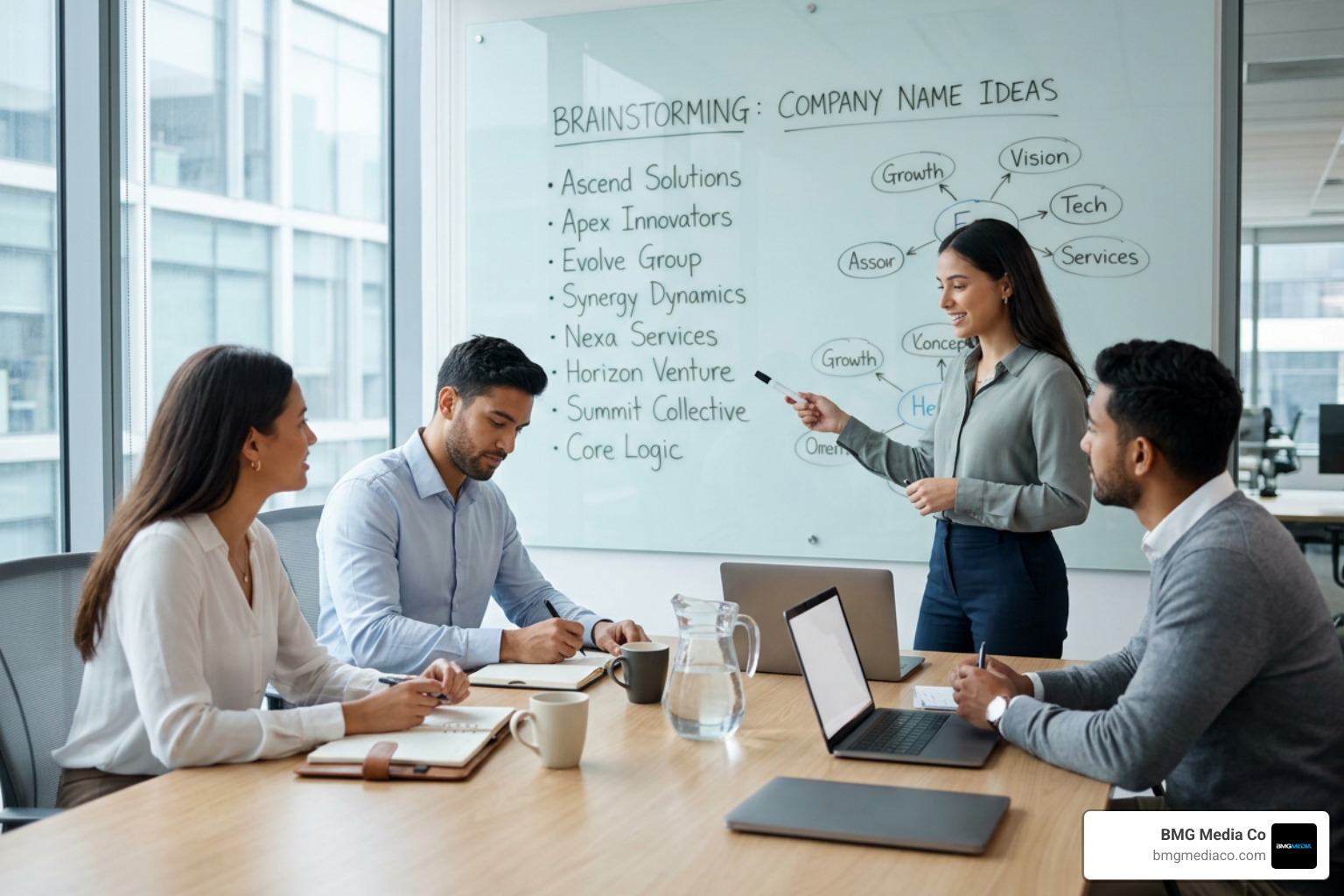
There are two major reasons for this shift:
.com domains are incredibly expensive and often entirely unavailable. To help you evaluate your options, let’s look at the six primary styles of company names:
While descriptive names tell customers exactly what you do on day one, short branded names give your business room to grow, pivot, and expand into new markets without ever needing a costly rebrand.
With the explosion of generative AI, founders have more tools than ever to brainstorm a company names idea. But how do these tools stack up against each other, and more importantly, how do they compare to human-driven branding?
Let’s look at the most popular AI-powered tools on the market today:
.com is taken. You can explore more categorized inspiration through their guide on Small business name ideas: 255+ brand or company names – Wix.com.While AI is incredible for breaking through writer’s block and generating hundreds of raw ideas in seconds, it lacks human intuition, cultural nuance, and strategic depth. Here is how automated tools compare to a professional branding agency:
| Feature / Capability | AI Naming Tools | Professional Branding Agencies |
|---|---|---|
| Generation Speed | Instant (seconds) | Strategic (weeks) |
| Volume of Ideas | High (hundreds of variations) | Curated (handful of highly vetted options) |
| Trademark Verification | Basic automated screening | Comprehensive legal risk assessment |
| Cultural & Linguistic Checks | Limited or none | Multi-market native speaker testing |
| Brand Strategy Alignment | Surface-level keyword matching | Deep alignment with business goals & USP |
| Custom Visual Identity | Template-based logo generation | 100% custom, hand-crafted branding |
Different industries demand entirely different naming languages. What works beautifully for a cutting-edge SaaS platform will fall completely flat for a high-end boutique or a local consulting firm.
.io, .ai, or .dev to keep the brand name clean.Once you have shortlisted your favorite company names idea, the real work begins. You must verify that the name is legally and digitally available before you spend a single dollar on logos, business cards, or web development.

Never assume a name is available just because a quick Google search doesn’t show an active website. Use domain registrars to check availability in real time. If your exact .com is taken, look at alternative extensions, but be careful not to choose a name so close to an existing brand that it causes confusion.
Consistency across your digital touchpoints is vital. Your social media handles should ideally match your domain name exactly. Keep handles under 15 characters, easy to type on a mobile device, and free of confusing underscores, hyphens, or random numbers.
This is where many founders make a devastating mistake. Registering a domain does not mean you own the trademark. You must search the United States Patent and Trademark Office (USPTO) Trademark Electronic Search System (TESS) database to ensure you aren’t infringing on an active trademark.
If you plan to register as an LLC or corporation, check your state’s business registry. For example, if you are establishing a business in Michigan, you must ensure your name is unique within the state database.
Depending on your specific location, you will want to leverage local resources and chambers of commerce to ensure local compliance and build your regional network:
Securing your legal foundation is just step one. To translate that name into a high-converting digital platform, you need experienced developers who understand how to integrate your brand identity with custom software. That is where our team of Top Professional Branding Services Michigan and Software Integration Experts can help you transition seamlessly from a registered name to a fully customized, high-performance website.
We have helped hundreds of businesses navigate the digital space, and we have seen our fair share of naming disasters. Here are the most common pitfalls to avoid when developing your company names idea:
If you find yourself stuck or want to ensure you aren’t making a critical error, it is highly beneficial to learn all about business naming companies and how their professional frameworks can save you thousands of dollars in future rebranding costs.
To check if a name is taken, start with a thorough Google search to see if any active businesses are using it. Next, search the USPTO TESS database for active federal trademarks in your industry. Finally, check your state’s corporate filing database (such as the Michigan LARA database for local businesses) and run a real-time domain search to see if the .com is registered.
Using your personal name (e.g., George Consulting) is excellent for building a highly personable, trust-based brand. However, it can limit the scalability of your business. If you ever plan to sell the company, step back from daily operations, or bring on partners, a neutral, branded name is much easier to transition than a personal brand.
Yes, you can absolutely rebrand later, but it comes with a cost. Rebranding requires updating all legal filings, purchasing new domains, redirecting old web traffic, redesigning your visual assets, and rebuilding search engine equity. While common, it is always more cost-effective to invest time in choosing the right name from the very beginning.
At BMG Media Co., we believe that your brand is more than just a logo, a tagline, or a clever company names idea—it is the entire experience your customers have with your business.
Headquartered in Birmingham, Michigan, we have spent over 15 years helping businesses across Metro Detroit and nationwide build powerful, unforgettable digital presences. Our non-negotiable core philosophy is simple: every website we build is 100% custom, designed from scratch, with no templates, no page builders, and no shortcuts. We take your brand name and turn it into a high-performance, conversion-engineered digital platform that matches your exact growth goals.
If you are ready to take your business to the next level with a brand identity and a custom web build that stands out in a crowded market, explore our guide on how to pick the best naming companies for your next big idea or reach out to us today to start crafting your digital future.
