August 2026
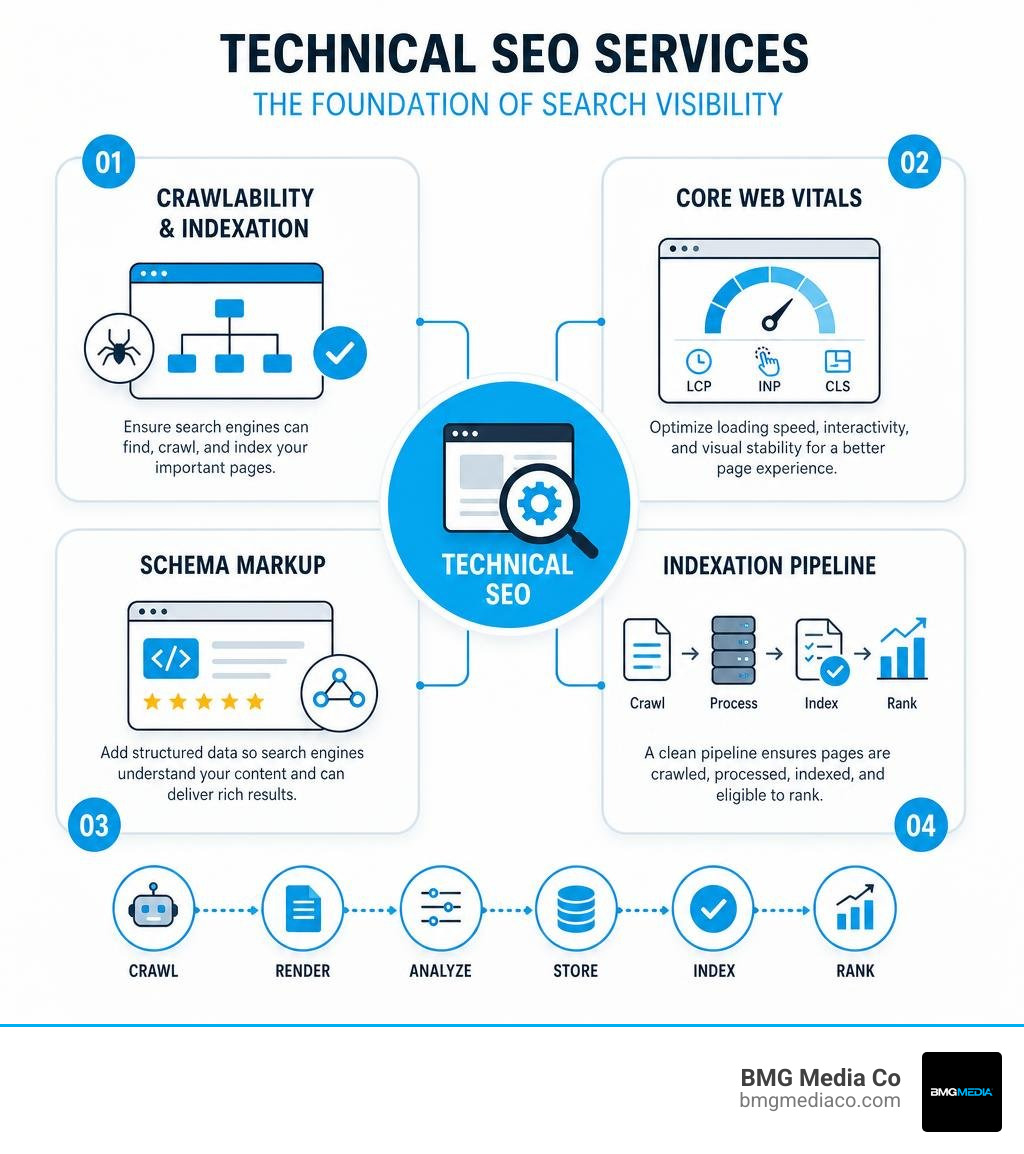
Technical SEO services are the process of optimizing your website’s backend infrastructure — crawlability, indexation, page speed, structured data, and site architecture — so search engines can efficiently find, understand, and rank your pages.
If you’re looking for a quick answer, here’s what technical SEO services typically cover:
| Service | What It Does |
|---|---|
| Crawlability & Indexation | Ensures search engines can find and index every important page |
| Core Web Vitals | Optimizes LCP, INP, and CLS for speed and page experience |
| Schema & Structured Data | Helps search engines understand your content and earn rich results |
| Site Architecture | Organizes pages and internal links for efficient crawl paths |
| Mobile Optimization | Ensures your site performs for the 61.95% of traffic coming from mobile users |
| XML Sitemaps & Robots.txt | Directs crawlers to the right pages and blocks wasted crawl budget |
| HTTPS Security | Signals trust to both users and search engines |
| Page Speed Optimization | A 1-second delay in load time reduces conversions by 7% |
Most businesses invest heavily in content and design — then wonder why they’re not ranking. The answer is almost always underneath: technical problems quietly blocking search engines from doing their job.
A slow page, a broken redirect, a misconfigured robots.txt file — none of these are visible to a casual visitor. But they are very visible to Google. And they cost you rankings, traffic, and revenue every single day they go unfixed.
I’m Blake George, founder of BMG Media Co., and over 15+ years building 1,000+ custom websites across industries from healthcare to real estate, I’ve seen how technical SEO services can unlock dramatic ranking improvements that no amount of content or backlinks alone can achieve. Whether you’re running a custom WordPress build, a headless architecture, or a large-scale e-commerce platform, the principles in this guide will show you exactly what needs to be fixed — and why it matters.
To understand why technical SEO services are so critical, you have to look at how search engines actually work. Google does not see your website the way a human does. It does not marvel at your beautiful hero images or read your copy with emotional resonance.
Instead, search engine algorithms rely on automated bots (often called spiders or crawlers) to scan your backend infrastructure, parse your code, and determine how your pages fit into the global web index.
If your site’s technical foundation is broken, search engine bots will struggle to crawl your pages. If they cannot crawl your pages, they cannot index them. And if they cannot index them, your site simply does not exist in search results. It is the digital equivalent of building a gorgeous, state-of-the-art retail store but locking the front door and turning off the streetlights.
By optimizing your crawlability, indexability, and overall site health, you remove the artificial barriers that prevent your content from ranking. Technical SEO is the engine room of organic growth; without a finely tuned motor, even the most beautifully designed vehicle will not move.
We like to think of search engine optimization as a three-legged stool. If any one of these legs is missing or weak, the whole structure collapses.
Here is a quick comparison to help you visualize how these disciplines work together:
| SEO Pillar | Primary Focus | Key Elements | BMG Media Co. Approach |
|---|---|---|---|
| Technical SEO | Infrastructure & Crawlability | Page speed, Core Web Vitals, schema markup, HTTPS, XML sitemaps, robots.txt | Hand-crafted clean code, 100% custom builds, zero page-builder bloat, zero shortcuts |
| On-Page SEO | Content & Keyword Optimization | Keyword mapping, metadata, content depth, internal linking, image alt text | SEO-driven copy integrated directly into custom-designed layouts |
| Off-Page SEO | Authority & Trust Building | Backlinks, digital PR, brand mentions, Google Business Profile management | Strategic outreach and localized visibility optimization |
If you want to dive deeper into how we blend high-performance development with organic visibility, you can learn more about advanced web optimization to see how a custom codebase changes the game.
As we navigate through June 2026, the search landscape has shifted dramatically. Traditional organic blue links are no longer the only game in town. Today, Google’s AI Overviews, Gemini SGE (Search Generative Experience), and alternative conversational engines like ChatGPT and Perplexity are changing how users find information.
This evolution has birthed a new discipline: Generative Engine Optimization (GEO).
AI search engines do not just index pages; they synthesize answers. To be cited as a trusted source in an AI Overview, your website must be incredibly easy for large language models (LLMs) to crawl, parse, and verify. This is where modern technical SEO services become your secret weapon.
AI agents prioritize sites that render instantly, use precise structured data to define entity signals, and maintain clean, semantic code. Furthermore, forward-thinking technical setups in 2026 now include optimized llms.txt files to guide AI agents on how to read and attribute your content. If your technical foundation is messy, AI search engines will bypass your site entirely in favor of cleaner, faster competitors.
When you partner with a premium provider for technical SEO services, you are not just getting a generic checklist. You are investing in a comprehensive overhaul of your site’s digital performance.
Let’s look at the core pillars that keep your website healthy, secure, and highly visible.
Page speed is no longer just a luxury; it is a direct ranking factor and a critical pillar of user experience. The statistics are unforgiving: a 1-second delay in page load time can reduce conversions by 7%.
Google measures this performance through Core Web Vitals, a set of three specific metrics that evaluate real-world user experience:
At BMG Media Co., we do not believe in band-aid solutions like heavy optimization plugins that try to mask poor coding. Because we build every single website 100% custom from scratch — with no Elementor, Divi, or pre-made templates — we eliminate the bloated code that tanks speed in the first place.
We profile real-user data using Chrome User Experience Reports (CrUX) and implement advanced performance budgets, image compression (using modern formats like WebP), minification, and server-side caching. If you want to see how we tackle this under the hood, you can discover Core Web Vitals optimization strategies designed for high-performance sites.
With 61.95% of all global web traffic coming from mobile users, Google has long operated on a mobile-first indexing model. This means Googlebot crawls and indexes the mobile version of your website to determine its search rankings.
If your mobile site has missing content, slow load times, or a frustrating user interface, your desktop rankings will suffer too. Responsive design is not just about shrinking your desktop layout to fit a smaller screen; it requires careful viewport configurations, mobile-optimized call-to-actions, and touch-target sizing.
To ensure your mobile experience is flawless, you can read our guide on mobile-first web design to see how we engineer seamless mobile responsiveness.
Think of schema markup as a translator for search engines. Written in JSON-LD format, structured data provides explicit clues about the meaning of a page to search engine crawlers.
By implementing schema, you can earn rich snippets in search results — such as star ratings, product pricing, event dates, and FAQ dropdowns. These rich results dramatically increase your click-through rates (CTR).
Common schema types we implement include:
Before you can fix the foundation, you have to know where the cracks are. A professional technical SEO audit is not a simple automated export from a free tool; it is a meticulous, diagnostic examination of your entire digital ecosystem.
Search engines do not have infinite resources. Google allocates a specific “crawl budget” to your website — the maximum number of pages Googlebot will crawl within a given timeframe.
If your site is plagued by crawl waste, Google may leave your most valuable, revenue-generating pages uncrawled and unindexed. Crawl waste is commonly caused by:
By performing deep log file analysis, we can see exactly how search engine bots behave on your server. We validate your XML sitemaps, optimize your robots.txt file to block unimportant directories, and ensure that every byte of your crawl budget is spent on pages that drive business results.
When you invest in professional technical SEO services, you should expect more than just a PDF report containing a list of errors. An audit is just a document; real value comes from shipping the actual fixes directly into your codebase.
A premium engagement includes:
If you are looking for verified, top-tier agencies in our home state, you can find top-rated local experts on the Semrush Michigan Technical SEO Agency List to see how we stack up.
We hear a lot of the same questions from business owners, CTOs, and marketing directors. Here are the straight answers to the most common queries.
The most frequent culprits we resolve during our audits include:
While content and link building are slow, compounding games, technical SEO fixes can often yield rapid results. For most websites, resolving critical crawl errors, cleaning up sitemaps, and improving page speed can show measurable ranking and traffic improvements within 4 to 8 weeks.
Larger, more complex enterprise or e-commerce sites with significant crawl issues may take 3 to 6 months to realize their full potential as Google re-crawls and re-evaluates the massive volume of pages.
Yes, and this is a very common scenario. General web developers are incredible at building functional, visually appealing websites, but they are rarely trained in the nuances of search engine algorithms, log file analysis, or schema architecture.
A technical SEO specialist bridges the gap by translating search engine requirements into clear, scoped engineering tickets. We collaborate directly with your development team — or handle the codebase execution ourselves — to ensure that your custom stack is optimized for maximum organic performance.
If you want to understand how development and SEO merge, you can explore the developer’s guide to SEO-driven web apps for an in-depth look.
At the end of the day, your website’s search visibility is only as strong as its technical foundation. You can write the most brilliant copy in the world and design a stunning user interface, but if search engine crawlers struggle to navigate your site, your investment is wasted.
At BMG Media Co., we believe in doing things the right way. Based in Birmingham, Michigan, we have spent more than 15 years crafting high-performance, 100% custom web solutions for brands across the country. We do not use templates, we do not use bloated page builders, and we never take shortcuts. Every line of code we write is optimized for speed, security, and search engine visibility.
If you are ready to stop guessing and start growing, you can find Birmingham experts on the Semrush Directory of Birmingham Technical SEO Companies to see our local standing.
Even better, let’s take a look under the hood of your current site. Get your site audited with BMG Media Co.’s SEO Technical Audit Services today, and let’s unlock the true organic potential of your brand.


