
May 2026
The Developer’s Guide to SEO Driven Web Apps
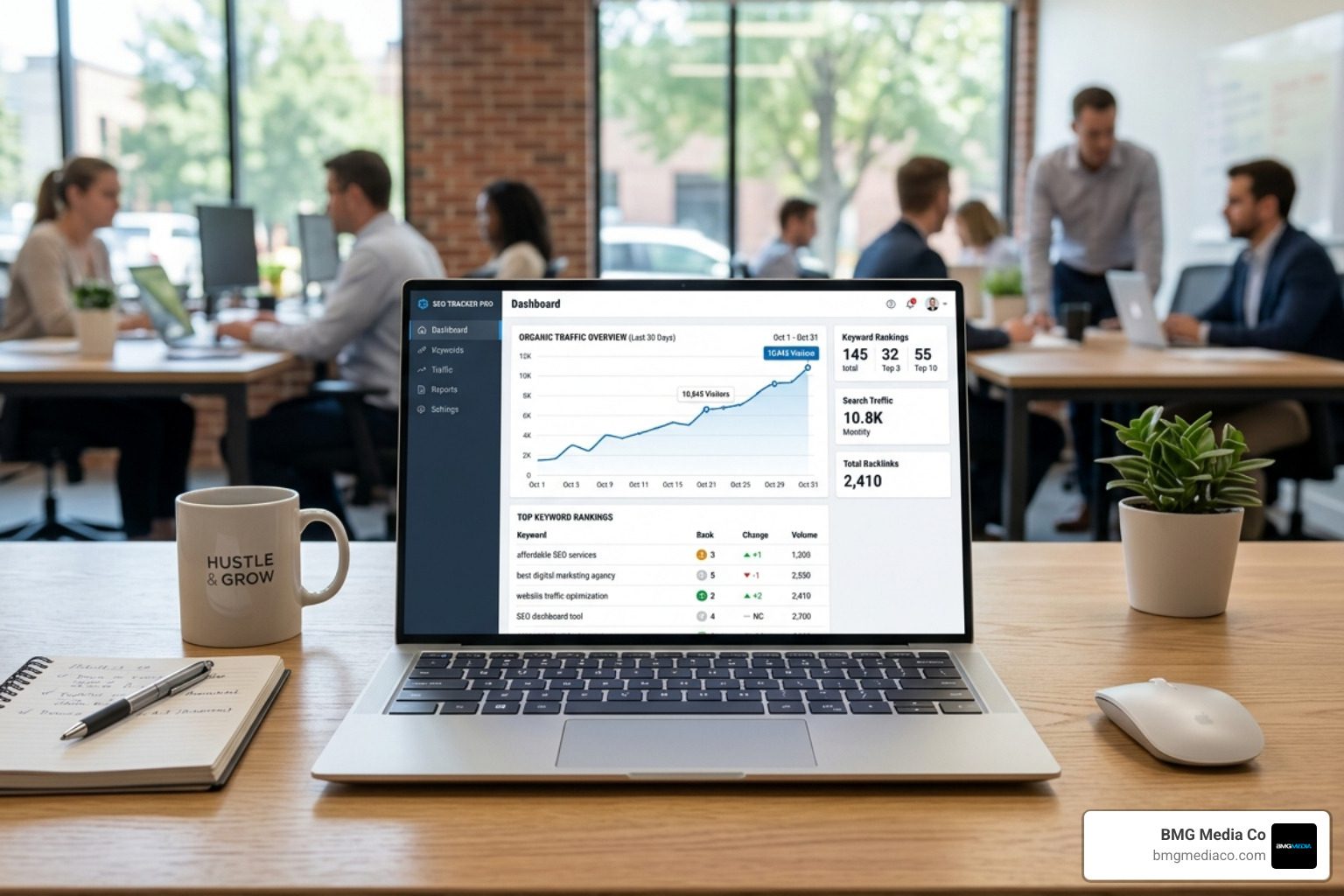
Why Your Web App Is Invisible to Search Engines (And How to Fix It)
SEO driven web apps are web applications built from the ground up with search engine visibility as a core requirement — not an afterthought.
Here’s what that means in practice:
| Element | Traditional Web App | SEO Driven Web App |
|---|---|---|
| Rendering | Client-side (JavaScript) | Server-side or hybrid |
| Crawlability | Often blocked or delayed | Fully accessible to bots |
| Meta tags | Static or missing | Dynamic, page-specific |
| URLs | Hash-based or generic | Keyword-rich slugs |
| Core Web Vitals | Rarely optimized | Actively monitored |
| AI search visibility | Invisible to most LLMs | Structured for citation |
The stakes are real. Research shows 95% of searchers never leave page one of Google — and 75% click only the top three results. If your web app isn’t built to be found, it simply won’t be.
Modern web apps — especially single-page applications (SPAs) built with React, Angular, or .NET — create a serious problem: search engines and AI crawlers often can’t read what’s on the screen. That’s because the content only exists after JavaScript runs in the browser. Googlebot handles this with a delayed second-pass rendering process, but many AI crawlers like those from OpenAI and Perplexity don’t execute JavaScript at all. That means up to 50–80% of your SPA’s content may be completely invisible to AI-powered search results.
Speed makes it worse. 40% of visitors abandon a site that takes more than 3 seconds to load — and 80% of those visitors never come back. A slow, un-crawlable app doesn’t just rank poorly. It loses customers at every stage of the funnel.
This guide walks through exactly how to fix that — from rendering strategies and Core Web Vitals to schema markup, sitemap automation, and AI search optimization.
I’m Blake George, founder of BMG Media Co, a nationally recognized web design and development agency based in Birmingham, Michigan, where I’ve spent over a decade helping companies build SEO driven web apps that rank, convert, and scale. Over the course of developing more than 1,000 custom digital platforms across healthcare, real estate, manufacturing, and consumer brands, I’ve seen how the right technical architecture separates invisible apps from market leaders.
Glossary for seo driven web apps:
Why Modern Architecture Demands SEO Driven Web Apps
In the early days of the web, every click triggered a full page reload. It was slow for users but great for search engines because every page was a static HTML file ready to be indexed. Today, modern architecture favors Single-Page Applications (SPAs) that offer fluid, app-like experiences. However, this shift has introduced a “technical wall” where content is often locked behind JavaScript execution.
If we want to build the highest converting websites, we have to balance this interactivity with crawlability. Search engines operate on a “crawl budget”—the amount of time and resources they are willing to spend on your site. When an app relies heavily on client-side rendering, the bot has to wait for JavaScript to load, execute, and fetch data. This inefficiency means fewer pages get indexed, and your content might stay hidden for weeks. To bridge this gap, developers must follow a SEO Web Developer Guide that treats search readiness as a core engineering metric.
Overcoming the Technical Wall of Single-Page Applications (SPAs)
SPAs are notorious for SEO challenges. Because they load a single HTML shell and update content dynamically via AJAX calls, they often lack the distinct physical pages that crawlers expect. Without proper intervention, a crawler might see nothing but a blank tag where your content should be.
To turn these into seo driven web apps, we focus on three technical pillars:
- State Management: Ensuring that the “state” of the app (what the user sees) is reflected in the URL.
- History API: Using the browser’s History API to create clean, shareable URLs instead of “hash-bang” (#!) URLs that search engines dislike.
- DOM Rendering: Making sure the primary content is present in the initial rendered DOM so bots don’t have to guess what the page is about.
If your application feels “invisible” despite having great content, it’s likely time for a technical SEO audit to identify where the rendering pipeline is breaking.
Preparing SEO Driven Web Apps for AI Search and GEO
As we move through 2026, traditional search is being supplemented by Generative Engine Optimization (GEO). AI engines like ChatGPT, Claude, and Perplexity are becoming primary discovery tools. Unlike Googlebot, many of these AI crawlers do not execute JavaScript at all. If your app is 100% client-side, it essentially doesn’t exist to an LLM.
To optimize for AI search, we must:
- Allow AI Crawlers: Configure your
robots.txtto permit bots likeGPTBotandPerplexityBot. - Provide Structured Data: Use JSON-LD to tell the AI exactly what your app does, its pricing, and its features.
- Create Citation-Worthy Content: AI engines love “how-to” guides, FAQs, and clear data tables that they can easily cite as sources.
The Search Engine Crawling and Serving Process in 2026
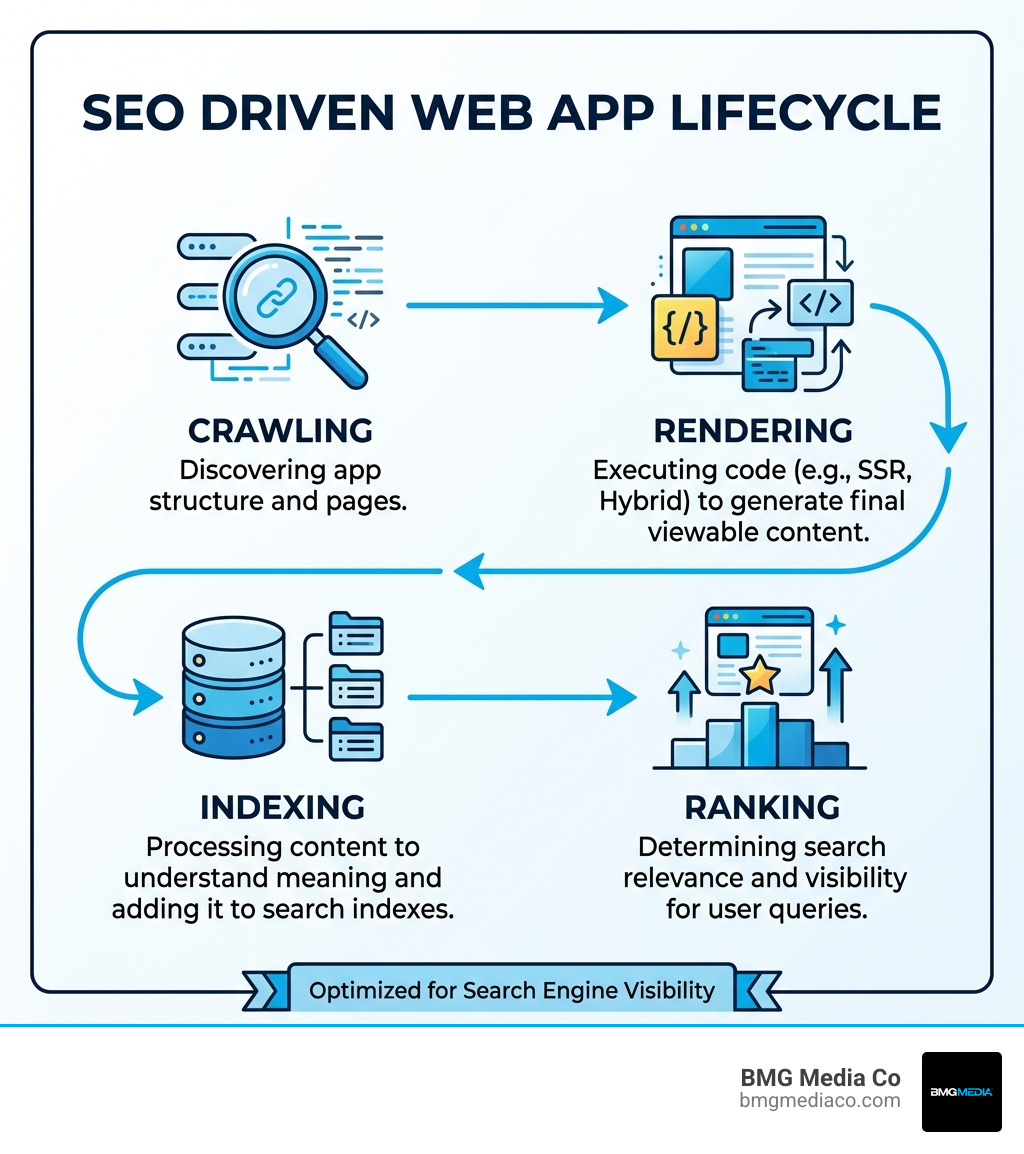
Google’s indexing process has become more sophisticated but also more selective. In 2026, the process generally follows a two-wave system:
- The Instant Wave: The bot fetches the HTML. If the content is there (via SSR or Pre-rendering), it is indexed immediately.
- The Delayed Wave: If the HTML is empty, the page is put in a queue for JavaScript rendering. This can take days or even weeks depending on your site’s authority.
By using the Metadata API to serve dynamic titles and descriptions instantly, we ensure that even if the full content takes a moment to process, the search engine at least knows the “who, what, and where” of the page.
Core Rendering Strategies for Search Visibility
Choosing a rendering strategy is the most important technical decision you’ll make for seo driven web apps. There is no one-size-fits-all approach, but the goal is always to get HTML to the crawler as fast as possible.
| Strategy | Search Friendliness | Performance (UX) | Best For |
|---|---|---|---|
| SSR (Server-Side) | Excellent | High (Fast Initial Load) | Dynamic data, e-commerce |
| SSG (Static Site) | Perfect | Fastest | Blogs, documentation, marketing |
| CSR (Client-Side) | Poor | High (Once Loaded) | Private dashboards, tools |
| ISR (Incremental) | Great | High | Large catalogs that update often |
When you pick a web app development framework, you are essentially choosing which of these strategies will be easiest to implement.
Implementing SSR and PPR in SEO Driven Web Apps
For enterprise-grade applications, we often lean into Server-Side Rendering (SSR). Frameworks like Next.js 15 and ASP.NET Core allow us to render the page on the server and send a fully formed HTML document to the user.
A newer, more advanced technique is Partial Prerendering (PPR). PPR allows us to keep a “static shell” (like your header and navigation) for instant loading while streaming in dynamic content (like a personalized user feed) as it becomes available. This ensures that the most important SEO elements are delivered in milliseconds, while the interactive parts of the app hydrate later. This hybrid approach is why choosing the right web app partner is vital—they need to understand these nuances to prevent your app from lagging in the SERPs.
Leveraging .NET and Python for Enterprise SEO
While JavaScript frameworks get a lot of the spotlight, backend powerhouses like .NET and Python provide unique advantages for seo driven web apps.
- .NET (ASP.NET Core): Microsoft’s framework is built for speed. It offers unmatched performance for web spiders and bots, allowing them to crawl large enterprise sites with minimal latency. It also provides robust tools for generating sitemaps and managing meta tags at scale.
- Python: Ideal for data-heavy applications. When building web applications with Python, developers can leverage powerful libraries to automate SEO tasks, such as analyzing content gaps or auto-generating alt text for thousands of images.
Technical SEO Implementation and Core Web Vitals
Google’s “Core Web Vitals” are no longer optional suggestions; they are critical ranking signals. If your app is fast but has a high “Cumulative Layout Shift” (where elements jump around as they load), your rankings will suffer.
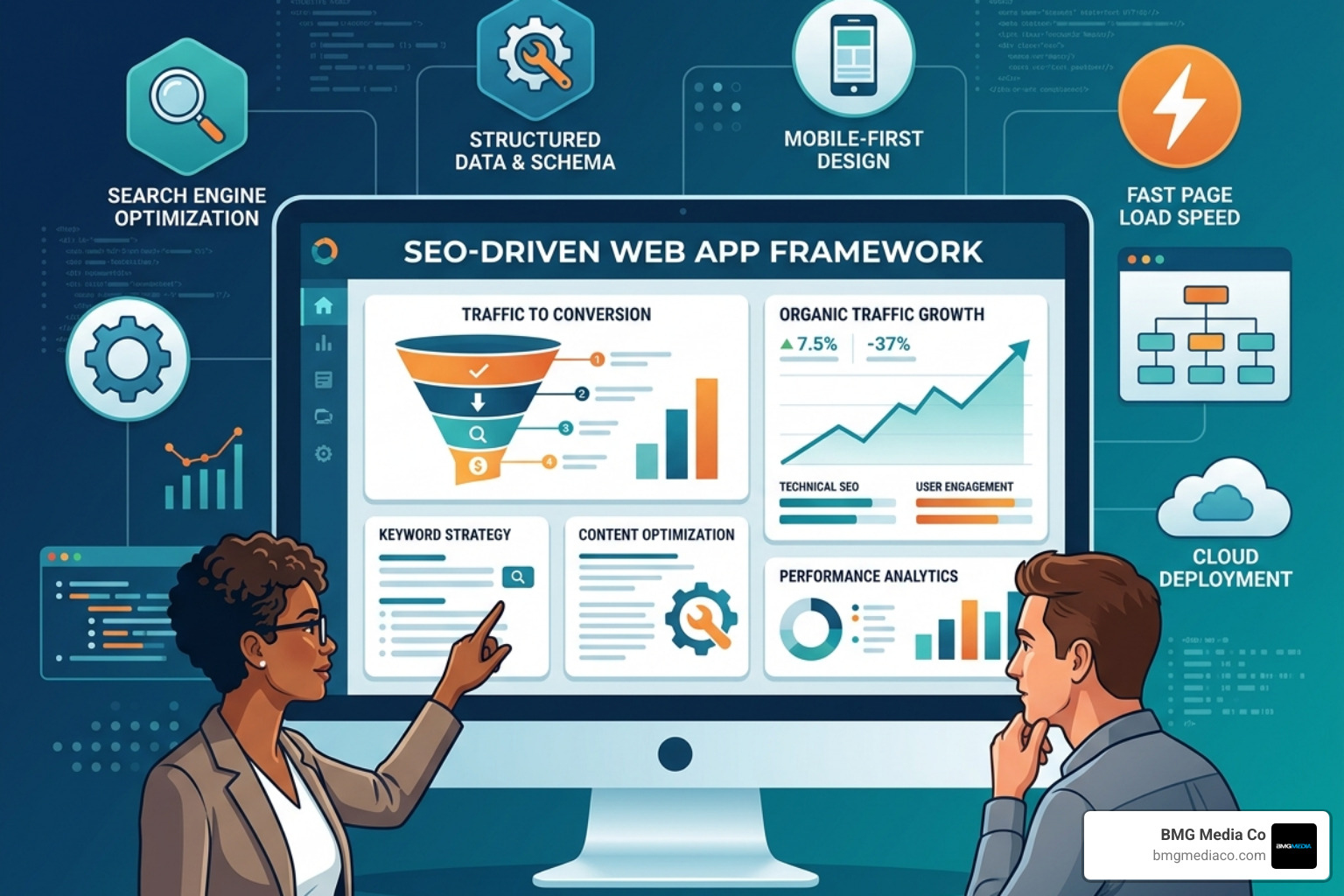
To stay in the “Green” zone for 2026, we target these benchmarks:
- LCP (Largest Contentful Paint): Under 2.5 seconds.
- INP (Interaction to Next Paint): Under 200 milliseconds.
- CLS (Cumulative Layout Shift): Under 0.1.
We often use tools like SeoSpider for bulk image compression and alt text optimization, which are essential for keeping page weights low and optimizing Core Web Vitals.
URL Structure and Internal Link Architecture
Search engines rank pages, not websites. This means every meaningful “view” in your web app needs a unique, crawlable URL.
- Avoid:
myapp.com/#/profile/123 - Use:
myapp.com/profile/john-doe
Using keyword-rich “slugs” instead of ID numbers helps both users and bots understand the content. Furthermore, implementing breadcrumbs improves navigation and creates a clear internal link hierarchy. This is a core part of responsive design, ensuring that the structure remains consistent whether a user is on a desktop or a smartphone.
Schema Markup and Automated Sitemaps
Structured data (Schema) is the language of the modern web. For seo driven web apps, we specifically use the SoftwareApplication schema. This tells Google your site isn’t just a document; it’s a tool with specific features, ratings, and pricing.
Automation is key here. For apps with thousands of dynamic pages, manual sitemaps are impossible. We recommend using SEO Automation tools to auto-generate XML sitemaps and handle auto-indexing for Next.js and other modern frameworks. This ensures that as soon as you publish a new page or product, search engines are notified within 24-48 hours.
Mobile-First Indexing and UX Signals
Since Google moved to mobile-first indexing, the mobile version of your web app is the version that determines your rank. It’s not enough for the app to be “responsive”—it must be optimized for mobile search intent.
This includes:
- Touch Targets: Ensuring buttons are large enough to be clicked easily.
- Font Size: Maintaining readability without zooming.
- Interactivity: Minimizing heavy scripts that drain mobile batteries or slow down the mobile search experience.
Frequently Asked Questions about Web App SEO
How does SEO for web apps differ from App Store Optimization (ASO)?
ASO is specifically for ranking within the Apple App Store or Google Play Store. SEO for web apps focuses on ranking in traditional search engines like Google and Bing. However, they are complementary. A well-optimized web landing page can drive organic traffic to your app store listing, often at a lower cost than paid ads. In fact, 40% of global users discover new apps via search engines.
Why is Interaction to Next Paint (INP) critical for web apps in 2026?
INP replaced First Input Delay (FID) as a core ranking signal because it measures the entire lifecycle of a user’s interaction, not just the first one. For highly interactive web apps, a poor INP (over 300ms) can lead to a 31% drop in rankings. It signals to Google that your app is “janky” or unresponsive, which hurts the user experience.
Can AI-generated content help my web app rank?
Yes, provided it offers real value. Google’s March 2024 update clarified that AI content is not penalized simply for being AI-generated. The focus is on E-E-A-T (Experience, Expertise, Authoritativeness, and Trustworthiness). Using AI to fill “content gaps” (like creating individual pages for every city you serve in Michigan) can be a powerful strategy when combined with human oversight.
Building the Future of Search-Ready Apps
At BMG Media Co, we don’t believe in templates or “good enough” SEO. Based in Birmingham, Michigan, our team specializes in building fully custom, high-performance seo driven web apps that are engineered to dominate the first page. Whether you are building a complex SaaS platform or a high-traffic e-commerce hub, your architecture is your destiny.
Don’t let your hard work go unnoticed by search engines. By implementing robust rendering strategies, monitoring performance, and staying ahead of AI search trends, you can turn your web application into a self-sustaining growth engine.
Ready to scale? Let’s build something that gets found.