August 2026

A magento integration expert is the difference between a store that runs on autopilot and one that quietly bleeds time, money, and data accuracy every single day.
Here’s what you need to know right away:
What a Magento integration expert does:
Why it matters for ERP sync specifically:
| Without an Expert | With an Expert |
|---|---|
| Manual data entry between systems | Automated, bi-directional data sync |
| Inventory mismatches and overselling | Real-time stock accuracy across channels |
| Hours lost weekly on reconciliation | Up to 15 hours saved per week on ERP reconciliation |
| Silent failures with no alerts | Monitoring, logging, and retry logic built in |
| Brittle connectors that break on updates | Resilient architecture designed to last |
Magento is one of the most powerful eCommerce platforms available — but it was never designed to work alone. It’s built to connect. The challenge is that connecting it correctly, especially to complex enterprise ERP systems like NetSuite, SAP, or Microsoft Dynamics, requires deep technical knowledge that goes far beyond installing a plugin.
Most integration failures don’t happen because the API is hard. They happen because the failure modes weren’t designed for — edge cases like partial orders, concurrent updates, and rate limits that only surface in production when real money is on the line.
I’m Blake George, founder of BMG Media Co., a custom web design and development agency that has built over 1,000 digital platforms for businesses ranging from startups to multi-billion-dollar enterprises — including complex API integrations and custom software solutions where being a magento integration expert is table stakes, not a bonus. In this guide, I’ll walk you through exactly how these integrations work, what can go wrong, and how to get them right.
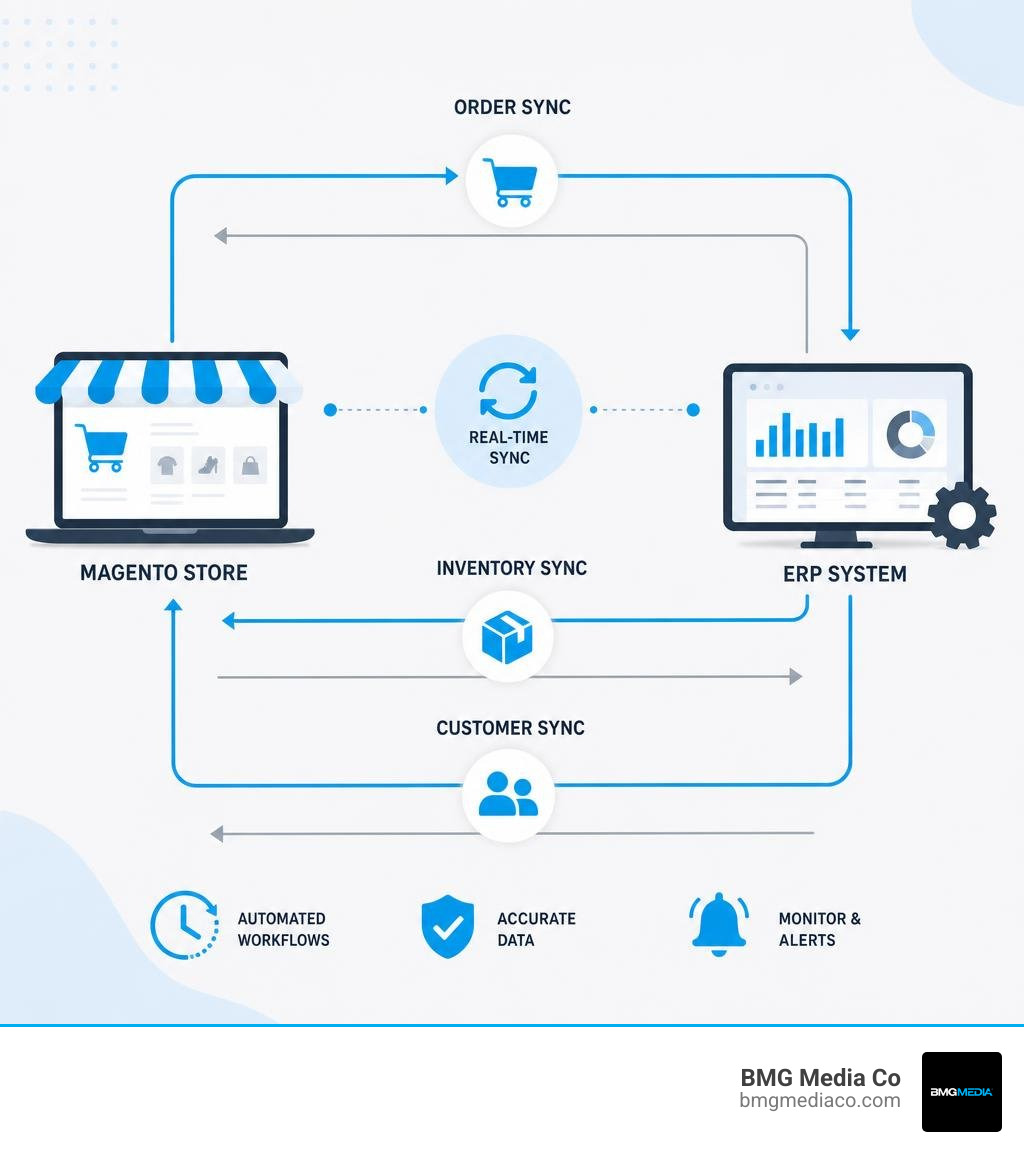

Enterprise growth demands automation. When your e-commerce operations scale, manual processes become an anchor dragging down your efficiency. If your team is still copy-pasting order details from your online storefront into your back-office billing systems, you are risking human error, delayed shipping, and poor customer reviews.
By working with a seasoned magento integration expert, you unlock the true potential of your e-commerce ecosystem. With a robust ERP integration, you can achieve a massive reduction in administrative overhead, including up to 15 hours saved weekly on reconciliation tasks. This allows your team to shift focus from manual data entry to strategic growth initiatives.
Furthermore, when systems communicate seamlessly, order processing times plummet. Integrating your shipping and logistics operations can lead to 27% faster order fulfillment, meaning your customers get their packages quicker, boosting overall customer satisfaction.
A true expert doesn’t just download a pre-built extension from the marketplace and hope for the best. They are architects of digital ecosystems. They understand Magento’s core architecture, its database schema, and how to safely leverage service contracts without modifying vendor code.
Whether they are designing custom database pipelines, writing custom API wrappers, or leveraging modern tools, they ensure that your integration is built to scale. A true expert brings deep knowledge of frontend performance alongside complex backend workflows, ensuring that data flows smoothly without degrading the user experience.
When you hire a specialized professional, they will map out your entire business logic. They determine which system owns which data (the “single source of truth”), establish rate-limiting protection, and build custom logic to handle unique business rules. This level of customization is exactly what we specialize in at BMG Media Co. through our Custom Software Development services.
The most dangerous integration errors are the ones you don’t see. A silent sync failure occurs when an API endpoint returns a success status code, but the payload fails to process correctly because of a formatting mismatch or an unhandled edge case.
For instance, if a customer applies a complex B2B volume discount that your ERP doesn’t recognize, the order might sit in a queue indefinitely without throwing a hard error. A magento integration expert prevents this by implementing:
By building resilient failure modes directly into the architecture, specialists ensure your system remains stable even when external APIs experience downtime.
To build a high-performing digital storefront, Magento must be connected to several key business tools. Each system plays a specific role in your operations:
For heavy-duty B2B and industrial operations, these connections are even more vital. You can learn more about how we structure these enterprise setups in our guide on E-commerce Website Development for the Industrial Sector.
There is no one-size-fits-all method for connecting Magento to your back-office software. The right choice depends on your transaction volume, real-time data needs, and budget.
| Method | Best For | Pros | Cons |
|---|---|---|---|
| Direct APIs (REST/GraphQL) | Real-time queries, mobile apps, custom frontends | High speed, modern standards, flexible data payloads | Requires custom development, can strain server if unoptimized |
| Middleware (iPaaS) | Complex multi-system environments (e.g., Celigo, Workato) | Centralized monitoring, visual mapping, offloads processing | Additional subscription costs, potential vendor lock-in |
| Native Connectors / Extensions | Simple, standard out-of-the-box setups | Quick deployment, lower upfront costs | Fails under complex business logic, hard to customize |
| Message Queues (RabbitMQ / Webhooks) | Asynchronous, high-volume event processing | Non-blocking, highly scalable, robust failure handling | Complex to configure and debug |
Choosing the right approach requires analyzing your current software stack and future scaling plans. For example, modern headless builds heavily rely on GraphQL, while legacy ERPs may still require SOAP protocols. For a deep dive into how to bridge these software gaps, check out The Missing Link: A Guide to Software Integration Web Apps.

Building an integration is only half the battle; maintaining it is where the real work begins. APIs are not static. External vendors frequently deprecate legacy endpoints, update security protocols, or change their data structures.
If your integration is not actively monitored, a routine update to your ERP or payment gateway can instantly break your checkout funnel. This is why continuous data validation, robust error logging, and routine security patching are non-negotiable.
Furthermore, as your catalog grows, database queries that once took milliseconds can slow to a crawl. Overlooking performance tuning can lead to slow page load speeds, which directly hurts your conversion rates. For specialized optimization tips, check out Custom Manufacturing Software Tips for Precision and Profit to see how we maintain high-speed data exchanges for complex backend systems.
Selecting the right integration approach and development partner will make or break your project. To ensure success, always begin with an in-depth discovery phase. A reputable partner will map out your existing workflows, document your API endpoints, and identify potential data bottlenecks before writing a single line of code.
When evaluating a partner, look for:
If you are currently evaluating potential agencies, our comprehensive resource, The Ultimate Guide to Picking a Web App Partner, outlines the exact questions you should ask to protect your investment.
Yes. While legacy ERP systems often lack modern REST or GraphQL APIs, a magento integration expert can bridge this gap by building custom middleware or API wrappers. This allows Magento to securely communicate with older systems using file transfers (such as CSV or XML via SFTP) or SOAP protocols, transforming manual legacy workflows into modern automated processes.
The timeline varies based on complexity. A straightforward integration using pre-built API connectors can take 4 to 6 weeks. However, highly customized enterprise integrations involving complex B2B pricing tiers, multi-warehouse inventory rules, and legacy databases typically take 3 to 6 months to safely design, test, and deploy.
The primary security risks include unauthorized data access, insecure API keys, and data leaks during transit. To mitigate these risks, ensure all integrations use strong encryption (HTTPS/TLS), implement strict OAuth or token-based authentication, limit API permissions to the bare minimum required, and regularly rotate access credentials.
A seamless ERP and Magento integration is the ultimate engine for modern e-commerce growth. By eliminating manual bottlenecks, securing your data flows, and ensuring real-time accuracy, you build a store that is ready to scale without breaking a sweat.
At BMG Media Co., we don’t believe in shortcuts. Headquartered in Birmingham, Michigan, we design and build 100% custom e-commerce platforms and API integrations from scratch. No bloated page builders, no unstable templates—just clean, high-performance code tailored to your exact business workflows.
Ready to eliminate silent sync failures and automate your operations? Explore our premium Custom Web Design and Development Services and let’s build an integration that actually lasts.
