May 2026
Best production website design in 2026 comes down to a handful of proven practices that separate high-converting sites from ones that get ignored.
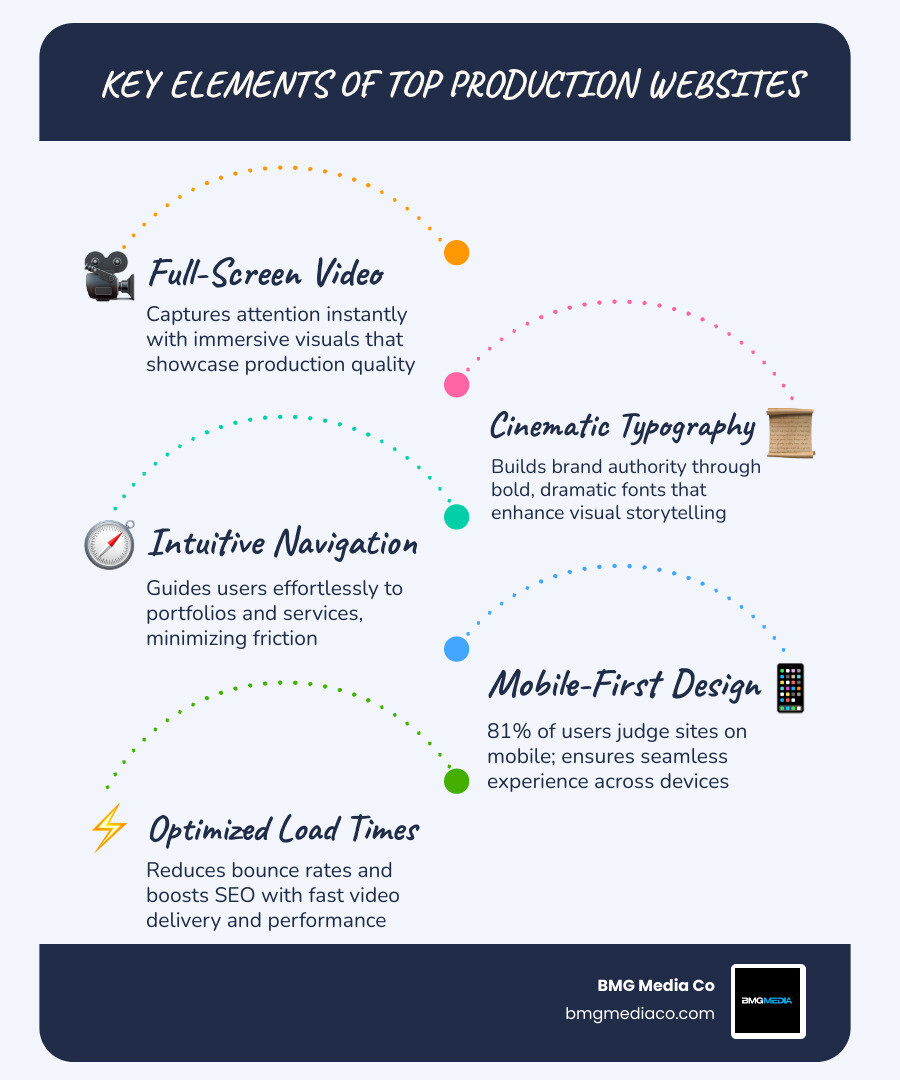
Here’s a quick snapshot of what the best production websites do right:
| Practice | Why It Matters |
|---|---|
| Full-screen video integration | Instantly communicates your work and capability |
| Bold, cinematic typography | Creates brand authority and visual impact |
| Minimal, intuitive navigation | Keeps visitors focused on your portfolio |
| Mobile-first design | 81% of people judge brands by their mobile experience |
| Fast load times with optimized video | Reduces bounce rate and improves Google rankings |
| Clear contact and service information | Converts visitors into leads |
| Scroll-triggered motion effects | Increases engagement and time on site |
Most production company websites fail at one or more of these. They load slowly, bury the portfolio, or look like a generic template from five years ago. That costs you real business — visitors leave, and they hire someone else.
The good news? These problems are fixable with the right approach to design, technology, and content strategy.
I’m Blake George, founder of BMG MEDIA, and over the past 15+ years building more than 1,000 custom websites, I’ve helped production companies and brands across multiple industries build what we consider the best production website for their specific goals. In this guide, I’ll walk you through exactly what it takes to make your site work harder for your business.
Best production website terms to remember:
When we talk about the best production website, we aren’t just talking about a digital business card. We are talking about an immersive, cinematic experience that mirrors the quality of the films, commercials, or industrial content you produce. In 2026, the bar for visual storytelling has never been higher.
One of the most effective ways to capture attention is through scroll-triggered motion effects. Unlike static sites, these designs react to the user’s input, creating a sense of life and momentum. As a user scrolls, elements might fade in, slide horizontally, or scale up. This isn’t just “eye candy”; it’s a way to guide the user’s eye toward your most important work.
Effective manufacturing website design often uses these same principles to explain complex processes. For a production company, this means using motion to transition between different project categories or to reveal behind-the-scenes glimpses of your set.
The best production website examples often move away from the “boring box” layouts. Instead, they embrace asymmetry and bold, striking typography. Large, sans-serif fonts can make a massive statement on a homepage, immediately establishing your brand’s “voice.” Whether you want to appear avant-garde, gritty, or ultra-professional, your choice of typeface does the heavy lifting.
Color isn’t just a decorative choice; it’s a psychological tool. Many top-tier production sites use a monochromatic or dark-themed palette to let the vibrant colors of their video work pop. We’ve seen that websites for manufacturing companies often use industrial grays and blues, but for a creative production house, you might opt for deep blacks or provocative, high-contrast accents that match your storytelling mission.
Your portfolio is the heart of your site. If it doesn’t look incredible, nothing else matters. The best production website ensures that the work is easy to find, beautiful to look at, and fast to play.
A common trend in 2026 is the use of “live” grids. Instead of static thumbnail images, these grids use short, muted autoplay loops that give a “preview” of the video when a user hovers over the tile. This adds a layer of interactivity and immediately proves that you have high-quality footage.
When organizing your portfolio, simplicity is key. Some of the most successful sites use a single-page “Productions” layout or split their work into “Released” and “Upcoming.” This “KISS” (Keep It Simple, Stupid) principle ensures that potential clients don’t get lost in a maze of sub-pages.
Don’t just show the final video—tell the story of how it was made. High-impact websites use case study layouts that include:
Using tools like Best Film Production Management Software [2025] can help you pull these elements together, as these platforms often house the very storyboards and schedules that make for great “making-of” content.
You can have the most beautiful site in the world, but if it takes ten seconds to load, no one will see it. Video content is heavy, and optimizing it is a non-negotiable part of building the best production website.
To achieve that coveted 98% increase in speed to market and significant traffic growth, you need a robust technical foundation. This involves:
At BMG Media, we specialize in custom site development for complex manufacturing needs, where performance is critical. We apply these same high-performance standards to production sites to ensure they remain “light” despite the heavy media.
Platforms like Webflow have revolutionized how production sites are built. With over 300,000 brands using the platform, it has proven its ability to deliver results, such as a 20% increase in site-wide conversions and millions in cost savings for hosting.
The beauty of these modern systems is the ability to use “cloneable” templates or custom CMS structures that allow you to add new projects in minutes rather than hours. While we always recommend a custom design over industrial website templates, using a powerful CMS backend is essential for rapid scaling.
Statistics show that 81% of people have a better opinion of brands that offer a great mobile experience. For a production company, this means your video player must be flawless on a smartphone.
The best production website doesn’t just show off work; it helps you run your business. By integrating the tools you already use into your site, you create a seamless experience for your crew and your clients.
Imagine a client logging into a secure portal on your website to view their project’s progress. By integrating tools like Video, TV & Film Production Management Software | StudioBinder, you can provide real-time updates, share storyboards, and even distribute call sheets.
Other essential integrations include:
These integrations move your website from a passive marketing tool to an active part of your production workflow.
Building trust is vital, especially for low-traffic sites that need to make every visit count. Highlighting your presence on professional networks like ProductionHUB, which serves over 700,000 users, can boost your authority. Mentioning that you use verified profiles and industry-standard tools shows potential clients that you are a serious player in the global production landscape.
In 2026, visual compulsion is driven by immersive storytelling. This includes full-screen video backgrounds, high-quality “hero” loops, and scroll-triggered animations that make the site feel like a living piece of media. Typography has also become more “cinematic,” using large, custom fonts that echo movie posters.
The secret is intelligent hosting and compression. Use a dedicated video hosting service (like Vimeo or a custom CDN) rather than uploading raw files to your web server. Implement “lazy loading” so videos only play when they enter the viewport, and use “poster images” (high-quality stills) that display while the video is buffering.
While templates are a quick fix, the best production website is almost always a custom build. Templates often come with “bloatware” that slows down your site and makes you look like every other company. A custom design allows you to tailor the user experience to your specific niche—whether that’s high-end fashion commercials or heavy industrial documentaries.
Building the best production website is a balancing act between high-end artistry and technical precision. For low-traffic sites, every single visitor is a precious lead. You cannot afford to lose them to a slow-loading page or a confusing portfolio.
By focusing on cinematic design, mobile performance, and the integration of professional production tools, you can turn your website into your most effective salesperson. Whether you are based here in Birmingham, Michigan, or operating globally, the principles of great web design remain the same: show your work, make it fast, and make it unforgettable.
At BMG Media Co, we specialize in creating these high-performance, award-winning sites. We don’t do templates; we build custom digital experiences that propel businesses to the top. If you’re ready to elevate your production brand, let’s talk about manufacturing web design and custom development that actually moves the needle.

