March 2026

Websites for manufacturing companies are no longer just digital brochures — they are the first stop for engineers, procurement managers, and executives deciding who to trust with critical contracts.
Here is a quick look at what makes a manufacturing website effective:
| Feature | Why It Matters |
|---|---|
| Clear capabilities and equipment lists | Buyers need to qualify you fast |
| Mobile-responsive design | Google ranks mobile versions first |
| Prominent RFQ and contact forms | Converts visitors into leads |
| Certifications (ISO, ITAR, AS9100D) | Builds immediate credibility |
| Case studies and parts galleries | Shows real-world proof of quality |
| Fast page load speeds | Reduces bounce rate, improves SEO |
The stakes are high. The industrial buying cycle can take nine months or more and typically involves multiple decision-makers across different departments. That means your website is not visited once — it is revisited repeatedly, across multiple devices, by multiple stakeholders before a purchase decision is made.
A weak website does not just lose a click. It loses a contract.
We walk through real-world examples of the best manufacturing websites and break down exactly what they do right — so you can apply those lessons to your own site.
I’m Blake George, Founder of BMG MEDIA Co., a nationally recognized web design agency based in Birmingham, Michigan, where I’ve spent over a decade building custom websites for manufacturing companies ranging from precision machining shops to global industrial suppliers. The examples and insights below draw directly from that hands-on experience.
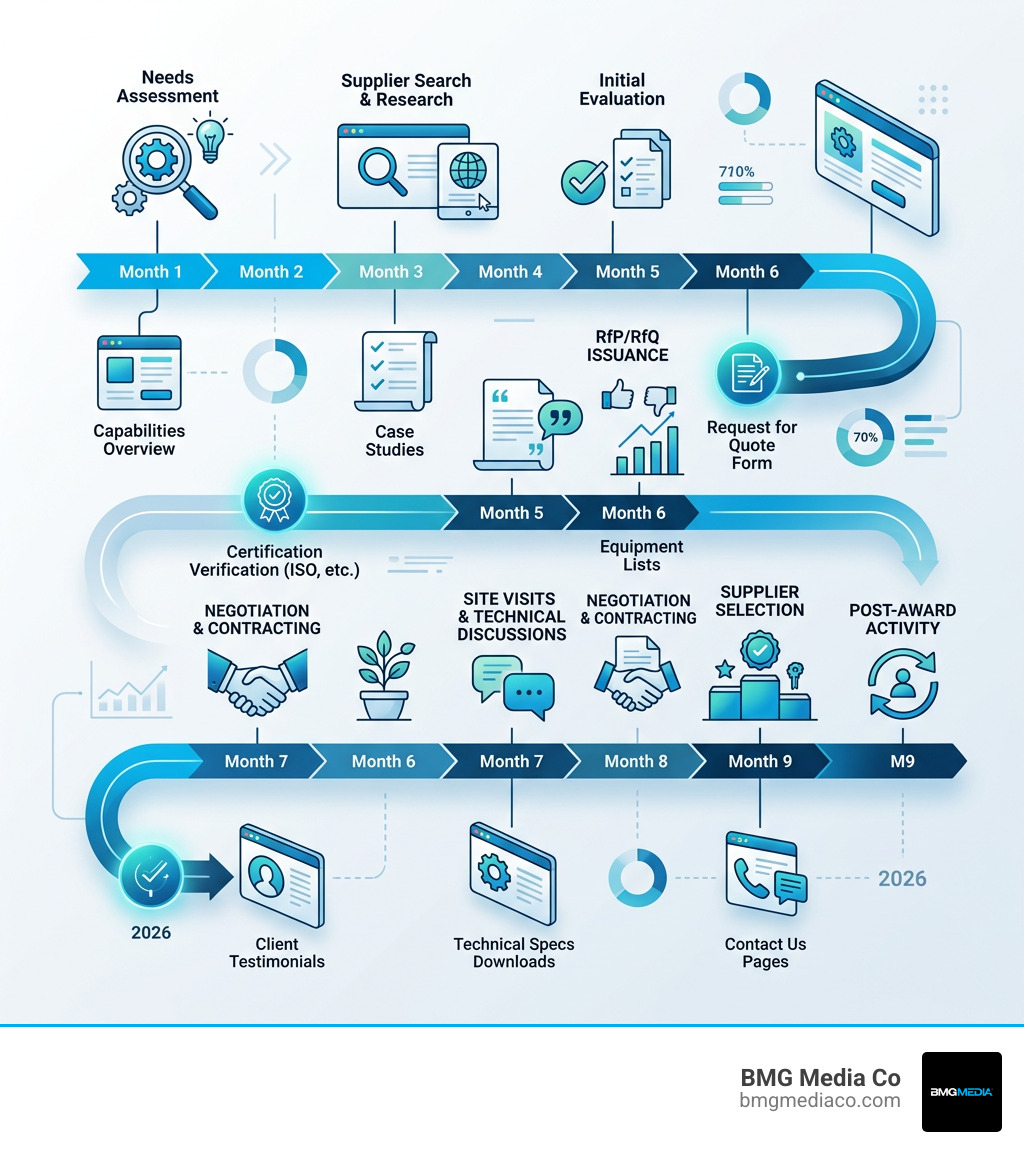
When an engineer or procurement officer lands on your site, they aren’t looking for flowery language or vague mission statements. They have a problem to solve and a part to source. They are looking for “proof of life”—evidence that you have the machinery, the expertise, and the certifications to handle their project.
One of the most common mistakes we see is hiding the equipment list. Your website should prominently feature your machinery, including make, model, and specific capabilities. If you offer CNC machining, do you have 3-axis or 5-axis capabilities? What are your standard tolerances? If you can hit ±0.001”, say so.
Buyers want to see a comprehensive list of processes—from milling and turning to secondary services like heat treating or plating. However, avoid the “everything to everyone” trap. Listing 150 different processes can actually dilute your perceived expertise. Focus on what you excel at.
In industrial manufacturing, trust is built on acronyms. Displaying your ISO 9001:2015, IATF 16949:2016, or AS9100D certifications is non-negotiable. If you handle defense contracts, your ITAR compliance and CMMC status should be front and center. These aren’t just badges; they are “de-risking” signals that tell a buyer you have the quality management systems in place to deliver consistent results.
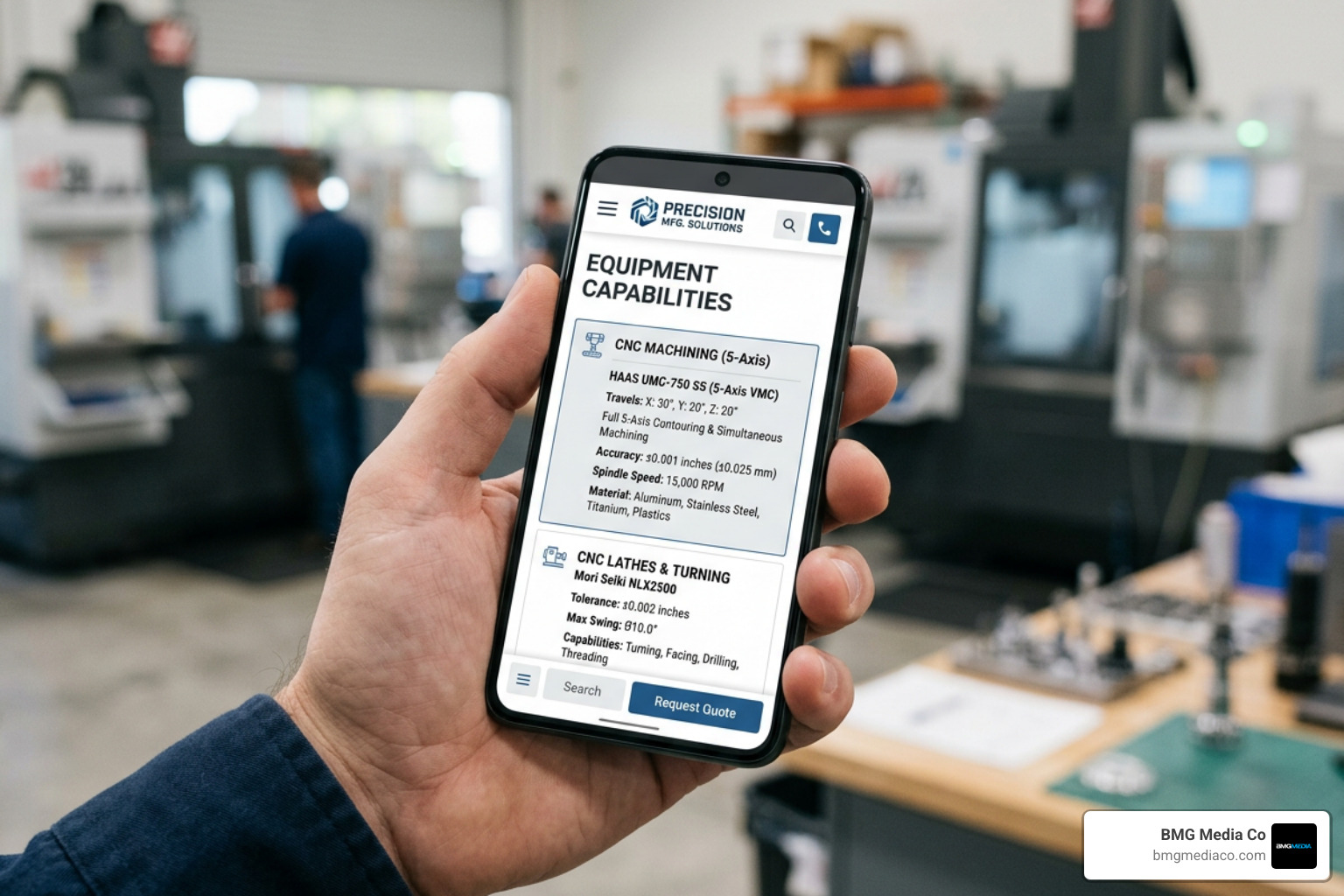
Many small shops start with a template-based site to save money. While this works for a “digital business card,” it often fails the high-performance test required for modern SEO and user engagement. Custom Manufacturing Web Design allows for integrated tools like eCatalogs, distributor locators, and custom quoting engines that templates simply can’t handle efficiently.
| Metric | Template-Based Website | Custom BMG Media Co. Website |
|---|---|---|
| Page Load Speed | Often bloated with unnecessary code | Optimized for lightning-fast performance |
| SEO Flexibility | Limited to basic metadata | Full control over site architecture and schema |
| Scalability | Hard to add complex tools later | Built to grow with your production capacity |
| User Experience | Generic and forgettable | Tailored to your specific industrial audience |
If a visitor can’t find your “Request a Quote” button within three seconds, your navigation has failed. B2B engagement on websites for manufacturing companies relies on a frictionless path from the homepage to the technical data sheets.
We can’t stress this enough: Google uses mobile-first indexing. If your site looks like a desktop relic from 2005 when viewed on a smartphone, your rankings will suffer. More importantly, engineers on the shop floor or executives traveling between plants often use mobile devices to perform quick research. A slow, clunky mobile site is an immediate “back button” event.
For companies with massive product catalogs, a “mega-menu” is your best friend. This allows you to categorize services by industry (Aerospace, Medical, Automotive) or by process (Injection Molding, Sheet Metal Fabrication). Including a prominent search bar at the top of every page helps returning customers jump straight to the specific part or material they need.
For an example of how we handle complex industrial navigation, look at our work for Portfolio – Cold Heading. We focused on making their specialized fastener manufacturing capabilities easy to navigate, ensuring that even with a deep service list, the user never feels lost.
If you are a Michigan-based manufacturer working with partners in Mexico or Europe, offering a Spanish or German version of your site can be a massive competitive advantage. It shows a level of global readiness that many smaller competitors lack.
In manufacturing, “seeing is believing.” You aren’t just selling a service; you’re selling your ability to execute complex geometries and maintain tight tolerances.
Ditch the stock photos of handshakes. Buyers want to see your facility. High-resolution photos of your clean room, your 5-axis mills in action, and finished parts are essential. Video montages of equipment running can demonstrate the scale and precision of your operation far better than a paragraph of text ever could.
Interactive elements are becoming the gold standard for websites for manufacturing companies. Tools that allow users to view 3D CAD models directly in the browser or use “spool calculators” provide immediate utility. This keeps visitors on your site longer and positions you as a tech-forward partner.
A “Parts Gallery” is often the most-visited page on a manufacturing site. It acts as a visual portfolio of what you’ve achieved for other clients. Pair this with detailed case studies that follow a “Problem-Solution-Result” format. For instance, show how you helped an aerospace client reduce lead times by 30% through a specific machining innovation.
Our project for Portfolio – BA Forging Enterprises highlights how clear, professional imagery of industrial processes can elevate a brand’s perceived value and build immediate trust with high-stakes buyers.
Your website has one primary job: generating leads. Every page should lead the user toward a clear Call-to-Action (CTA).
The “Request for Quote” (RFQ) is the lifeblood of industrial sales. A high-performing RFQ form should:
Platforms like Xometry and Protolabs have changed buyer expectations by offering instant quoting. While not every manufacturer can (or should) offer instant pricing, your website should at least integrate with your CRM (like Salesforce or HubSpot). This ensures that when a lead comes in, it is immediately routed to the right sales engineer for follow-up.
We implemented streamlined lead generation strategies for Portfolio – DiJet USA and Portfolio – Trident Systems, focusing on reducing the friction between the user’s interest and the final quote submission.
Not every visitor is ready to buy today. Some are in the “research” phase of that nine-month cycle. Offer them ungated basic info but use “gated” content for high-value resources. White papers on “Designing for Manufacturability” or “Material Selection Guides” are excellent ways to capture email addresses from engineers who are still early in the procurement process.
Looking at what the leaders are doing can provide a roadmap for your own digital transformation.
Companies that leverage digital-first manufacturing are winning the “speed war.” These sites use AI and automated DFM (Design for Manufacturability) feedback to give buyers instant answers.
Niche manufacturers often succeed by being incredibly specific about what they do.
Google uses mobile-first indexing, meaning it ranks your site based on its mobile version. Beyond SEO, the industrial buying cycle is non-linear. An engineer might find you on a desktop at work, but a plant manager might review your capabilities on a tablet during a walkthrough, and an executive might check your “About Us” page on their phone while traveling. If the experience breaks on any of those devices, you risk losing the lead.
In B2B manufacturing, the cost of a “bad hire” is astronomical. If a part fails, it could shut down a production line or cause a safety issue. Certifications like ISO 9001:2015 act as a third-party verification of your quality processes. Social proof—such as testimonials from Fortune 500 clients or logos of recognized partners—further de-risks the decision for the buyer.
Don’t just look at “hits.” Track these high-value metrics:
Your website is the digital front door to your factory. In an industry where contracts are worth millions and relationships last decades, you cannot afford a “template” presence that looks like every other shop in the state.
At BMG Media Co., we specialize in building custom, high-performance websites for manufacturing companies. Based in Birmingham, Michigan, we understand the local industrial landscape and the global demands of the manufacturing sector. We don’t use templates because your business isn’t a template—it’s a unique operation with proprietary processes and specialized expertise.
With over 1,000 sites completed and a focus on award-winning, custom development, we help manufacturers turn their websites into their most effective sales tools. Whether you need a simple, high-speed capabilities site or a complex web app with integrated quoting, we have the experience to deliver.
Ready to upgrade your industrial presence? Let’s talk about your next Manufacturing Web Design project.
