July 2026
Choosing the right development company names can be the difference between a brand that sticks and one that gets scrolled past. Before a prospect reads a single word of your pitch, your name is already doing the talking.
Here are some strong development company name ideas to get you started:
| Style | Example Names |
|---|---|
| Invented | Devora, Codexis, Buildrex |
| Compound | StackForge, CodeBridge, DevPath |
| Keyword-based | Build Co., Dev Studio, Code Works |
| Founder-based | George Digital, Blake & Co. |
| Geographic | NedDev, Detroit Builds, Midwest Dev |
A great name is short, easy to say, easy to spell, and available as a .com domain. It should score at least 14 out of 18 on a standard business naming checklist that evaluates pronunciation, memorability, distinctiveness, meaning, and trademark safety — anything under 12 is a “maybe later.”
Most founders underestimate how much weight a name carries. As one naming framework puts it: names are more important in development than almost any other industry because they immediately signal professionalism or cheapness.
The stakes are real. A weak name forces your marketing to work harder than it should. A strong one makes everything easier — SEO, referrals, client trust, and brand recall.
I’m Blake George, founder of BMG Media Co. and a web design and development veteran with 15+ years and 1,000+ custom builds under my belt — which means I’ve seen how development company names shape client perception before the first conversation even happens. In this guide, I’ll walk you through everything you need to choose a name that actually works.
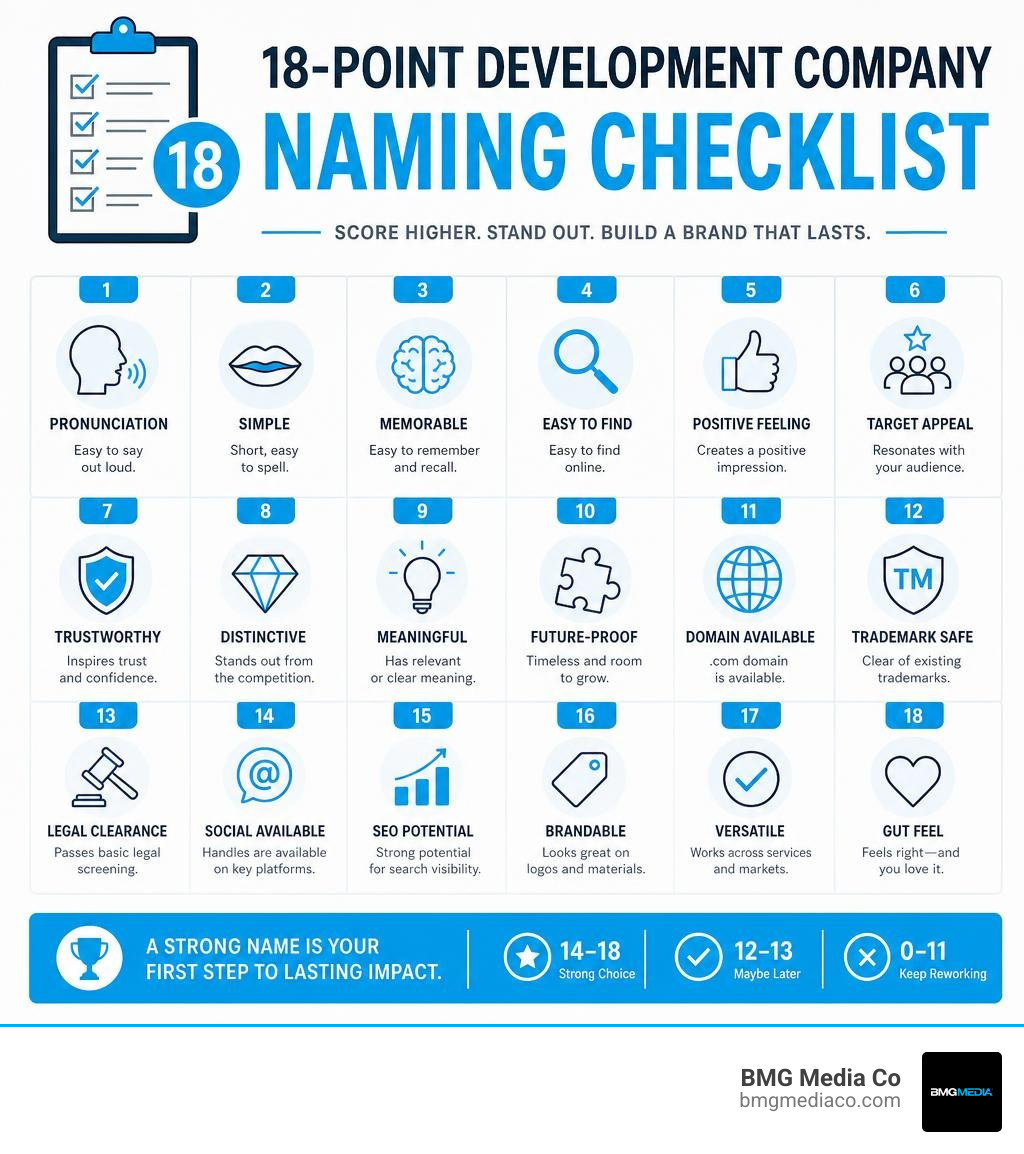
Development company names terms explained:
When we analyze what makes a business name truly premium, we have to look past simple aesthetics. A successful development company name must balance immediate industry clarity with long-term brand equity. This is what branding experts call cognitive ease. If your target clients in Metro Detroit or major tech hubs like Austin and Los Angeles have to strain to understand, pronounce, or spell your name, you are bleeding leads before they ever see your portfolio.
To stand out in the premium tier, a name must achieve several critical goals:
Investing time in choosing a business name from brainstorm to brand identity ensures you do not end up with a forgettable, generic brand. When we build custom digital platforms, we treat the naming process with the same engineering rigor we apply to writing clean, database-optimized code.

Before you start throwing random words together, it helps to understand the linguistic styles available to you. Categorizing your approach keeps your brainstorming structured and aligned with your target audience. Whether you are building complex enterprise software, high-end residential real estate, or custom web platforms, your naming style should match your market positioning.
Here is a breakdown of the primary naming styles used by successful development firms globally:
| Naming Style | Core Characteristics | Pros | Cons | Real-World Examples |
|---|---|---|---|---|
| Abstract / Invented | Completely fabricated words or modern linguistic blends. | High domain availability; easy to trademark; highly distinctive. | Requires significant marketing spend to build initial brand recognition. | Makrops |
| Compound | Fusing two real words together to create a new concept. | Highly memorable; tells a clear brand story; modern aesthetic. | Can occasionally sound slightly generic if overused. | BairesDev |
| Keyword-Based | Explicitly includes functional terms like ‘software’, ‘dev’, or ‘build’. | Immediate industry clarity; excellent for local SEO and search intent. | Can limit future business pivots; harder to find clean .com domains. | Marka Development |
| Founder-Based | Utilizing the surname of the founder(s) to establish the brand. | Projects deep personal accountability; timeless; builds immediate trust. | Harder to scale if the founder exits; lacks immediate functional context. | Bechtel |
| Geographic | Incorporating local landmarks, cities, or regional identifiers. | Establishes strong local authority; great for regional trust. | Can limit expansion into national or global markets. | NedDev |
If you are stuck trying to find the perfect fit, exploring stuck on a name creative ideas for your web development business can help spark the exact blend of technical authority and creative flair your brand needs.
Let’s look at how these styles play out in the real world. A classic, multi-generational giant like Bechtel relies on a founder-based name to convey a century of trust and massive physical infrastructure capability. On the digital front, a company like BairesDev uses a compound style to signal its nearshore software engineering focus. Meanwhile, custom digital product creators like Makrops go the abstract route, allowing their brand to scale smoothly across mobile apps, AI solutions, and 3D worlds without being boxed in by a single keyword.
Finding a name that clicks is a systematic process, not a sudden stroke of lightning. To protect your investment and build a brand that lasts, we recommend following a disciplined, multi-phase framework.
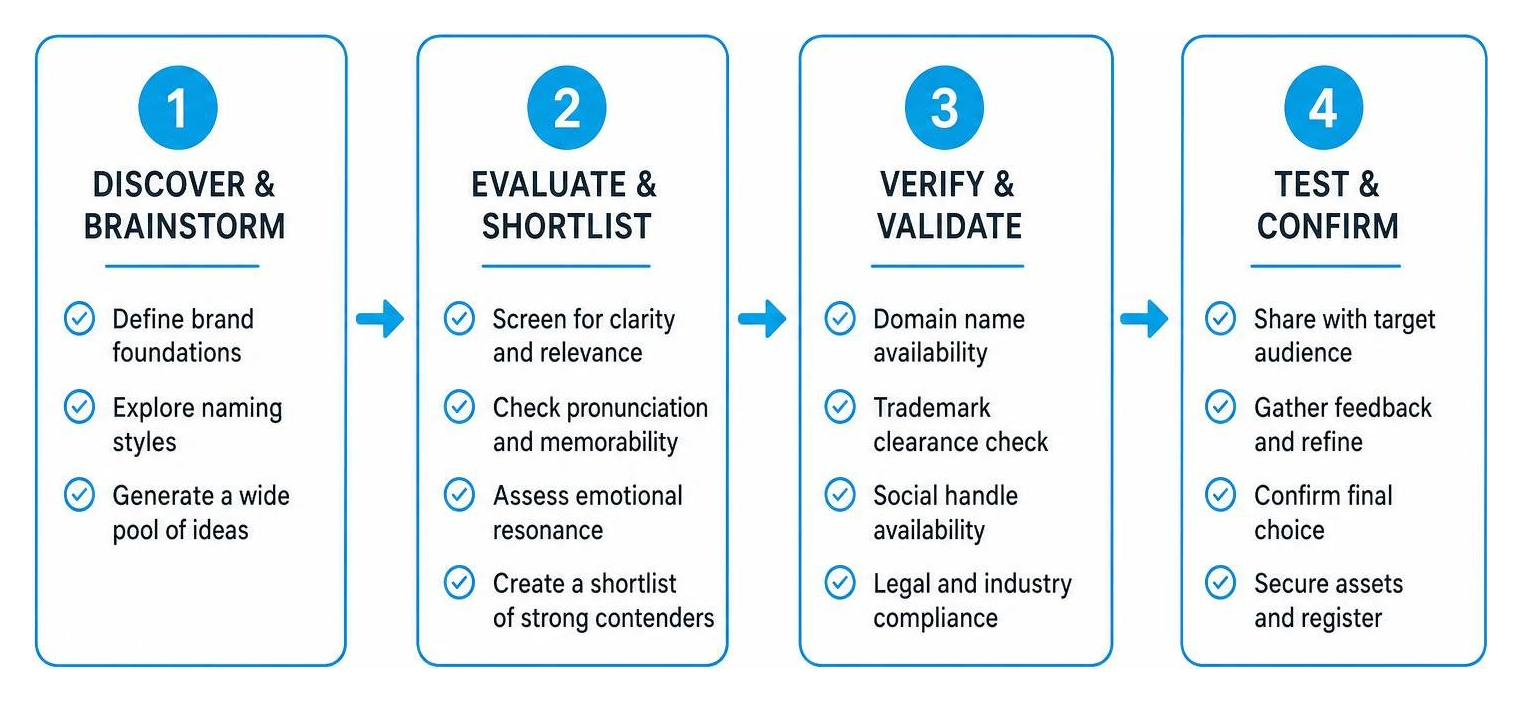
Brainstorming should always start with a clear understanding of your brand’s unique “secret sauce.” Are you focusing on premium, custom-coded web architectures? Or are you a high-end physical builder?
To generate a massive pool of raw ideas, you can leverage modern AI tools like ChatGPT, Claude, or specialized name generators. However, a word of caution: generic AI prompts almost always generate cheesy, overused clichés. If you ask an AI for “development company names,” you will likely get flooded with uninspiring, alliterative options like “Bold Blueprints” or “Apex Apps.”
To get high-quality outputs from AI tools, apply strict negative constraints:
For more hands-on strategies, read our guide on no more boring brands creative ways to generate a company names idea. It will help you move past boring, template-style names and discover highly distinctive concepts that stand out in competitive markets like Metro Detroit, New York, and Chicago.
Once you have a list of 5 to 10 strong contenders, it is time to put them through a rigorous vetting process. This is where many founders make costly mistakes that lead to forced rebranding down the road.
First, check your local state business registry. If you are operating in Michigan, search the state’s corporate database. Make sure you are also checking specific municipal guidelines, as cities like Northville and Novi have their own localized business registration and licensing frameworks.
Second, conduct a formal national trademark search. In the United States, use the U.S. Patent and Trademark Office (USPTO) online search system. Look for active trademarks in your specific service classes (such as Class 42 for software development or Class 37 for construction).
Third, perform the “Phone Test” and “Noisy Room Test.” Call a colleague or friend and say the name once over the phone. Can they spell it back to you without you having to explain it? Next, imagine shouting your company name across a crowded networking event in Detroit or Chicago. Is it easily understood, or does phonetic friction make it sound like something else entirely?
For a deeper dive into how professional agencies systematically screen names, review our article all about business naming companies.

When we work with growing businesses, we frequently see the same naming mistakes repeated. Avoiding these critical errors will save you from legal headaches, brand confusion, and expensive rebranding campaigns.
If you are planning to hire an agency to guide you through this process, check out our guide on how to pick the best naming companies for your next big idea to ensure you partner with a team that understands both high-end design and technical execution.
We see these geographic limitations play out across Southeast Michigan. While municipal portals like those in Troy, Rochester Hills, Farmington Hills, and West Bloomfield are fantastic resources for local economic development, your primary brand name should remain broad enough to command authority when pitching clients in Chicago, Los Angeles, or New York. Keep your local roots in your brand story, but keep your name scalable.
Including functional keywords can be highly beneficial for immediate search intent and local SEO. It tells prospective clients exactly what you do on the first encounter. However, it can also box your business into a specific service. If you name your company “Pure Code” but eventually want to expand into high-end UI/UX design, branding, or business automation, your name might confuse clients looking for those creative services.
If you do choose to use a functional keyword, pair it with a distinctive, high-end abstract or compound word to maintain a premium feel.
The ultimate test for memorability is the 48-Hour Recall Test. Share your top three name choices with a small group of people who represent your target demographic. Do not email them or write the names down—simply say them out loud in conversation. Two days later, follow up with them and ask which names they remember. If they can immediately recall a name and spell it correctly, you have a winner.
In the digital era, your domain name is your online storefront. A matching .com domain instantly projects authority, security, and established credibility. If you are forced to use a complex, hyphenated domain or an obscure extension because your exact-match .com is taken, you risk losing valuable organic search traffic and email deliverability. For a premium development business, securing a clean, exact-match domain is a non-negotiable step in establishing digital authority.
At BMG Media Co., we have spent over 15 years building custom digital platforms, high-performance web applications, and enterprise-grade software from our headquarters in Birmingham, Michigan. Founded in 2009 by Blake George, our agency has grown from a recession-era bet on local businesses into a globally recognized force with over 1,000 completed custom projects.
We believe that a premium brand deserves a premium foundation. Just as we build every single website 100% custom from scratch—with zero templates, zero page builders, and zero compromises—we believe your company name should be hand-crafted to reflect your unique vision, values, and long-term growth trajectory.
If you are ready to transition from a generic, template-style brand to a powerful, custom-coded digital presence that commands authority across Southeast Michigan and major national markets, let’s build something remarkable together.
Discover how to take your brand to the next level by reading our expert analysis on how to pick the best naming companies for your next big idea.
