June 2026

Finding the best web designer for your business is one of the most important decisions you’ll make for your online presence. The right designer doesn’t just make things look good – they build sites that rank, convert, and grow with your business.
Quick answer: The best web designer for your business is one who can combine:
Right now, there are over 1 billion websites on the internet. More are launched every single day. With e-commerce expected to make up 24% of all retail sales by 2026, and more than half of all web traffic coming from mobile devices, the stakes for getting your website right have never been higher.
Yet most businesses still struggle with the same problems:
The difference between a site that works and one that doesn’t often comes down to who built it.
I’m Blake George, founder of BMG Media Co, a nationally recognized web design and development agency that has built over 1,000 custom websites across real estate, healthcare, manufacturing, and more – which gives me a front-row seat to what separates the best web designers from the rest. Below, I’ll break down exactly what to look for, who to consider, and how to make the right call for your business.
In 2026, the best web designer is not just a visual creative. They are part strategist, part UX thinker, part technical problem solver, and part business partner.
A standout designer should understand:
That last one matters most. Pretty pages are nice. Results are nicer.
Top web designers combine design craft with real-world execution. We look for skills like:
The best designers also know when to challenge assumptions. If a client asks for five pop-ups, neon text, and a homepage video that loads like a boulder uphill, a good designer should politely push back.
For a deeper look at fundamentals, see our guide to Web Design Principles You Need to Know.
Experience is not just “years in design.” It is relevant experience.
A designer who has worked on:
will usually be a safer bet than someone with a flashy portfolio full of concept work and no proof it performed in the wild.
When reviewing candidates, ask for measurable outcomes such as:
Case studies with before-and-after context are especially helpful because they show thinking, not just visuals.
Most top designers rely on a stack of tools rather than one magic platform.
Common tools include:
Google Web Designer is especially useful for HTML5-based interactive content, responsive creative, direct code editing, and animation workflows. It supports both simple scene-based animation and more advanced timeline control, which can help teams create adaptable visual experiences.
If you want to see why testing matters after launch, read The Importance of A/B Testing in Web Design.
The list at the top is useful, but the real value is knowing how to compare options intelligently.
A smart evaluation framework should include:
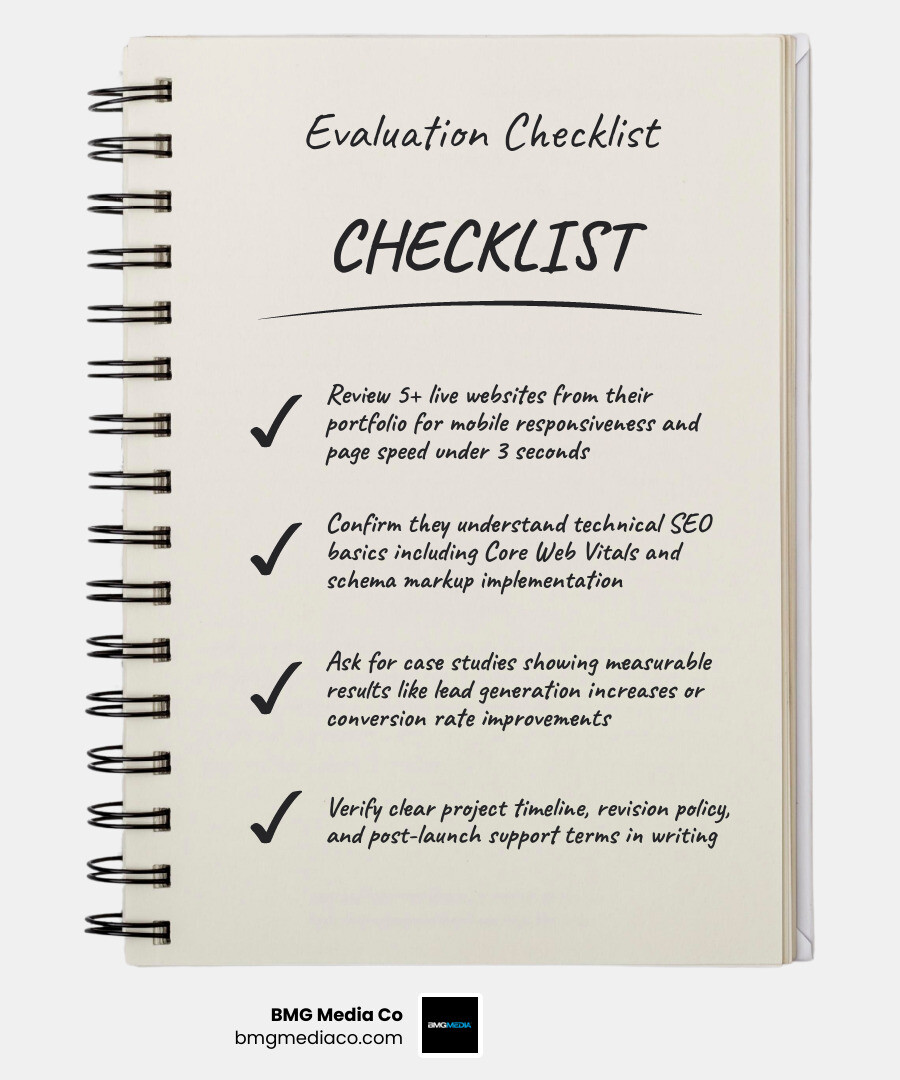
A portfolio should show more than attractive screenshots. Anyone can make a homepage mockup look good. The real test is whether the work holds up as a functioning business website.
Review portfolios using this checklist:
It is also smart to compare candidates against trusted research sources and directories such as Top Web Design Companies – May 2026 Rankings | Clutch.co and Top Web Design Companies in the USA – 2026 Reviews – Goodfirms.
For more practical hiring advice, see Finding the Right Web Design Contractor for Your Project.
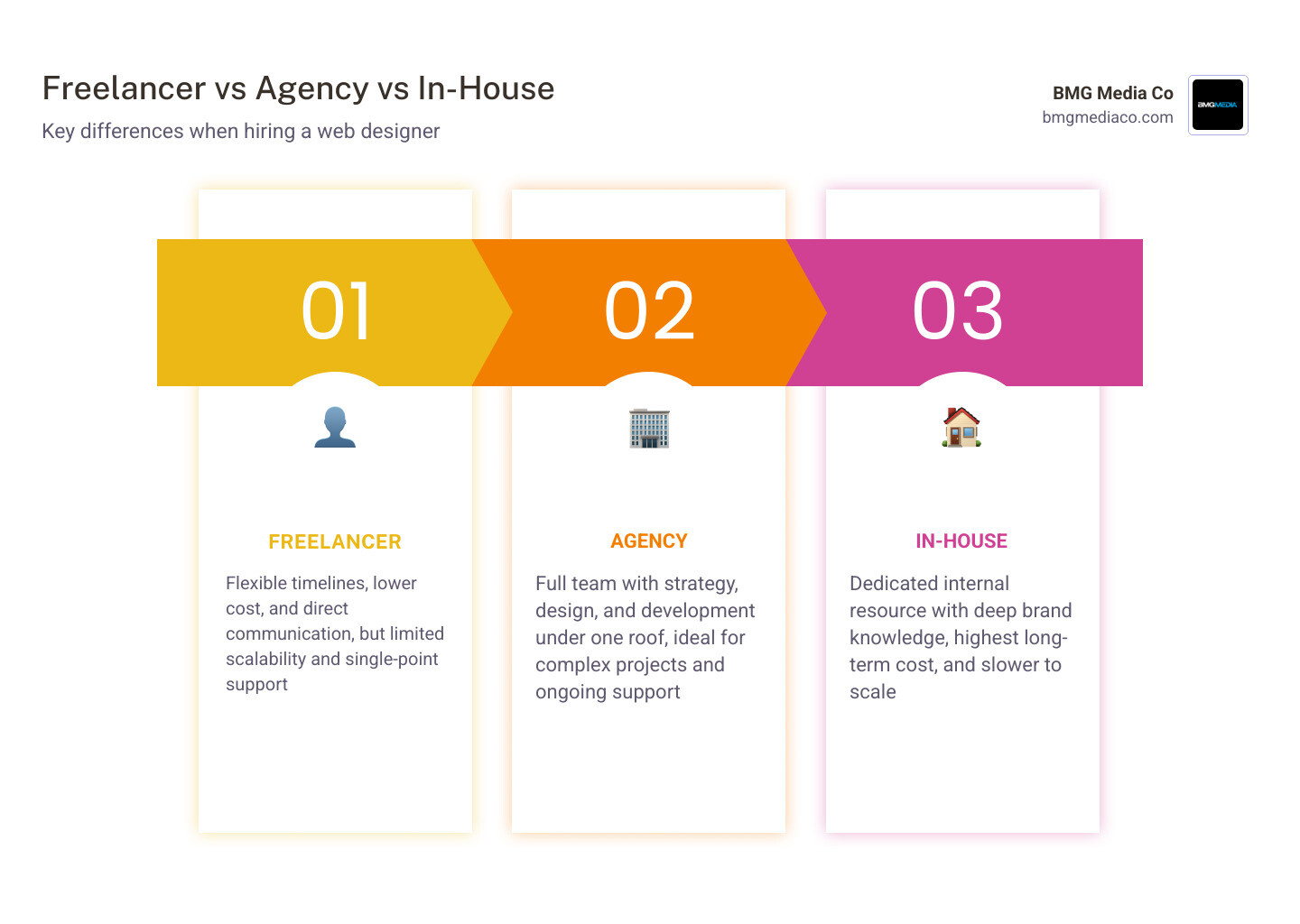
Each option has pros and cons.
| Option | Best for | Pros | Cons |
|---|---|---|---|
| Freelancer | Small to mid-size projects | Flexible, often lower cost, direct communication | Capacity limits, less redundancy, variable process |
| Agency | Businesses needing strategy, design, development, and support | Broader expertise, stronger systems, scalability | Higher investment, more moving parts |
| In-house | Large companies with constant design needs | Deep internal brand familiarity, ongoing access | Highest fixed cost, slower hiring, limited specialty range |
Freelancers can be excellent when well-vetted. Agencies tend to be stronger when projects involve branding, SEO, development, integrations, and long-term growth. In-house teams make sense if design is a daily operational function.
Some premium talent networks emphasize rigorous screening, fast matching, and trial-based hiring models. Those signals can be helpful, though businesses should still independently review fit, communication style, and relevant experience.
If your project extends beyond marketing sites into software or product work, our Ultimate Guide to Picking a Web App Partner may help.
Bring these questions to every consultation:
The best web designer should answer clearly without hiding behind jargon or interpretive dance.
Good design is not just about appearance. It is a chain reaction: design affects usability, usability affects engagement, engagement affects conversions, and all of that influences growth.
More than half of web traffic comes from mobile devices, so responsive design is not optional. It is the default.

Leading designers usually follow these best practices:
Accessibility is a quality standard, not a bonus feature. A site that is hard to use for people with visual, motor, or cognitive differences is also often harder for everyone else to use.
For more on mobile-first execution, read Responsive Design 101: From Mobile First to SEO Ready.
The top designers build with SEO and conversion in mind from the start, not as emergency repairs after launch.
That includes:
Performance and SEO often overlap. Faster pages improve user experience and can support visibility in search. Some portfolios in the research showed meaningful gains from redesigns, including stronger organic traffic, faster implementation cycles, and higher click-through rates with schema improvements.
Designers should also test ideas instead of guessing. CTA placement, form length, navigation labels, and hero messaging can all influence conversions. Small changes sometimes create very un-small revenue impacts.
For related reading, see The Easiest Way to Make Your Website Look Good on Every Screen.
The current trend cycle favors design that feels clean, fast, credible, and useful.
Key trends we are seeing for 2025-2026:
The important word there is “used.” Trends are tools, not goals. The best web designer knows when a trend supports the user and when it just makes the homepage look like it drank too much espresso.
You can also explore our take on evolving aesthetics in Top 5 Web Design Trends 2024.
One of the easiest ways to spot a pro is to ask about process. Experienced designers almost always have one.
A professional web design project usually follows these stages:
Discovery
Strategy
Wireframes
Visual design
Development
QA and testing
Launch
Training and support
That strategy-first approach is why we strongly recommend reading Why Your Business Needs a Custom Website Design and Development Strategy.
Timelines vary based on scope, content readiness, and revision cycles.
Typical ranges:
Project duration depends heavily on content readiness, feedback speed, revision cycles, and technical complexity.
What slows projects down most?
In other words, “Can we just add a member portal?” is not usually a same-day favor.
Pricing depends on depth, not just page count.
Common pricing factors include:
Smaller freelance projects may start relatively low, while fully custom business websites, e-commerce builds, and larger strategic engagements can cost substantially more depending on scope and complexity.
As a rule:
If platform decisions are part of your budget planning, our guide to Best Website Building Platforms 2024 is a useful starting point.
You do not need to search the entire internet until your coffee gets cold. Start with a shortlist and a framework.
Good places to research candidates include:
Create a shortlist of 3 to 5 candidates. That is usually enough to compare quality without turning hiring into a full-time hobby.
When narrowing your list, benchmark these signals:
Strong brand alignment matters too. A great designer should help your business look like itself, just sharper. If brand voice is part of the challenge, our article on How to Find Your Business Voice Through Custom Design can help.
Look for alignment in four areas:
The right fit is someone who understands your goals, explains decisions clearly, and can show similar work that produced business value.
It depends on your needs.
If you are committed to a specific platform like WordPress, hiring a specialist can be smart. If your project includes branding, UX, SEO, custom functionality, and future growth planning, a broader partner may be better.
The key question is not “Do they know the platform?” but “Can they build the right solution on the right platform?”
Watch out for:
If someone promises a fully custom, enterprise-grade, SEO-optimized masterpiece by Friday for the cost of two pizzas, we would keep shopping.
Choosing the best web designer is really about choosing the best fit for your goals, budget, and growth stage.
For some businesses, that will be a vetted freelancer. For others, it will be a platform, in-house hire, or boutique agency. But if you want a partner that can handle strategy, custom design, development, SEO, and long-term performance under one roof, we believe the custom-agency model is hard to beat.
At BMG Media Co, we build fully custom websites and digital experiences with no templates, no shortcuts, and no one-size-fits-all thinking. We are based in Michigan, we have completed 1,000+ websites, and our focus is simple: create websites that look better, load faster, and perform harder for the businesses behind them.
If you are ready to plan a site that actually supports growth, explore our custom web design and development services.

