June 2026
A truly beautiful website in 2026 is far more than a digital art piece. It is a highly functional system where visual design and user utility work in perfect harmony. When we analyze the world’s leading web designs, we find that the most striking interfaces rest on a foundation of timeless design principles: deliberate typography, balanced color palettes, generous whitespace, and responsive layouts that adapt flawlessly to any device.
To make a lasting impression, a website must first master how it presents information. Typography is no longer just about choosing a readable font; it has become a central design element. Modern sites utilize variable fonts and fluid typography to scale text seamlessly across screens.
Similarly, whitespace—often called negative space—is not merely empty real estate. It is a powerful tool used to give design elements room to breathe, create a clear visual hierarchy, and guide the user’s eye naturally from one section to the next.
But none of this matters if the experience breaks down on a mobile device. True beauty requires seamless responsiveness. To dive deeper into how to achieve this technical balance, explore our guide on The Easiest Way to Make Your Website Look Good on Every Screen.
As we navigate 2026, the definition of web beauty has evolved from static layouts to dynamic, living digital environments. The most beautiful websites in the world today are characterized by:
These elements are not just decorative; they are strategic tools used to capture and hold user attention. For an in-depth look at how these visual elements are shaping the web, check out our analysis of the Top 5 Web Design Trends 2024.
Behind every breathtaking visual experience lies a powerful technical stack. The transition from flat, two-dimensional pages to immersive, cinema-grade web environments is driven by modern frontend technologies:
By leveraging these advanced technologies, designers can create experiences that feel less like static brochures and more like interactive software. To understand why these technologies are becoming essential for modern businesses, read our article on Why Custom Animations Are the Future of Brand Engagement.
To truly understand what makes a website beautiful, we must look at concrete examples. The following 20 websites represent the pinnacle of modern web design, having earned recognition from prestigious bodies like the Webby Awards, CSS Design Awards, and Awwwards. Each of these sites demonstrates how to turn technical complexity into an elegant, user-friendly experience. For more examples of custom, high-end design, explore our curated Portfolio.
An incredible digital museum experience, Oculi Mundi | Q42 brings the historic Sunderland Collection of maps, atlases, and globes from the 13th to the 19th centuries to life. Built using Next.js, Tailwind, and Sanity CMS, the site allows users to wander through a spatial 3D environment. Atlases are presented as floating 3D carousels, while a dedicated “research mode” offers a clean grid view for those who prioritize raw information over pure immersion.
A masterpiece of narrative design, the RonitkumarSoni/Ocean-Depths repository showcases a cinematic journey from the ocean’s surface down to its darkest depths. Powered by React, GSAP ScrollTrigger, and Lenis smooth scrolling, the site features a 654-frame canvas engine that renders interactive bioluminescent creatures and custom flashlight mask effects as you scroll deeper into the digital abyss.
Inspired by high-end luxury aesthetics, the shaozheng0503/SILLAGE project is an immersive fragrance experience built with React 19 and React Three Fiber. It features real-time rendered 3D perfume bottles using Three.js MeshTransmissionMaterial to simulate realistic glass refraction. The site utilizes dual parallax systems (2D mouse tracking and 3D scene scrolling) to create an elegant, tactile product showcase.
For those who appreciate educational beauty, Bartosz Ciechanowski stands as one of the most brilliant examples of interactive writing on the internet. His deeply researched articles on physics and mechanical concepts use custom-coded, interactive 3D simulations instead of static diagrams, allowing readers to physically manipulate variables to understand complex mathematical and physical concepts.
Treating the web as an evolving art medium rather than a static container, the a-organvm/a-mavs-olevm repository is an experimental digital sanctuary. Built entirely with vanilla JavaScript and no build steps, it models its navigation on ancient Greek temple architecture. Visitors explore non-linear labyrinthine paths, generative audio-reactive 3D spheres, and fluid dynamics simulations that change with every single visit.
This award-winning portfolio showcases the power of minimalist, motion-first design. Built around ultra-smooth transitions and bold, clean typography, it demonstrates how a creative professional can present their work in a way that feels luxury, high-end, and deeply engaging without cluttering the screen with unnecessary text.
Demonstrating next-generation glassmorphism, the smart-developer1791/solidjs-threejs-gsap-dimensional-glass-landing project combines Solid.js and Three.js to render real-time 3D glass panels. The landing page features physically accurate prismatic light refraction, a magnetic cursor with gravitational pull effects, and an incredibly lightweight bundle size (~85KB) that achieves a near-perfect Lighthouse performance score.
The homepage for the popular publishing platform Ghost is a masterclass in clean, modern SaaS design. By pairing crisp, high-contrast imagery with hot pink and lime green accents, the site feels energetic yet highly professional. Subtle animated video elements showcase the product in action, proving that software landing pages can be beautiful and highly functional.
ETQ’s e-commerce platform is a legendary example of minimal design. By stripping away typical retail clutter and utilizing bare, neutral backgrounds, the site lets its exceptional product photography do the heavy lifting. Simple text animations and incredibly smooth transition effects elevate the shopping experience to match the premium nature of the footwear brand.
The luxury Swiss watchmaker utilizes immersive scrolling to showcase the meticulous craftsmanship of its timepieces. Rather than presenting static product grids, the site takes users on a visual journey through high-definition video loops, exploded 3D views of watch movements, and elegant typographic layers that emphasize heritage and luxury.
Raycast’s website is widely regarded by developers and designers as a gold standard in modern tech branding. It features deep, dark-mode color palettes, vibrant gradients, subtle background grid patterns, and unique text glow effects that make the interface feel incredibly polished and premium.
Gumroad’s modern web presence proves that e-commerce doesn’t have to be boring. Using a tasteful mix of playful parallax scrolling, bold retro-inspired color contrast, and a clear storytelling flow, the site guides creators through its features while injecting a distinct, memorable brand personality.
Unsplash Plus showcases the power of visual breathing room. By utilizing a full-width gallery layout where high-quality images flow slightly outside of traditional grid bounds, combined with generous whitespace and highly strategic, minimal color accents, the platform creates an elegant, premium browsing environment.
An old favorite that still sets a high bar, the SWISS Airlines website integrates parallax scrolling, smooth flight-path animations, and stunning alpine photography. The result is an interactive journey that simulates the experience of flying over the Swiss Alps, turning a standard booking process into an emotional brand experience.
Shademaster proves that traditional service industries can leverage award-winning design. The roofing and outdoor design company structured its website with segmented, highly intuitive navigation that allows users to self-serve, plan projects, and request custom quotes autonomously—streamlining the sales process beautifully.
Wealthsimple breaks the mold of boring financial services. By utilizing custom, lighthearted animations, playful non-investing GIFs, and a warm, approachable color palette, the site makes the complex world of personal finance feel accessible, fun, and highly modern.
The website for Serve Robotics is a clean, future-forward showcase of cutting-edge robotic technology. It features high-definition video backgrounds of their autonomous delivery robots, paired with crisp, bold typography and interactive diagrams that explain complex engineering in a simple, highly visual format.
A beautiful example of food-and-beverage web design, Crav Burgers uses rich, high-contrast food photography, bold typography, and playful scroll-triggered animations to build immediate appetite appeal and drive users toward online ordering.
Nannina’s restaurant website utilizes stunning, intimate photography of its dishes and dining space, paired with organic transitions and a warm, cohesive color palette. The design focuses on conveying the physical atmosphere of the restaurant, compelling visitors to book a table.
An educational site detailing 70 years of genetics research, Inra uses an interactive DNA chain timeline to visualize chronological data. The site demonstrates how dense, historical information can be transformed into an engaging, navigable digital archive. To see how industrial and manufacturing businesses can achieve this same level of functional beauty, check out our curated gallery of Websites for Manufacturing Companies: A Gallery of Industrial Excellence.
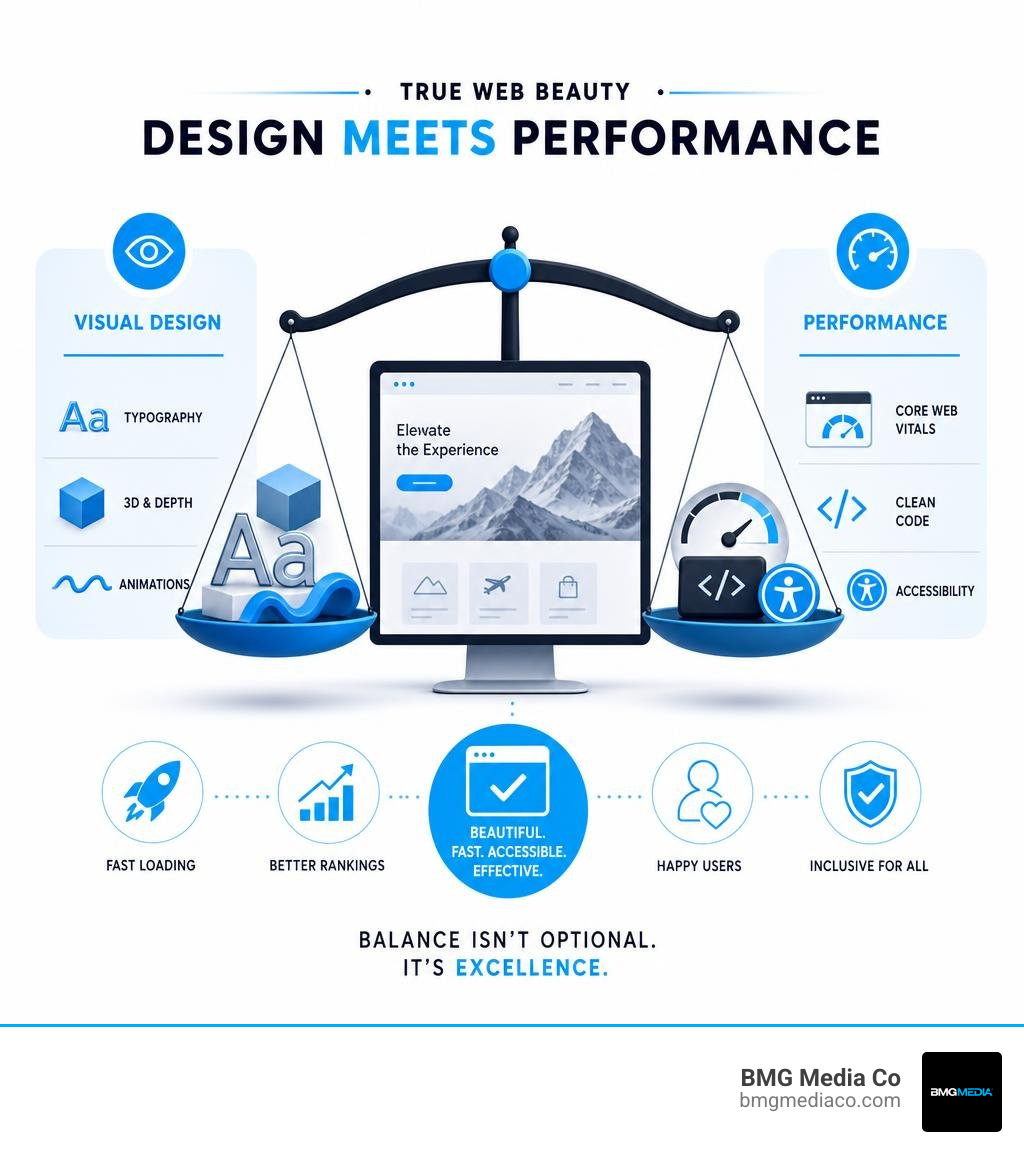
The most common trap in high-end web design is sacrificing performance for visuals. A website can have the most beautiful 3D animations in the world, but if it takes ten seconds to load, visitors will bounce before they ever see them.
True web beauty requires balancing aesthetics with usability, accessibility, and search engine optimization (SEO). At BMG Media Co., we achieve this balance by building every website 100% custom from scratch. By avoiding bloated templates and page builders, we ensure that the site’s code remains clean, lightweight, and optimized for speed.
This custom approach is critical for hitting Google’s Core Web Vitals—the performance metrics that directly impact your organic search rankings. We optimize asset compression, implement lazy loading, and leverage modern hosting environments so that custom animations load instantly.
Furthermore, high-end web design must be accessible to everyone. This means designing with proper color contrast, keyboard navigability, and screen-reader compatibility to meet ADA compliance standards. To learn more about building beautiful, search-friendly, and responsive websites, read our comprehensive guide on Responsive Design 101: From Mobile First to SEO Ready.
When looking at award-winning websites, the goal should never be to copy their visual layouts. Instead, successful businesses and designers analyze the underlying strategies that make those sites work.
Ask yourself:
By extracting these structural and UX strategies, you can apply them to your own unique brand identity. Additionally, managing a highly visual site requires a flexible, easy-to-use backend. A custom Content Management System (CMS) allows your team to update visual assets and text without risking breaking the site’s layout. To explore your options, read our analysis of The Best Website Building Platforms 2024.
Awwwards receives over 1,000 website submissions per month from creative agencies and designers worldwide. Submissions are graded by a jury of industry experts and community voters across design, usability, creativity, and content. The average score for a coveted “Site of the Day” winner is 7.23 out of 10, representing the absolute elite tier of global web design.
The most beautiful, highly animated websites maintain fast loading speeds through rigorous performance optimization. This includes utilizing lightweight, clean code, advanced asset compression (such as WebP/WebM formats), lazy loading non-critical assets, and utilizing high-performance hosting with Content Delivery Networks (CDNs). Building custom sites from scratch—rather than using bloated page builders—is the single most effective way to ensure fast load times.
Yes, highly visual websites can be exceptional conversion engines when designed strategically. The key is using visual elements to guide the user’s eye toward clear, intuitive call-to-action (CTA) buttons rather than distracting them. Beautiful design builds immediate brand trust and emotional engagement, which naturally increases conversion rates. For a real-world look at how this works in highly regulated, conversion-critical industries, explore our piece on Creative Medical Website Designs That Actually Convert.
If you are ready to stop blending in with templates and start building one of the most beautiful, high-performing websites in your industry, BMG Media Co. is here to bring your vision to life.
Founded in 2009 by Blake George in Birmingham, Michigan, BMG Media Co. is a premium custom web design and development agency. Born during the Great Recession, our agency was built on a foundation of resilience, resourcefulness, and a drive to help businesses grow when conditions are tough. Today, we have successfully delivered over 1,000 custom website projects for clients across the United States—from our deep local roots in Southeast Michigan (including Troy, Bloomfield Hills, and Rochester Hills) to key national hubs like Chicago, New York, Dallas, Austin, and Los Angeles.
Our core belief is simple: we build 100% custom from scratch. We do not use templates, we do not use page builders, and we do not tolerate Elementor bloat. Every line of code, every custom WordPress build (using ACF Pro), and every UI/UX layout is hand-crafted to fit your brand and drive actual business growth.
Let’s build something extraordinary together. Explore our Custom Web Design and Development Services and contact us today to discuss your project.
