April 2026

Creative medical website design is the practice of building healthcare websites that go beyond standard templates — combining strong visuals, intuitive navigation, and patient-focused functionality to earn trust and drive real conversions.
Here’s a quick look at what sets creative medical websites apart:
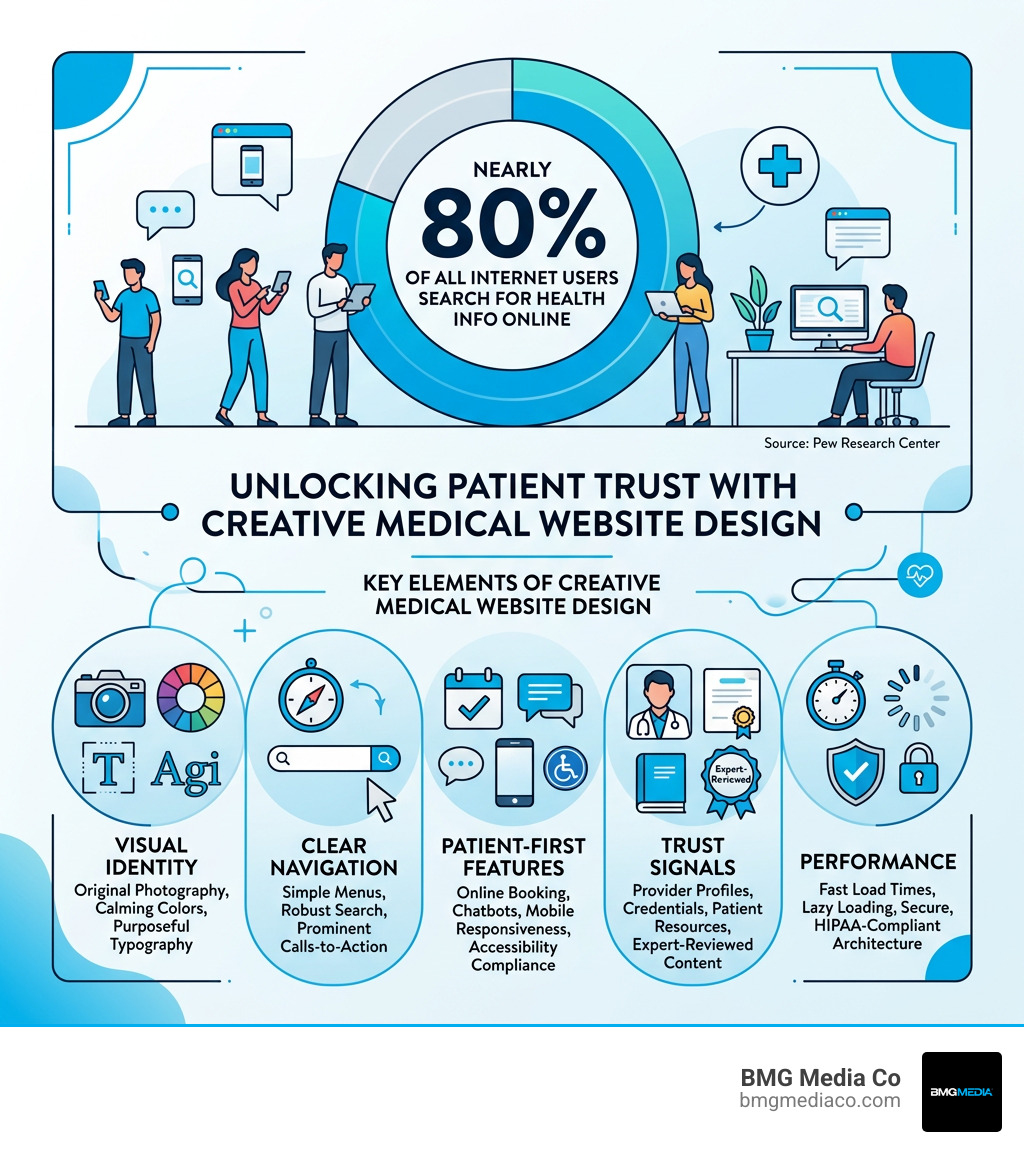
Nearly 80% of all internet users have searched for health information online, according to Pew Research Center. That means your website is often the first interaction a patient has with your practice — and a generic, outdated design can send them straight to a competitor.
Healthcare websites face a unique challenge: they must be visually compelling while also being clinically credible, easy to navigate for diverse audiences, and compliant with strict regulations. Getting that balance right is what separates a forgettable medical site from one that actually converts visitors into patients.
I’m Blake George, founder of BMG Media Co, and over the past decade I’ve led the design and development of more than 1,000 custom websites — including creative medical website designs for healthcare brands across the country. I’ll break down the best examples and strategies you can use as a starting point for your own build.
Creative medical website design vocabulary:
When we talk about creative medical website design, we aren’t just talking about “pretty” pictures. We are talking about a strategic intersection of art and science. A creative design differs from a standard one by its ability to solve complex user problems through elegant, non-generic solutions.
Standard medical sites often feel clinical, cold, and cluttered with 20+ navigation links that overwhelm the user. In contrast, a creative approach utilizes Medical/Healthcare Web principles to streamline the experience. It uses ample white space and serif typefaces to convey a sense of prestige and authority, much like we did with the Legacy Dermatology Group project.
Key defining elements include:
According to Pew Research, 80% of internet users seek health information online, which makes these creative differentiators essential for standing out in a crowded market.
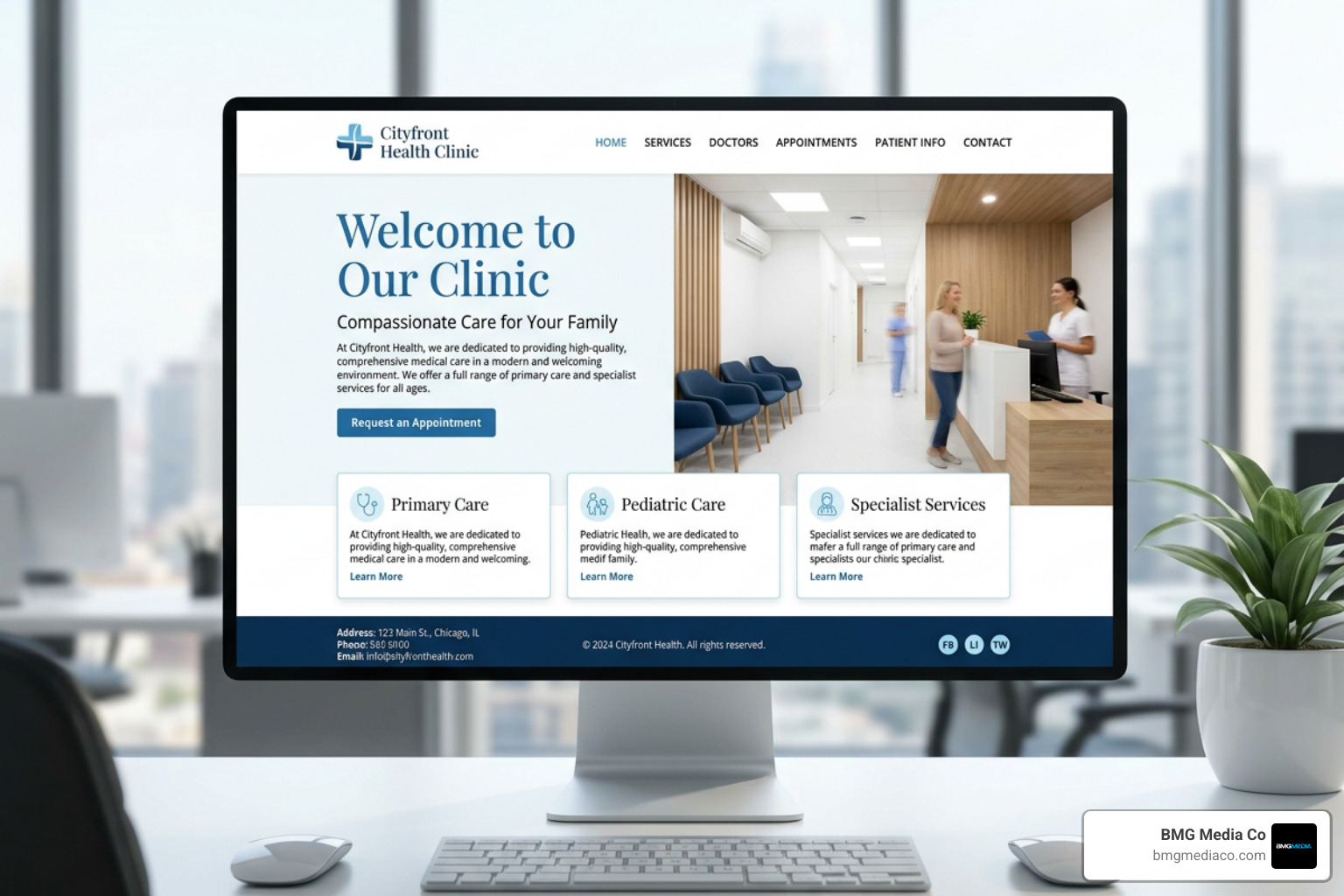
Visual storytelling is the “secret sauce” of high-converting medical sites. It’s about showing, not just telling. Instead of using generic stock photos of “doctors smiling at clipboards,” successful sites like Maven Clinic use original photography that matches their specific brand color palette. This builds immediate credibility and makes the practice feel “real” to the prospective patient.
We also see a rise in user-controlled video. Hartford HealthCare excels here by offering facility tours and provider interviews that don’t auto-play. This gives the user control, which is vital for patients who may already be feeling anxious or overwhelmed.
Furthermore, 3D animations and data visualizations can simplify complex medical concepts. For example, in our work with Motor City Orthopedics, we focus on how visual elements can guide the user’s eye toward the most important information, such as surgical outcomes or recovery timelines, without using frightening medical jargon.
To get your creative juices flowing, let’s look at some industry leaders who are pushing the boundaries of what a healthcare site can be.
A beautiful website is useless if a patient can’t find the “Neurology” department or a specific doctor. This is where robust search capabilities come in. The best creative medical website design features search bars that offer autocomplete functions and categorized results.
For instance, the Mayo Clinic search features allow users to filter by “Symptoms & Causes” or “Diagnosis & Treatment,” which mirrors the way a patient actually thinks. Integrating these with Doctor Appointment Booking Sites ensures that once the information is found, the “conversion” (booking the appointment) is only a click away.
To turn a visitor into a patient, your site needs specific “hooks” that encourage engagement. We recommend several high-performance features for every medical build:
| Feature | Standard Navigation | Patient-Centric Navigation |
|---|---|---|
| Menu Items | 20+ links in a “mega-menu” | 3-5 primary links focused on care |
| Search | Basic keyword matching | Autocomplete with categorized results |
| Mobile UX | Tiny buttons, hard to click | Large, thumb-friendly touch targets |
| CTAs | Buried in the “Contact” page | Floating or sticky “Book Now” buttons |
Accessibility isn’t just a “nice-to-have”; it’s a legal and ethical requirement. In the healthcare space, your audience often includes seniors, people with visual impairments, or those with motor-skill challenges. Adhering to WCAG 2.2 AA Standards ensures your site is usable for everyone.
Key strategies include:
Designing for healthcare means playing by a different set of rules. You can’t just throw up a contact form and call it a day. Every creative medical website design we produce at BMG Media Co is built with a “security-first” mindset.
Because of our commitment to these high standards, BMG Media Earns Clutch Leader Award for Top Web Designers in the Healthcare Space, confirming that our “Michigan-made” custom builds stand up to the toughest industry scrutiny.
To create a calming impression, use a soft color palette (cool blues, greens, or muted earth tones) and plenty of negative space. Avoid “visual clutter” like auto-playing videos, pop-ups, or aggressive red-colored buttons. High-quality, original photography of compassionate providers also helps humanize the digital experience.
This is a common challenge for large hospital systems. The best approach is to use a “tiered” navigation. Keep patient care (Find a Doctor, Locations) in the primary navigation, and move research or donation links to a secondary top-bar or a robust footer. Using “self-identifying” menus (e.g., “For Researchers”) is another effective way to separate these audiences.
Start by following the WCAG 2.2 guidelines. This includes using high-contrast colors, providing alt-text for all images, ensuring your site is fully navigable via keyboard, and using large, easy-to-click buttons. At BMG Media, we run comprehensive accessibility audits during the development phase to catch and fix issues before launch.
At the end of the day, a creative medical website design is an investment in your practice’s future. It’s the difference between a patient feeling confused and clicking away, or feeling heard and booking an appointment.
At BMG Media Co, we specialize in high-performance, fully custom builds that help healthcare providers in Birmingham, Michigan, and across the country stand out. We don’t use templates, and we don’t take shortcuts. With over 1,000 sites completed and an award-winning team, we have the expertise to translate your clinical excellence into a digital experience that converts.
Ready to elevate your practice? Build your custom creative medical website design with us today.
