August 2026
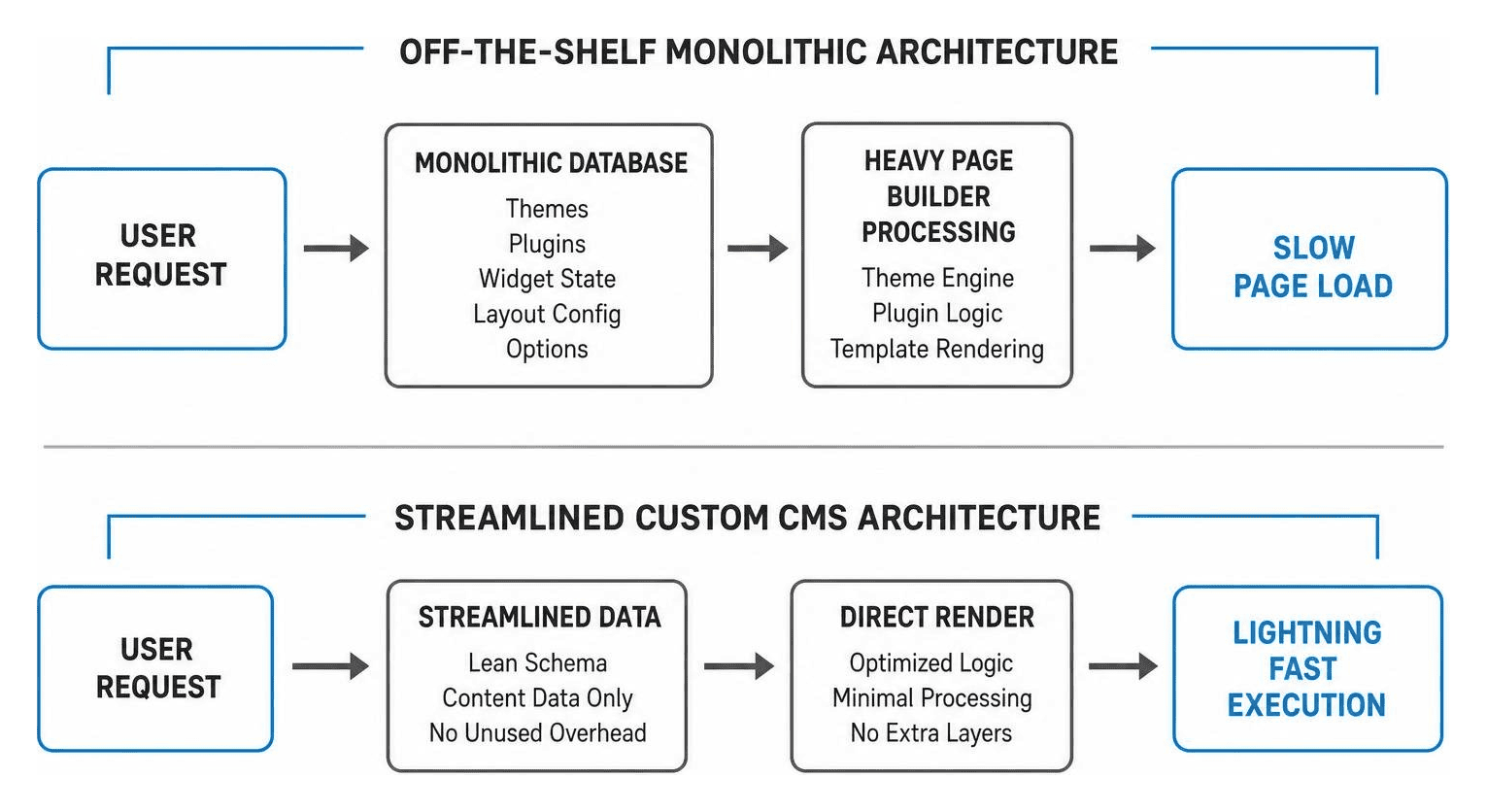
Off-the-shelf platforms are engineered to solve every potential problem for millions of different users. To achieve this universality, platforms like standard WordPress, Joomla, or generic website builders rely on heavy framework abstractions, massive visual page builders, and dozens of third-party plugins. This approach forces your infrastructure to run tens of thousands of lines of unused code on every request.
A bespoke system decouples or streamlines the two core components of site administration: the Content Management Application (CMA)—the interface where your team writes, uploads, and edits content—and the Content Delivery Application (CDA)—the backend engine that compiles, formats, and serves that content to the visitor.
In a pre-built CMS, the CMA and CDA are tightly coupled and bloated with generalized database schemas. Every simple page load queries a relational database for layout configurations, plugin options, active themes, and widget settings before it can even fetch the actual article text.
Custom software, on the other hand, utilizes a lean, hand-crafted architecture. Your database tables are designed specifically around your real content relationships—nothing more, nothing less.
When evaluating long-term ROI, understanding why your business needs a custom CMS or ecommerce build becomes clear through direct comparison:
| Performance & Strategic Vector | Off-the-Shelf Platforms (WordPress/Joomla) | Custom CMS Builds |
|---|---|---|
| Codebase Architecture | Monolithic, template-heavy, generic data models | Clean, hand-crafted, modular code |
| System Extensibility | Reliant on third-party plugins and third-party updates | Native API integrations built directly into the core |
| Page Speed & Efficiency | Bloated assets; average load times exceed 3-5 seconds | Optimized asset delivery; sub-second response times |
| Security Surface Area | High target; vulnerable to public, automated exploits | Minimal attack surface; isolated custom permissions |
| Maintenance Burden | Constant plugin breakages, security patches, template updates | Stable system updates without external dependency issues |
| Core Web Vitals Impact | Hard to optimize due to third-party scripts | Hand-optimized for pristine performance out of the box |
Performance is directly tied to conversions, user satisfaction, and search visibility. Off-the-shelf solutions suffer under the weight of visual page builders (like Elementor or Divi) that inject deep nesting of containers, excessive inline styling, and unoptimized JavaScript files.
By utilizing targeted custom cms development services, you strip away every single byte of unused execution code. This hand-crafted architecture can improve page load speed down to 0.8 seconds while offering a reliable 99.9% uptime guarantee SLA.
From a security standpoint, off-the-shelf open-source CMS platforms are constant targets for automated, script-driven cyberattacks. Because their codebases are completely open to the public, malicious hackers study their core files and third-party plugins to find zero-day vulnerabilities. A vulnerability discovered in a widely used plugin can expose millions of websites simultaneously.
A tailored CMS drastically shrinks your target attack surface. With zero reliance on third-party community plugins, the vectors used by automated botnets simply do not exist in your codebase. Furthermore, custom builds allow you to engineer compliance frameworks directly into the architecture—such as strict PCI-DSS standards for financial transactions and HIPAA-compliant data handling for healthcare portals.
While a simple blog or a local service business with three static pages can manage fine on basic platforms, growing organizations quickly run into a brick wall of technical debt.
The businesses that benefit most from a tailored CMS include:
Modern content delivery is no longer restricted to a single desktop web browser. Today, your digital assets must feed mobile applications, smart displays, wearable devices, partner feeds, and internal web portals simultaneously. This reality has driven the adoption of headless CMS architecture.

In a traditional monolithic setup, the administrative backend and the public-facing display (the frontend design) are fused together. In a headless setup, the frontend presentation layer is completely separated (decoupled) from the backend content database. The CMS acts purely as a content repository, serving data out via ultra-fast RESTful or GraphQL APIs.
Using modern headless architecture with frameworks like React, Next.js, or Vue on the frontend can achieve an API response time of 50ms and increase deployment speed by 60%.
This API-driven layout makes business systems integration straightforward. Instead of installing messy, slow plugins that attempt to sync data in the background, a custom CMS communicates directly with your core enterprise applications:
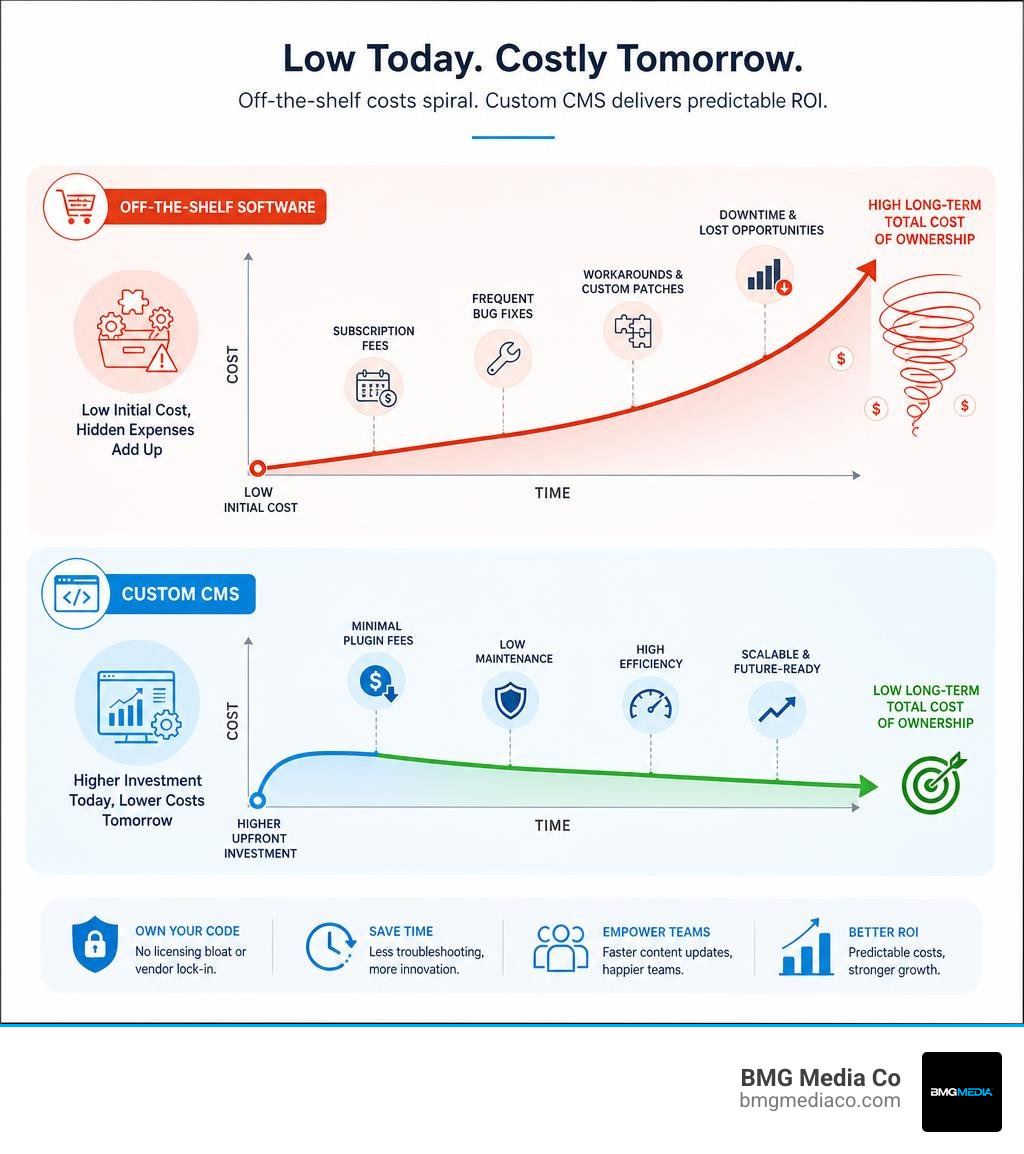
When business executives weigh custom builds against off-the-shelf platforms, the discussion often turns to upfront cost versus long-term total cost of ownership (TCO).
A standard template website may appear remarkably inexpensive on day one. However, as the site grows, hidden costs quickly mount: continuous plugin subscription fees, emergency developer interventions when updates break site functionality, expensive workarounds for simple features, and the lost revenue caused by slow load times and security vulnerabilities.
Investing in specialized custom cms development services reverses this financial equation. While the initial investment is higher, the long-term total cost of ownership is far lower. You own your code outright—eliminating licensing bloat and plugin dependencies while gaining a high-performance system that can increase content team efficiency by 70% and save 40% in ongoing development time.
Development timelines generally align with project scope:
To understand why tailored software pays for itself, discover why your business deserves custom web development solutions.
Building a bespoke CMS platform requires a clear, structured development methodology to ensure every operational requirement is fully captured, engineered, and rigorously validated.
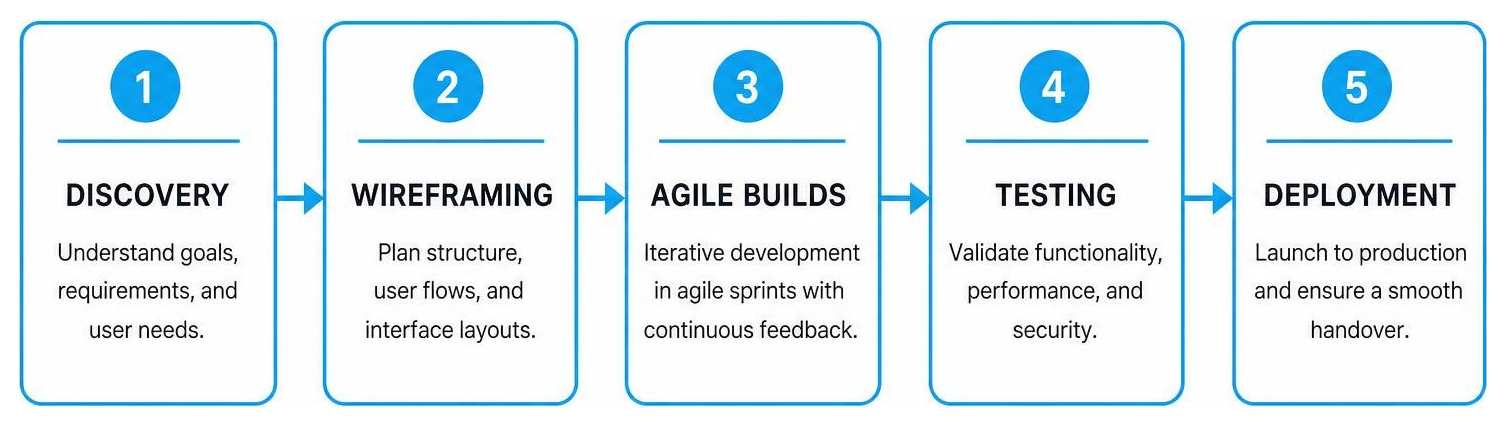
Our development process follows a disciplined, five-phase roadmap engineered for precision and performance:
We start by dissecting your operational workflows. We map out your content creation pipelines, user roles, security requirements, and third-party data connections. This phase establishes clear project objectives before a single line of code is written.
We design the exact database schema, component relationships, and API endpoints needed for your system. Concurrently, we prototype the editor interface in Figma, ensuring your content creators receive an intuitive, uncluttered administrative interface tailored specifically to their publishing steps.
Using short, iterative development cycles, our engineering team builds your CMS backend and frontend interfaces. We enforce strict role-based access control (RBAC), granular permission settings, automated content versioning, and clean audit logs.
Before release, the platform undergoes comprehensive quality assurance: load testing to ensure high-traffic stability, automated security vulnerability scans, cross-browser rendering checks, and WCAG accessibility compliance checks.
Data migration must be handled delicately. We stage your custom build in a parallel server environment, performing full 301 URL redirect mapping, structural metadata transfers, and pre-launch SEO audits. This meticulous execution allows custom CMS migrations to achieve 100% traffic retention post-migration with zero operational downtime.
For an in-depth dive into bespoke methodology, explore our complete guide on demystifying custom software development solutions.
An open-source platform relies on generic, public codebases designed to fit every type of website, requiring third-party plugins and heavy visual builders for custom features. A custom CMS is engineered from scratch for your specific business logic, data models, and workflow needs. It eliminates code bloat, removes plugin vulnerabilities, delivers significantly faster page speeds, and transfers total intellectual property ownership to your company.
Timeline depends directly on structural complexity. Focused custom builds generally take 6 to 12 weeks. Large enterprise custom platforms requiring deep CRM/ERP integrations take 12 to 18 weeks. Complex multi-site legacy ecosystem overhauls and data migrations typically span 20 to 40 weeks.
Yes. With proper migration protocols—including full 301 redirect mapping, structural database translation, parallel staging environments, and comprehensive pre- and post-launch SEO audits—a custom CMS migration can retain 100% of your search engine traffic while improving search visibility through enhanced page speed and cleaner Core Web Vitals.
Relying on off-the-shelf page builders and stacked plugins introduces speed bottlenecks, security vulnerabilities, and workflow limitations that hold growing businesses back. When your website becomes central to your operations, settling for template workarounds creates technical debt that slows down your momentum.
A custom-built CMS gives you complete control over your digital infrastructure. From hand-crafted database architectures and lightning-fast load times to seamless headless API integrations and tailored publishing workflows, bespoke software turns your backend interface into a business asset.
At BMG Media Co., we have spent over 15 years building high-performance digital platforms completely from scratch—no templates, no page builder bloat, and zero shortcuts. If you are ready to eliminate technical debt and elevate your web operations, explore our premium custom web design and development services and let’s build a platform tailored for your long-term growth.
