July 2026

Custom software development solutions are software applications built specifically for your business, your workflows, and your goals — rather than adapted from a generic product designed for everyone.
Here’s the short version of what you need to know:
If you’ve ever found yourself duct-taping five different SaaS tools together just to run a single business process, you already understand the core problem custom software solves.
The global custom software development market was estimated at $50.94 billion in 2026 and is projected to reach $115.95 billion by 2031 — a signal that businesses across every industry are increasingly choosing purpose-built over packaged.
But “custom software” is one of those terms that gets used loosely. You’ll hear bespoke software, tailor-made software, and custom application development used interchangeably. This guide cuts through the jargon and gives you a clear framework for understanding what custom software actually is, when it makes sense, what it costs, and how to get it right.
I’m Blake George, founder of BMG Media Co. and a digital strategist with over 15 years building custom software development solutions for businesses ranging from startups to multi-billion-dollar enterprises. This guide draws on that experience to help you make smarter decisions about your software investments.
Common custom software development solutions vocab:
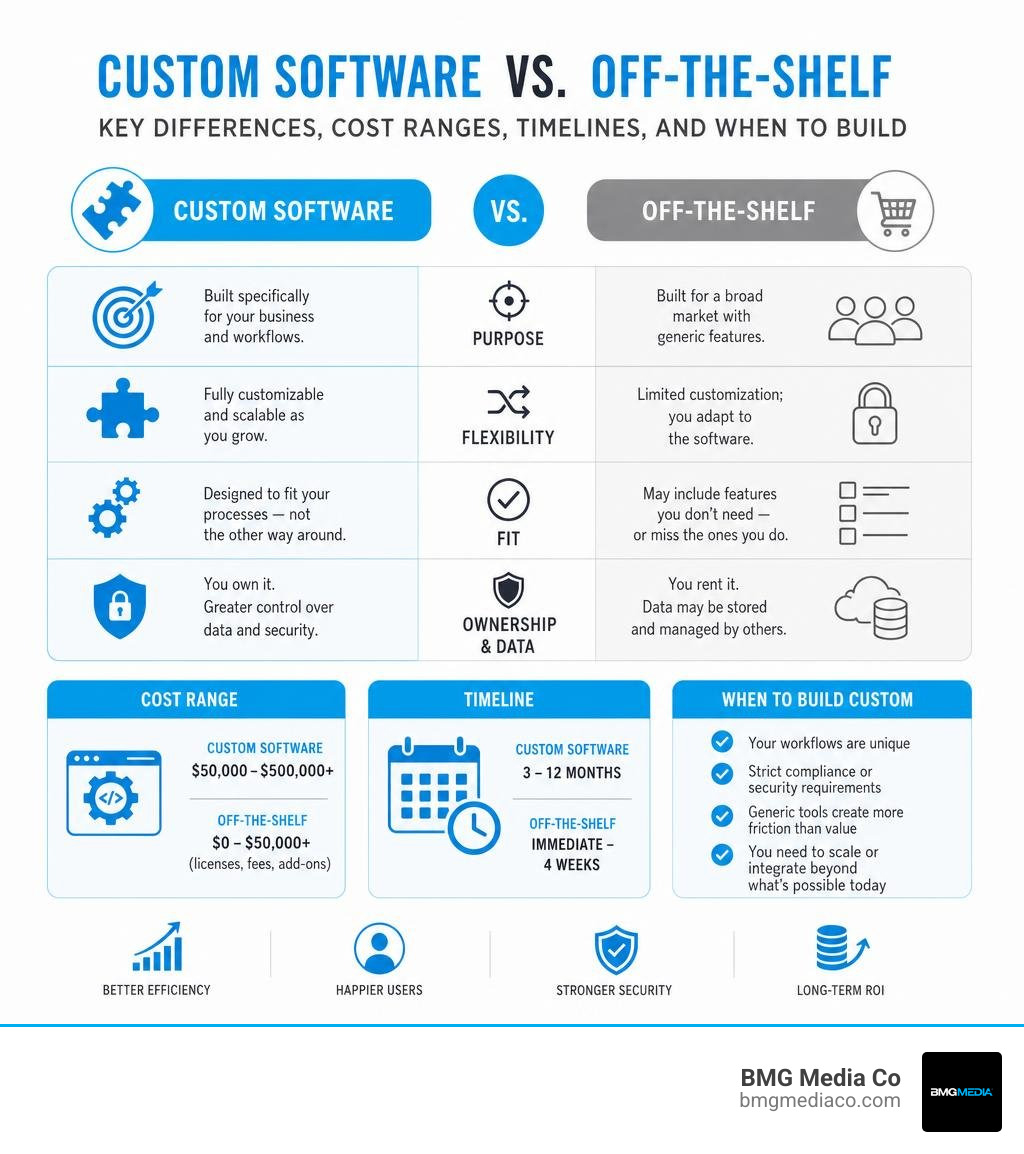
To truly understand how custom builds transform operations, we have to look at the underlying software engineering. Commercial off-the-shelf (COTS) software is designed to be a “one-size-fits-all” solution. It is built for the mass market, meaning the vendor must design features that satisfy the lowest common denominator of thousands of different businesses.
While COTS tools like Salesforce, QuickBooks, or generic project management platforms are excellent for standard business functions, they inevitably introduce workflow friction when applied to specialized operations. When your team has to adjust their daily habits, manually copy-paste data between systems, or create elaborate Excel-based workarounds just to fit into a pre-made software’s rigid structure, your technology is no longer serving you—you are serving your technology.
Bespoke software engineering flips this dynamic. Instead of forcing your business to adapt to the software, the software is engineered to mirror your exact workflows, terminology, user roles, and data structures. This seamless alignment is what gives growing companies a distinct competitive edge. By automating manual steps and eliminating disconnected systems, you unlock operational efficiencies that pre-packaged alternatives simply cannot replicate.

When comparing custom builds to off-the-shelf platforms, many decision-makers get sticker shock from the upfront development cost. However, a true financial evaluation requires looking at the total cost of ownership (TCO) over a three- to five-year horizon.
With commercial software, you are locked into recurring licensing fees that scale with your headcount. Add in the cost of mandatory upgrades, premium support tiers, and the inevitable custom consulting fees required to make the “packaged” tool work with your other systems, and the lifetime cost of COTS rises dramatically.
Custom software development solutions eliminate these per-seat licensing surprises. Once the software is built, you own the asset. As your team grows from 50 to 500 users, your software costs do not scale linearly. This makes custom solutions highly cost-effective in the long run, with most businesses realizing a full return on investment within 18 to 24 months through reduced operational overhead and eliminated subscription fees. To explore why tailored digital assets outperform rigid templates, read our guide on Why Your Business Deserves Custom Web Development Solutions.
Like any major business investment, choosing bespoke software involves balancing clear advantages against real responsibilities.
The Benefits:
The Drawbacks:
For a deeper dive into how custom systems solve the limitations of generic platforms, see our article on Why Your Business Needs a Custom CMS or Ecommerce Build.
Deciding whether to build from scratch, buy off-the-shelf, or implement a hybrid model is one of the most critical technology decisions a leadership team will make.
The hybrid model has emerged as a highly practical path for mid-market and enterprise organizations. In this scenario, a company uses commercial software to handle standard, non-differentiating business functions (such as using Microsoft 365 for email or Workday for core HR) while developing custom extensions, add-ons, or integration layers to handle their proprietary, revenue-driving workflows.
Modern API extensibility makes this hybrid approach incredibly powerful. By building custom software that connects directly to the documented APIs of your legacy systems or SaaS platforms, you can preserve your existing investments while eliminating the workflow gaps that hold your team back.
| Decision Criteria | Build (Custom) | Buy (Off-the-Shelf) | Hybrid Model |
|---|---|---|---|
| Upfront Cost | High | Low to Moderate | Moderate |
| Time to Value | 3–12 Months | Immediate to Weeks | 2–6 Months |
| IP Ownership | 100% Client Owned | Vendor Owned | Shared/Custom Layer Owned |
| Competitive Advantage | High (Proprietary workflows) | Low (Same tool as competitors) | Moderate to High |
| Maintenance Burden | Client Responsible | Vendor Managed | Shared Responsibility |
| Best Suited For | Core business functions that drive unique market value | Standard administrative tasks (accounting, email) | Extending legacy systems with modern workflows |
While custom software can benefit almost any organization, certain sectors and operational functions drive the highest demand due to their regulatory complexity or highly specialized workflows.
The cost of custom software is directly tied to its complexity, the number of platforms supported (web, iOS, Android), the depth of integrations, and security requirements.
To provide a realistic picture of the financial landscape in July 2026, let’s break down the typical investment ranges across different project scales:
When engaging a development partner, you will generally choose between two primary pricing models: Fixed Price or Time and Materials (T&M).
Fixed-price models work best when project requirements are highly defined, static, and unlikely to change. However, because software development is inherently iterative, most complex projects benefit from a Time and Materials model. T&M provides the flexibility to adjust requirements, reprioritize features based on user testing, and scale team resources up or down as the project evolves. To better understand how custom engineering teams structure these engagements, refer to The Complete Guide to Custom Software Developers.
A successful custom software project is a journey of structured phases. While a complete enterprise-grade platform can take 8 to 12 months or longer, a highly functional MVP can typically be delivered within 10 to 16 weeks by focusing strictly on high-value core features.
The process begins with a dedicated discovery phase (2 to 4 weeks), where business analysts and software architects map out user flows, define system architecture, and create interactive wireframes.
From there, development moves into agile sprints (usually two-week blocks). During each sprint, developers write clean code while QA engineers run continuous testing to identify and resolve bugs early. This iterative approach ensures that by the time you reach the MVP launch and final deployment, the system is stable, secure, and fully aligned with your business goals. For real-world inspiration on what these timelines can produce, explore these Not Your Average App: Inspiring Customized Software Examples for Businesses.
High-performing software is built on a foundation of rigorous engineering standards, proactive security practices, and modern architecture.
In today’s threat landscape, security cannot be treated as an afterthought or a final step before launch. It must be baked into the development lifecycle from day one using a “security-by-design” framework. This involves aligning development with international standards like ISO 27001 for security management and OWASP (Open Web Application Security Project) Level 2 guidelines to protect against common vulnerabilities.
Key security practices include:

The choice of technology stack directly impacts your application’s long-term scalability, performance, and maintenance costs. Modern custom software development solutions favor modular, cloud-native architectures that prevent vendor lock-in and handle scaling effortlessly.
On the front end, frameworks like React, Next.js, and Vue.js deliver fast, responsive, and highly interactive user experiences across all devices. On the backend, robust languages and environments such as Node.js, Python, and .NET power complex business logic, database queries, and background processes.
Rather than building massive, monolithic applications that are difficult to update, modern architecture relies on microservices and serverless patterns. By breaking the application down into small, independent services that communicate via secure API integrations, businesses can scale specific parts of their system without needing to upgrade the entire infrastructure. This modular design is especially critical when connecting disparate business systems; learn more about this in The Missing Link: A Guide to Software Integration Web Apps.
Custom software projects are highly rewarding, but they are not without risk. According to industry research, including the Project Management Institute’s 2026 reporting, approximately 31% of complex IT projects face challenges meeting their original goals, often due to scope drift, poor communication, or a lack of stakeholder alignment.
To mitigate these risks, successful projects rely on structured change management and transparent governance. By establishing clear “phase-gate” processes—where stakeholders must review and sign off on requirements, designs, and sprint demos before moving forward—organizations can prevent scope drift and keep projects on time and on budget.
Additionally, partnering with a development agency that emphasizes clear communication, maintains detailed technical documentation, and delivers code directly to your proprietary repositories protects you from vendor lock-in and ensures long-term project momentum. To evaluate top-performing teams in your region, independent resources like Clutch’s rankings of the Top Software Developers in Michigan – Jun 2026 Rankings | Clutch.co can provide valuable benchmarks.
Choosing the right development partner is a strategic decision that goes far beyond comparing hourly rates. The ideal partner should function as an extension of your business, bringing both technical expertise and strategic consulting to the table.
When evaluating potential custom software development solutions providers, focus on three critical criteria:
To guide your selection process, read our comprehensive resource on The Ultimate Guide to Picking a Web App Partner.
As we look toward the future of digital product engineering, several emerging technologies are fundamentally changing how custom software is built and operated.
Custom software development costs vary based on features, complexity, and integration requirements. A focused MVP or rapid prototype typically starts between $50,000 and $80,000. Comprehensive business automation tools or custom CRM/ERP platforms for mid-market companies generally range from $150,000 to $250,000, while complex, enterprise-grade applications requiring advanced compliance can exceed $500,000.
With a reputable custom development partner, you should own 100% of the intellectual property, source code, and data. This work-made-for-hire arrangement should be clearly outlined in your Master Services Agreement (MSA) and Software Ownership clauses, ensuring your business gains a valuable proprietary asset with zero vendor lock-in.
A focused MVP can typically be designed, built, and launched within 2 to 4 months (approximately 10 to 16 weeks). More comprehensive, full-featured enterprise systems or legacy modernization projects typically take between 6 and 12 months from the initial discovery phase to final production deployment.
At BMG Media Co., we believe your business deserves technology that matches your ambition. Founded in 2009 by Michigan State University graduate and Shark Tank alumnus Blake George, BMG Media Co. was built on a simple, non-negotiable standard: every project is built 100% custom from scratch.
Headquartered in Birmingham, Michigan, we have grown from a local powerhouse in Metro Detroit into a globally recognized agency. With over 1,000 successfully completed projects and a distributed team providing 24/7 support, we build high-performance, secure, and scalable digital solutions for ambitious brands across the United States—from Chicago and Dallas to New York and Los Angeles.
We don’t do templates. We don’t do page builders or bloated, generic shortcuts. Every line of code, every database schema, and every user flow we deliver is hand-crafted to solve your unique operational challenges and fuel your long-term growth.
Ready to retire the workarounds and build software that actually fits your business? Get in touch with us today to schedule a founder-direct scoping consultation. Let’s build something great together.
