September 2026

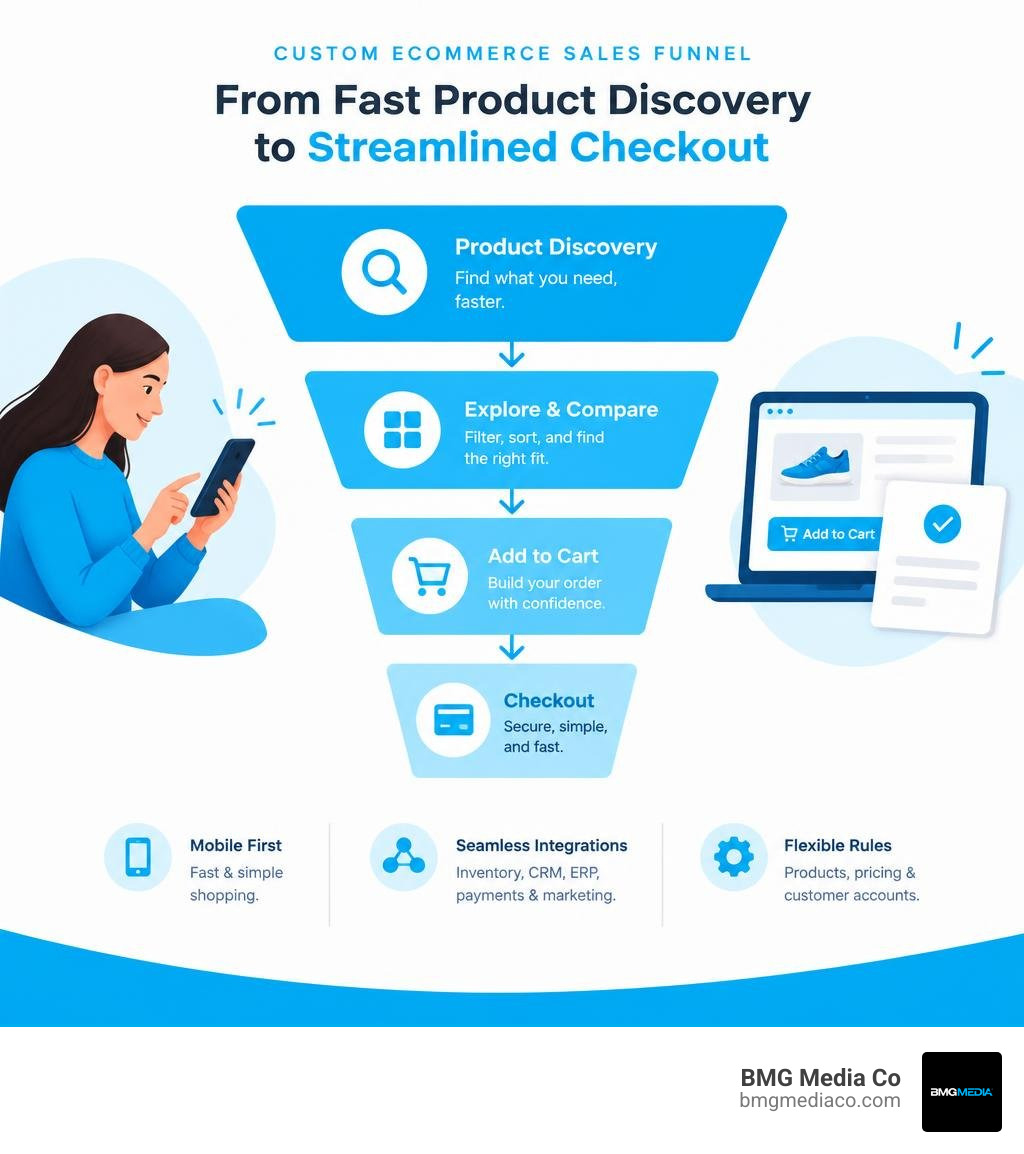
Michigan custom ecommerce solutions help growing businesses sell more by building the store around their actual customers, products, and operations – not around a pre-made template’s limits. The strongest builds focus on three priorities:
A custom store can reduce friction that causes visitors to leave, such as slow pages, confusing navigation, limited product filtering, and checkout steps that do not fit how customers buy. It also gives manufacturers, wholesalers, and retailers room for features like account-specific pricing, bulk ordering, quote requests, and live inventory visibility.
At BMG Media Co., custom ecommerce work starts with the business problem: what customers need to do, what internal systems need to share data, and what will make the buying path easier. That approach helps determine whether a custom WooCommerce build, Shopify, Magento, or a fully custom web application is the right fit.
I am Blake George, founder of BMG Media Co., and I have helped lead custom website and digital platform work for businesses since 2009. In this guide, I will explain how Michigan custom ecommerce solutions can turn a website into a more capable sales and operations tool.
Know your michigan custom ecommerce solutions terms:
Off-the-shelf templates and generic page builders offer a fast entry point, but they quickly become digital bottlenecks as order volumes climb. Pre-packaged themes carry excess stylesheets, bloated script libraries, and rigid structures designed to cater to everyone at once. When you need a unique customer journey, templates force you to install dozens of third-party plugins—each adding weight, slowing server response, and introducing security vulnerabilities.
A custom-built store strips away every line of unnecessary code. Instead of forcing your business logic into a generic framework, the architecture is tailored around your specific operational requirements.
| Feature | Custom Ecommerce Architecture | Off-the-Shelf Page Builders |
|---|---|---|
| Code Efficiency | Zero bloat, lightweight, purpose-built codebase | Heavy pre-packaged CSS/JS frameworks |
| Page Speed & Load Time | Sub-second load times optimized for Core Web Vitals | Slowed down by excess script overhead and generic plugins |
| Checkout Personalization | Fully bespoke, frictionless, one-page or multi-step checkout | Constrained by rigid default checkout templates |
| System Integrations | Direct API connections to ERP, CRM, and warehouse databases | Relies on brittle, generic third-party connector apps |
| Security & Scalability | Hardened custom database queries and isolated endpoints | High vulnerability footprint due to widespread plugin use |
Custom architecture delivers significant conversion rate improvements by eliminating the friction that drives bounce rates upward. When an online store loads instantly, presents clear product data, and guides users straight to checkout without unnecessary steps, buyers complete their transactions. Understanding why your business needs a custom CMS or ecommerce build starts with recognizing that your digital storefront is an active sales engine, not just an electronic brochure.
Turn clicks into customers—because every click deserves a happy ending. Maximizing conversion rates requires engineering every touchpoint with precision. When mobile shoppers hit a site that takes more than three seconds to load, bounce rates skyrocket. Custom engineering focuses on Core Web Vitals from the first line of code, optimizing Time to First Byte (TTFB), eliminating layout shifts, and keeping interaction delays near zero.
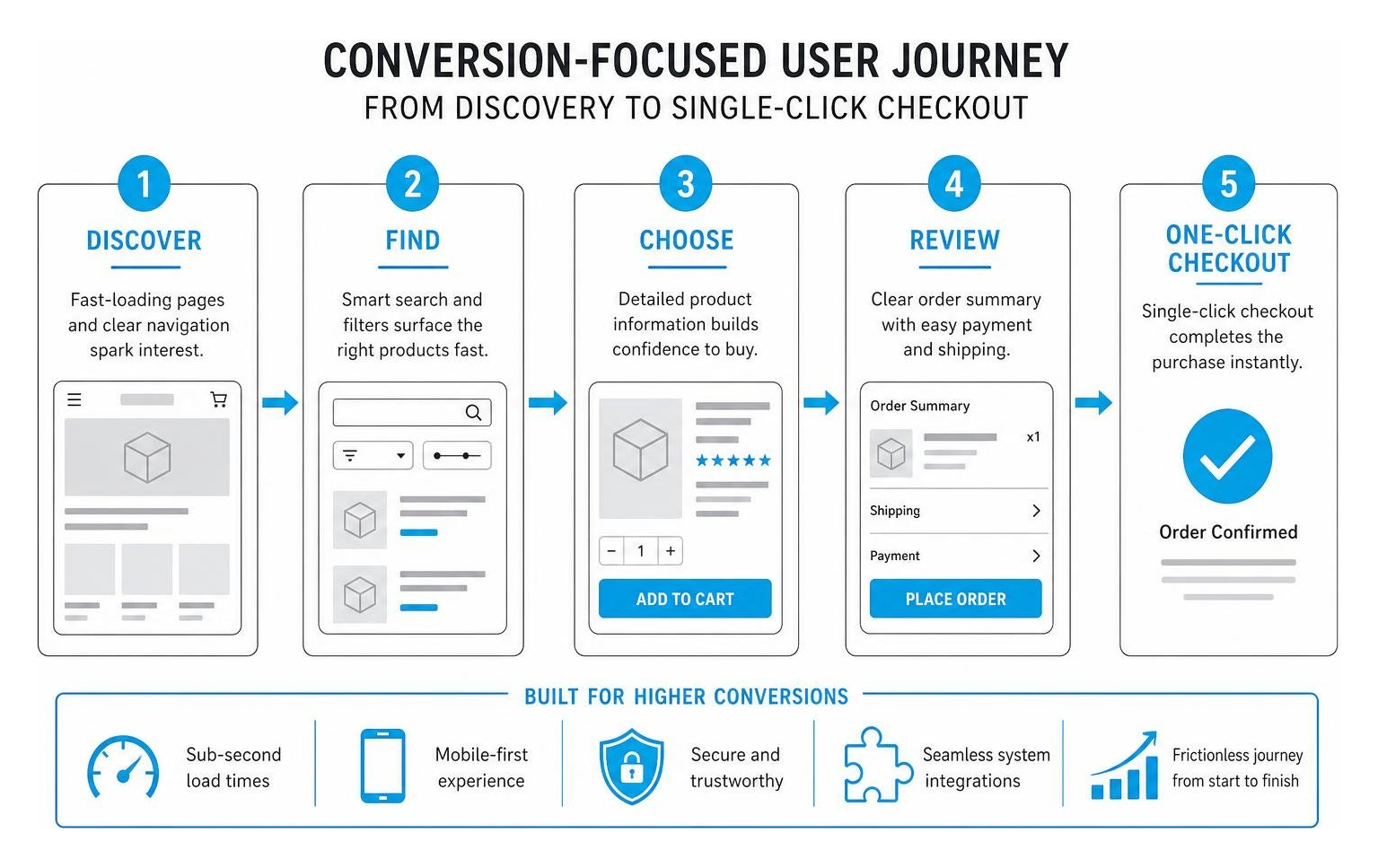
Mobile responsiveness in a custom build is not an afterthought where desktop blocks are awkwardly stacked for smaller screens. It is designed ground-up for touch targets, thumb-friendly navigation, mobile wallets (Apple Pay, Google Pay), and distraction-free checkout funnels. This is precisely why Michigan conversion optimization services outperform redesigns; performance is baked directly into the custom codebase rather than patched over an unstable foundation.
Selecting the proper ecommerce engine depends entirely on your product catalog, operational complexity, and growth trajectory. No single platform fits every business model. For example, in custom ecommerce builds for growing retailers like Modern Skate & Surf, crafting tailored product catalogs and optimized checkout architecture eliminates third-party plugin bloat while ensuring seamless stability during peak sales periods.
Making the right decision requires selecting the ideal Michigan website design agency for growth to evaluate your operational requirements against total cost of ownership.
A storefront should never exist on an island. If your internal team spends hours manually re-entering website orders into your accounting software or updating stock counts across multiple systems, your website is actively creating overhead. Custom ecommerce platforms excel at automated data orchestration.

Using secure REST and GraphQL endpoints, custom systems communicate directly with your enterprise software suite. Automated inventory synchronization prevents stockouts and over-selling by updating availability across warehouse locations in real time. Customer data, purchase histories, and abandoned carts flow straight into your CRM (like HubSpot or Salesforce) to power automated retention workflows.
By utilizing Michigan API integration services connecting apps and databases, payment gateways, third-party logistics (3PL) providers, and shipping carriers communicate smoothly, automating label generation, customs documentation, and tracking notifications.
Michigan is an industrial powerhouse, and industrial and B2B digital commerce operates on completely different principles than everyday consumer retail. A manufacturer selling precision tooling cannot use a standard retail checkout that only takes retail credit cards and charges flat shipping.
Custom platforms cater directly to complex B2B buying behavior:
Delivering these complex capabilities requires tailored e-commerce website development for the industrial sector that meets the high standards Michigan businesses expect from a digital partner.
Migrating from an outdated, legacy ecommerce platform to a modern custom environment can cause anxiety around lost order data or declining Google rankings. A botched replatforming can devastate organic search traffic overnight if legacy URL paths return 404 errors.
A disciplined migration process follows strict protocols:
Product, Offer, AggregateRating).Leveraging established magento integration expert secrets for seamless ERP sync ensures your data pipelines remain reliable throughout the cutover.
Building an enterprise-ready ecommerce platform from scratch is an engineering investment that requires careful scoping, discovery, and precision execution. Understanding web app development costs from shoestring to enterprise allows business owners to budget accurately for long-term ROI rather than quick-fix patches.
Most custom ecommerce projects start in the low five figures, with detailed proposals provided after a thorough discovery call. Total investment scales based on:
Most custom ecommerce website projects take between three and six months from discovery to launch, depending on complexity and content readiness.
Post-launch maintenance ensures continuous security, optimal server response, and platform longevity. High-performance managed hosting, active Core Web Vitals monitoring, routine database optimization, and compliance updates (ADA accessibility and payment security standards) keep your store running reliably around the clock. For high-growth retailers like Modern Skate & Surf, custom architecture has proven essential for maintaining checkout stability during peak sales periods without relying on unstable third-party plugin stacks.
Custom ecommerce projects generally start in the low five figures. The final investment depends on specific system requirements, such as whether the store needs direct bidirectional ERP synchronization, custom pricing tiers for wholesale clients, specialized product configurators, or custom payment gateway logic. A transparent discovery phase provides a defined scope and fixed-fee proposal before any coding begins.
A typical custom build takes between three and six months from initial discovery to final deployment. Highly complex enterprise projects involving extensive database migrations or multi-system software integrations may take longer, whereas streamlined builds with readily available product data and assets can launch closer to the twelve-week mark.
While we are headquartered in Birmingham, Michigan, we partner with businesses across the country. Modern distributed workflows, shared project management dashboards, regular video milestones, and staging environments ensure complete transparency regardless of physical distance. Clients receive direct access to senior engineers and continuous momentum throughout every project stage.
Your digital storefront is the core engine of your modern sales operation. Relying on generic templates and patchwork plugins creates friction for your customers, introduces security liabilities, and caps your revenue growth. Investing in custom ecommerce architecture gives your business the speed, reliability, and backend automation needed to scale without constraints.
Headquartered in Birmingham, Michigan, BMG Media Co. brings a proven track record of delivering high-performance, completely custom digital solutions. Our team has built 1000+ websites since 2009, hand-crafting every line of code without using templates or bloated page builders. From growing retail brands to complex industrial manufacturers across Metro Detroit, Troy, Ann Arbor, and nationwide, we engineer digital storefronts designed to convert.
Explore our custom web design capabilities to see how bespoke engineering transforms digital commerce, or request a free quote today to plan your custom ecommerce build.
