July 2026

Choosing a company name is one of the first — and most consequential — decisions you’ll make as a founder. Here’s a quick overview of the key steps:
A bad name won’t kill a good company — but it can feel like it could. The wrong choice can trigger trademark disputes, confuse customers, limit your ability to scale, and cost tens of thousands of dollars to fix through a rebrand. The right name, on the other hand, does real work: it builds recognition, supports search visibility, and gives your brand room to grow.
Yet most founders rush this step or get stuck in it entirely. Some spend weeks agonizing over a single word. Others pick something too narrow, too hard to spell, or — in one well-documented case — something that means something very different in another language.
The naming process has real legal structure behind it. It touches state filing requirements, federal trademark law, domain strategy, and brand positioning — all at once. That’s a lot to navigate, especially when you’re trying to get a business off the ground.
I’m Blake George, founder of BMG Media Co., and over the past 15+ years of helping businesses — from early-stage startups to multi-million-dollar enterprises — build their digital presence, choosing a company name has consistently been the step that either sets a brand up for momentum or quietly holds it back. In this guide, I’ll walk you through the full process, from your first brainstorm to legal registration and beyond.
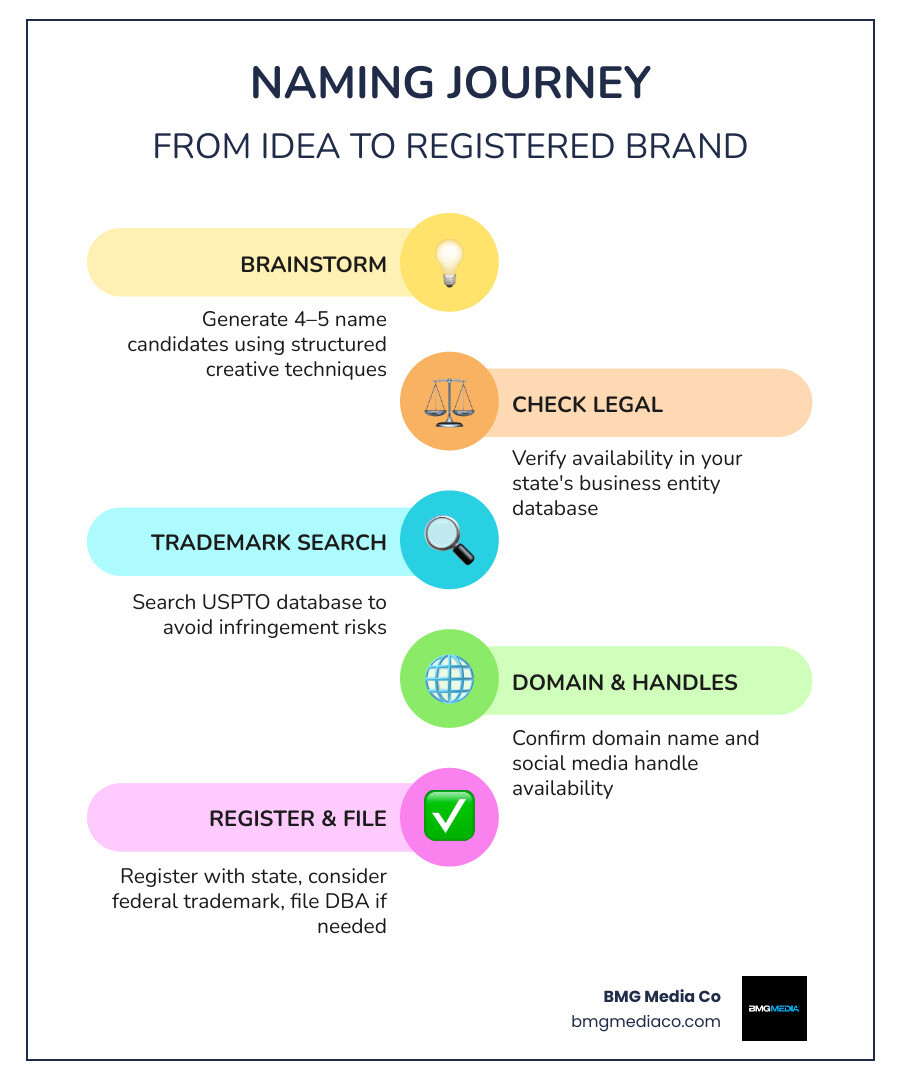
Choosing a company name terms you need:
Before you fall in love with a name, you have to understand the legal boundaries. Naming a business isn’t just an exercise in creative writing; it’s a legal filing process. When you register a business, you are interacting with state-level filing offices, federal trademark databases, and domain registrars. Each of these operates independently, which means securing one does not automatically grant you rights to the others.
The foundational rule of state registration is distinguishability. The legal name of your LLC or corporation must be entirely distinguishable from the names of other active entities already on record with your state’s filing office. Most states will not allow you to register a name that is already taken or is confusingly similar to an active business. Distinguishability rules vary by state, but generally, simply changing punctuation, pluralization, or adding a common corporate designator (like “LLC” or “Inc.”) will not make a name unique in the eyes of the law.
To navigate these regulations, you must consult the official guidelines. The SBA Business Naming Guide outlines the four distinct ways to register and protect a business name: as a legal entity name, a federal trademark, a DBA, or a domain name. Understanding how these layers interact is the first step toward building a legally secure brand.
Your chosen business structure directly dictates the rules you must follow when choosing a company name. If you are forming a formal business entity, such as an LLC or a C-Corporation, state laws require you to include specific designators at the end of your name.
For a Limited Liability Company, you must include designators like “Limited Liability Company,” “LLC,” or “L.L.C.” For corporations, you must use suffixes such as “Corporation,” “Incorporated,” “Company,” “Limited,” or their respective abbreviations (“Corp.,” “Inc.,” “Co.,” “Ltd.”).
Conversely, if you operate as a sole proprietorship or a general partnership, you are legally required to conduct business under your personal surname (or surnames) unless you formally file a Doing Business As (DBA) registration. For example, if your name is John Smith and you start a custom home remodeling business, your legal business name is simply “John Smith” until you file the appropriate paperwork to trade as “Smith Remodeling.”
Additionally, every state maintains a list of restricted and prohibited words. Words like “Bank,” “Trust,” “Insurance,” “Attorney,” or “University” typically require specialized licensing, professional credentials, and additional state paperwork before they can be included in your business name. If you want to dive deeper into how your business entity selection shapes your naming constraints, you can read More info on choosing a business name.
One of the most common points of confusion for new business owners is the difference between a legal business name, a brand name, and a DBA (Doing Business As). They are not the same thing, and they serve completely different operational and legal functions.
Using a DBA provides incredible branding flexibility. For instance, a single parent company registered as “Michigan Custom Holdings, LLC” can file multiple DBAs to operate “Detroit Custom Cabinets,” “Birmingham Kitchen Design,” and “Troy Tile Works” as separate customer-facing brands under one legal entity.
To help visualize how these names function in the real world, review the comparison below:
| Feature | Legal Business Name | Brand Name | DBA (Doing Business As) |
|---|---|---|---|
| Primary Purpose | Government registration, tax compliance, and legal liability. | Customer recognition, marketing, and emotional connection. | Operating under a name different from your legal entity name. |
| Required Suffixes | Yes (e.g., LLC, Inc., Corp.). | No. | No (in fact, DBAs generally cannot include “LLC” or “Inc.”). |
| Uniqueness Rule | Must be distinguishable on state records. | Must not infringe on active trademarks. | Multiple businesses can use the same DBA in many states. |
| Where it Appears | Tax returns, bank accounts, vendor contracts, legal agreements. | Website, logo, signage, social media, product packaging. | Local advertising, customer invoices, business bank accounts. |
Once you understand the legal guardrails, you can dive into the creative side of choosing a company name. Brainstorming should be treated as a structured process rather than a random search for inspiration. If you sit in a room and wait for a lightning bolt of genius, you are likely to end up frustrated.
A great name is built on a clear understanding of your brand’s personality, core values, and target market. Before writing down name ideas, define your brand’s core attributes. Are you modern, tech-forward, and disruptive? Or are you traditional, reliable, and premium?
As outlined in the Shopify Brand Naming Guide, brand names generally fall into distinct structural categories:
To move past generic ideas, you need structured brainstorming exercises that force your brain to make lateral connections. Here are three highly effective techniques:
If you want to read about more creative ways to break through writer’s block and generate concepts, check out More creative ways to generate ideas.
Once you have a shortlist of 3 to 5 candidate names, you must test them in real-world scenarios. A name might look beautiful on a whiteboard, but fail completely when spoken aloud or translated to a digital interface. Use these three diagnostic tests to evaluate your names:
At BMG Media Co., because we build every single website 100% custom from scratch, we know that a name’s visual layout directly impacts your UI/UX and digital identity. To learn how a name transitions from a blueprint into a functional brand, read More info on creative development names.
You have a name you love, it sounds great on the phone, and it looks beautiful on paper. Now comes the ultimate filter: validation. In 2026, finding a name that is completely clear of trademark conflicts and has an available digital footprint is one of the hardest parts of launching a business.
State-level business registration only checks if another company is registered under that exact name in your specific state. It does not protect you from federal trademark infringement. If you register a name with your state, but it infringes on a federally registered trademark in your industry, you can still be forced to rebrand.
As detailed in the Stripe Startup Naming Guide, “ownability” is a critical metric. You must evaluate your chosen name across federal trademark databases, domain registries, and social media platforms to ensure you can claim and protect your brand identity.
A trademark protects a business name, logo, or slogan at the national level, preventing competitors in the same industry from using confusingly similar marks. To ensure your name is safe to use, you must conduct a thorough trademark search:
If you are unsure about the legal clearance of your name, consulting a trademark attorney can save you from incredibly costly lawsuits down the road. For more guidance on navigating this professional landscape, read More info on naming companies.
In our digital-first economy, your domain name is your brand’s virtual storefront. Ideally, you want to secure the exact-match .com domain for your business name. However, short, exact-match dictionary .com domains are highly scarce and often incredibly expensive.
If your exact name is taken, you have several strategic options:
.com extension without paying premium prices for a parked domain..io, .dev, or .co are widely accepted. If you are building an artificial intelligence brand, .ai has become the industry standard.Once you have secured your domain, the next step is translating that name into a high-performance web presence. To explore creative ideas on how to align your domain strategy with your web development goals, read More info on web development naming.
If your business is successful, it won’t stay confined to your home city or state. You must choose a name that can scale with your long-term growth trajectory. If you plan to expand your operations to other states, you will need to file for a “foreign qualification” in those jurisdictions.
When you apply for a foreign qualification, the state filing office in the new state will check your legal business name against their own database of registered entities. If your name is already registered by a local business in that state, your application will be rejected.
To expand, you will be forced to adopt an “assumed” or “fictitious” name specifically for use in that state. This means managing different brand names in different regions, which fragments your marketing efforts and dilutes your brand equity.
To prevent this, you can proactively utilize name reservations and name registrations. A name reservation temporarily holds a name (typically for 60 to 120 days depending on the state) while you prepare to file. A name registration is a longer-term option (usually lasting one year) that allows a corporation to preserve its legal name in a foreign state before officially qualifying to do business there.
If you plan to scale internationally, the challenges multiply. You must perform trademark searches in every target country (such as using the EUIPO database in Europe or the WIPO database globally) and hire local cultural consultants to perform linguistic checks. A name that sounds premium in English might have an offensive, ridiculous, or highly inappropriate meaning in another language.
Even the most experienced entrepreneurs make mistakes during the naming phase. To ensure your brand is built on a solid foundation, avoid these common pitfalls:
An entity name is registered at the state level when you form an LLC or corporation. It prevents other businesses in your specific state from registering an identical name, but it offers no protection in other states or against federal trademark claims.
A trademark is registered at the federal level with the USPTO. It provides nationwide protection within your specific industry, giving you the exclusive right to use the name in commerce and the legal standing to sue competitors who use confusingly similar names.
No. Your domain name does not have to match your legal business name. Many businesses use a formal legal name for corporate registration and tax purposes, while using a shorter, more memorable brand name and domain for their website. For example, your legal name could be “Midwest Digital Solutions, LLC,” while your domain is “midwestdigital.com” or “getmidwest.io.”
You should expect the naming process to take at least one month of dedicated, iterative work. This timeline allows for deep brainstorming, linguistic testing, domain acquisition negotiations, and a comprehensive federal trademark search with a qualified attorney. Rushing this process almost always leads to legal or branding complications later on.
Choosing a company name is the bridge between your initial business concept and your long-term brand identity. It is a process that requires a delicate balance of creative storytelling, strategic brand positioning, and disciplined legal compliance.
At BMG Media Co., we believe that your brand name deserves a digital home that is just as unique, thoughtful, and high-performing. We don’t believe in shortcuts, templates, or bloated page builders. Every single website we design and develop is built 100% custom from scratch in our Birmingham, Michigan headquarters to match your brand’s specific goals and scale with your growth.
Whether you are launching a new startup in Chicago, expanding an enterprise brand in Dallas, or looking to refresh your visual identity in New York, our team of expert designers, developers, and brand strategists is here to bring your vision to life.
If you are ready to transition your newly chosen name into a premium digital brand, explore our guide on How to Pick the Best Naming Companies for Your Next Big Idea or reach out to us today to start building something custom.
