July 2026

Technical SEO auditing services are the process of systematically analyzing your website’s infrastructure to find the hidden problems that prevent search engines from crawling, indexing, and ranking your pages.
Here’s the quick answer if that’s all you need:
What does a technical SEO audit cover?
A professional audit delivers a prioritized action plan — not just a list of problems — so your team knows exactly what to fix first.
You could have a beautifully designed website with compelling content and still rank nowhere. The reason is almost always hiding in the code. A rogue robots.txt rule. A stray noindex tag. Redirect chains eating your crawl budget. These are invisible to anyone who doesn’t know where to look — but search engines see them on every visit.
With 53.3% of all trackable web traffic coming from organic search, the cost of ignoring these issues is real and measurable. The gap between position #1 (27.6% of clicks) and position #10 (2.4% of clicks) isn’t usually about content quality. It’s often about technical health.
I’m Blake George, founder of BMG Media Co., and over 15+ years building 1,000+ custom websites across industries, I’ve seen how technical SEO auditing services can unlock organic growth that no amount of content or link building can achieve on a broken foundation. This guide gives you everything you need to understand the process, know what to expect, and take action.
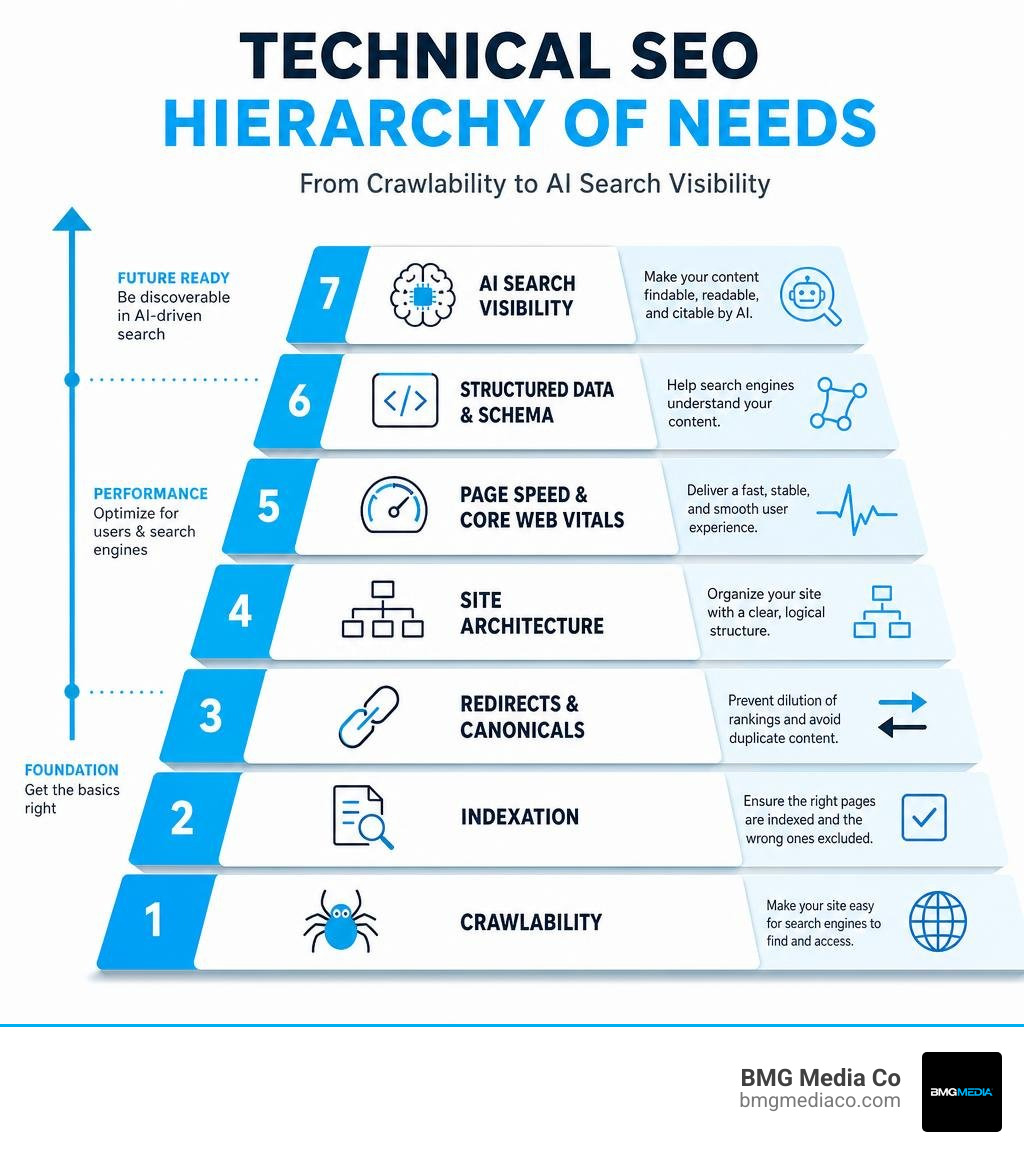
Think of a technical SEO audit as a comprehensive health checkup for your website’s engine. You wouldn’t paint a car with a broken transmission and expect it to win a race. Similarly, you cannot expect high organic traffic if your site is structurally broken. Search engine bots crawl the web constantly, looking for signals of quality, speed, and clear organization. If your site’s infrastructure is cluttered or confusing, those bots will leave, taking your rankings with them.
When we look at modern web performance in June 2026, the stakes are higher than ever. With search engines executing complex JavaScript and processing massive amounts of data, a single misconfigured canonical tag or a stray noindex directive can drop your most profitable pages from the index overnight. If you’re wondering why your marketing efforts have stalled despite publishing great content, you likely need a deep dive into your backend setup. For a detailed look at why this matters right now, check out our guide on Why Your Site Needs SEO Technical Audit Services Right Now.
A thorough audit doesn’t just look at what’s broken; it looks at how search engines interact with your entire digital footprint. It evaluates how easily search engine bots can discover your content, whether they waste time on duplicate parameters, and if they can easily render your pages. Without this baseline, you are essentially flying blind.
Investing in technical SEO is not just a line item for your IT department; it is a direct driver of business revenue. Organic search accounts for 44.6% of B2B revenue—more than double any other marketing channel. Furthermore, SEO leads boast an average 14.6% close rate, which is over eight times better than traditional outbound marketing at a measly 1.7%.
When you clean up your site’s technical debt, search engines can index your high-value pages more efficiently. Because 60% to 80% of organic leads generally come from just 10% to 20% of your pages, making sure those specific pages are technically flawless is critical. Real-world data shows that a comprehensive technical SEO investment can yield a staggering 584% three-year ROI, with the payback period often landing under three months.
Improving your site’s technical health also directly boosts your conversion rates. When a site loads instantly and behaves predictably, users stay longer and buy more. To keep a close eye on these metrics, it is vital to establish continuous monitoring. You can learn more about keeping your site optimized by reading our insights on how to Keep Your Site on Track with Performance Monitoring.
A website is a living, breathing entity. Every time your team publishes a new blog post, updates a product page, installs a plugin, or modifies a line of code, the underlying technical structure changes. Because of this constant evolution, we recommend a comprehensive technical SEO audit at least once a year as a routine health check.
However, certain major events demand an immediate, specialized audit:
If you are planning a new launch or a major site update, you must build technical SEO into the blueprint from day one. To prevent post-launch traffic disasters, consult The No-Nonsense Guide to High Performance Web Launches.
A truly professional audit doesn’t rely on simple checklists. It examines your website across multiple layers of infrastructure to ensure that search engines and human users alike enjoy a seamless experience.
Before a search engine can rank your website, it has to find it. This process relies on crawlability and indexation. Crawlability refers to the search engine’s ability to navigate through your site’s links without hitting dead ends, redirect chains, or crawl traps. Indexation is the next step: once a page is crawled, the search engine must decide whether to save it in its massive database.
Our technical audits look closely at several foundational elements:
robots.txt file, ensuring search engines have an accurate roadmap of your site.For modern websites built on dynamic JavaScript frameworks, rendering is a major hurdle. If search engine bots cannot execute your JavaScript efficiently, they will miss your content entirely. To build applications that are inherently friendly to search crawlers, check out The Developer’s Guide to SEO-Driven Web Apps.
Understanding how search engines crawl and index your site is fundamental; you can learn more about Google’s crawling process directly from the Google Search Central Documentation.
Page speed is no longer just a luxury; it is a confirmed ranking factor. Google’s Core Web Vitals measure the real-world user experience of your pages based on three primary metrics:
Because search engines use mobile-first indexing, they evaluate your site based on how it performs on a mobile screen. If your mobile layout is sluggish or hard to navigate, your desktop rankings will suffer too. To optimize these vital metrics, explore our deep dive on Core Web Vitals Optimization for High Performance Sites.
We also design every custom site to be completely responsive across all devices out of the box. You can learn more about this approach in The Easiest Way to Make Your Website Look Good on Every Screen.
Structured data (often called schema markup) is a standardized format for providing search engines with explicit clues about the meaning of a page. By implementing Schema.org code, you help search engines understand whether a page is a product, an event, a recipe, or a local business. This eligibility can win you “rich results” — eye-catching search listings that include star ratings, pricing, and FAQs.
In June 2026, structured data has taken on an even more critical role: AI Search Readiness. Large language models (LLMs) and search engines use structured data to feed their generative AI answers. If your site lacks clear schema markup, AI systems may fail to parse your content, meaning your brand won’t show up in AI search results or citations. Ensuring your schema is clean and complete is the first step to staying visible in an AI-dominated search landscape.
Many business owners believe they can run a free, automated SEO checker and get a complete picture of their site’s health. While automated tools have their place, they only scratch the surface.
| Feature | Automated SEO Tools & SaaS Checkers | Manual Expert Technical SEO Audits |
|---|---|---|
| Primary Method | Automated software crawls pages based on rigid, pre-defined rules. | Experienced developers and SEO experts analyze custom code and server logs. |
| Contextual Awareness | Low. Cannot tell if an issue actually hurts your unique business goals. | High. Tailored directly to your business model, tech stack, and user flows. |
| Accuracy | High rate of false positives and generic, irrelevant warnings. | Low. Filters out the noise to focus only on issues that move the needle. |
| Root Cause Analysis | Identifies what is broken (e.g., “50 broken links”) but not why. | Diagnoses why it broke (e.g., “a database routing conflict in your custom theme”). |
| Deliverables | A generic, automated PDF report with a template checklist. | A prioritized, developer-ready roadmap with custom code snippets. |
Automated tools like Screaming Frog, Semrush, or basic SaaS checkers are excellent for gathering raw data. They can crawl thousands of pages quickly and flag obvious errors like broken links or missing alt text. However, they lack human context.
An automated tool might flag 10,000 “issues” on your site, leaving your development team overwhelmed and unsure of where to start. Many of these flags are false positives or minor issues that have zero impact on your actual rankings or revenue. For instance, a tool can tell you that your page loads slowly, but it cannot tell you that the bottleneck is a bloated third-party tracking script that your marketing department installed last week. To understand how to test your site’s performance without blowing up your load times, read Performance Web Testing: Don’t Let Your Load Time Explode.
Furthermore, automated tools cannot provide custom, platform-specific solutions. They won’t tell you how to fix a complex database query on your custom WordPress build; they will simply tell you that the server response time is high. While basic automated tools can provide a starting point, they still require expert hands to translate raw data into real-world code and actionable strategies.
This is where human expertise becomes indispensable. A skilled technical SEO consultant acts as a translator between complex search engine guidelines and your development team. Instead of handing your developers a 200-page automated report, an expert delivers a highly curated, prioritized roadmap.
At BMG Media Co., we look at your website through the lens of custom engineering. We don’t use bloated templates or generic page builders that slow down your site and create massive technical debt. When we perform an audit, we provide developer-ready specifications and actual, hand-crafted code snippets that your team can implement immediately.
An expert-led audit ensures that every recommended fix is tied directly to a business goal: increasing visibility, building trust, or driving revenue. To understand how custom development and advanced optimization work hand-in-hand to scale your business, read How to Scale with Advanced SEO Web Optimization and Custom WordPress Development.
The search landscape is undergoing its most massive shift in decades. Traditional search engine results pages (SERPs) are sharing space with AI-driven answers, such as Google’s AI Overviews, ChatGPT search, and Perplexity. This new paradigm has birthed a new discipline: Generative Engine Optimization (GEO).
When an AI engine answers a user’s query, it doesn’t just display a list of blue links. It synthesizes information from multiple web sources and provides a direct, conversational answer with citations. If your site is not optimized for these engines, your organic click-through rate (CTR) can drop significantly — in fact, position #1 CTR can drop by up to 58% when an AI Overview appears above it.
To ensure your brand remains visible in this new era, a modern technical audit must evaluate your “citability.” This involves:
llms.txt to guide AI crawlers on how to read your site’s content.Adapting to these AI-driven shifts requires a forward-looking approach to technical SEO, ensuring your site remains highly visible across both traditional search engines and generative AI platforms.
The turnaround time for a professional technical SEO audit depends heavily on the size and complexity of your website. For smaller websites (under 100 pages) with standard setups, a light audit can be delivered in 5 to 7 business days. For larger, enterprise-level sites, e-commerce platforms with thousands of product variations, or complex international sites, a comprehensive audit typically takes 14 to 30 days. This allows time for deep log file analysis, JavaScript rendering tests, and competitor benchmarking. For highly specialized audits, the timeline is tailored specifically to your business goals and the complexity of your tech stack.
When you invest in a professional technical SEO audit, you should receive much more than a automated PDF. A high-quality service delivers:
While every website is unique, our audits frequently uncover several common culprits that quietly drain organic performance:
At BMG Media Co., we believe that your website is your most valuable digital asset. We don’t believe in templates, bloated page builders, or shortcuts. Every single website we build is hand-crafted from scratch, ensuring that your digital presence is fast, secure, and structurally optimized for search engines and AI models alike.
Headquartered in Birmingham, Michigan, and serving key national markets from Chicago and Dallas to New York and Los Angeles, we combine enterprise-grade technical capability with founder-direct, boutique attention. When you partner with us for technical SEO auditing services, you don’t just get a list of problems — you get a custom, developer-ready action plan designed to reclaim your organic traffic and scale your business.
Don’t let hidden technical debt stall your growth. If you are ready to find out what is quietly holding your rankings back, let’s start the conversation. Explore our insights on Top SEO Michigan Firm: Hunt, Don’t Get Buried in the Search Results and request your custom technical SEO action plan today.


