June 2026

The average website redesign cost in 2026 ranges from $3,000 to $160,000+, depending on your site’s size, complexity, and who you hire. Here’s a quick breakdown so you can find your ballpark right away:
| Project Type | Typical Cost Range | Timeline |
|---|---|---|
| Simple visual refresh | $1,500 – $5,000 | 1–3 weeks |
| Small business site (5–20 pages) | $3,000 – $15,000 | 3–6 weeks |
| Mid-market site (20–75 pages) | $15,000 – $80,000 | 6–12 weeks |
| Enterprise site (100+ pages) | $80,000 – $250,000+ | 3–6 months |
| E-commerce redesign | $20,000 – $125,000+ | 8–16 weeks |
Most small to mid-sized businesses land somewhere between $10,000 and $50,000 for a professional redesign.
Here’s the problem most businesses run into: they budget $8,000, then get an invoice for $15,000. Not because the agency was dishonest — but because nobody explained what actually drives the price before work started.
A website redesign isn’t just a visual makeover. It touches your site’s architecture, content, SEO, integrations, hosting, and long-term performance. Miss any one of those, and you’re paying twice.
This guide breaks down exactly what you can expect to pay, what moves the price up or down, and where the hidden costs tend to appear.
I’m Blake George, founder of BMG Media Co., and over the past 15+ years I’ve led more than 1,000 custom website projects — giving me a clear, ground-level view of what the average website redesign cost actually looks like across industries, budgets, and business sizes. Whether you’re a small business owner or a marketing director at a growing enterprise, I’ll walk you through everything you need to budget confidently.
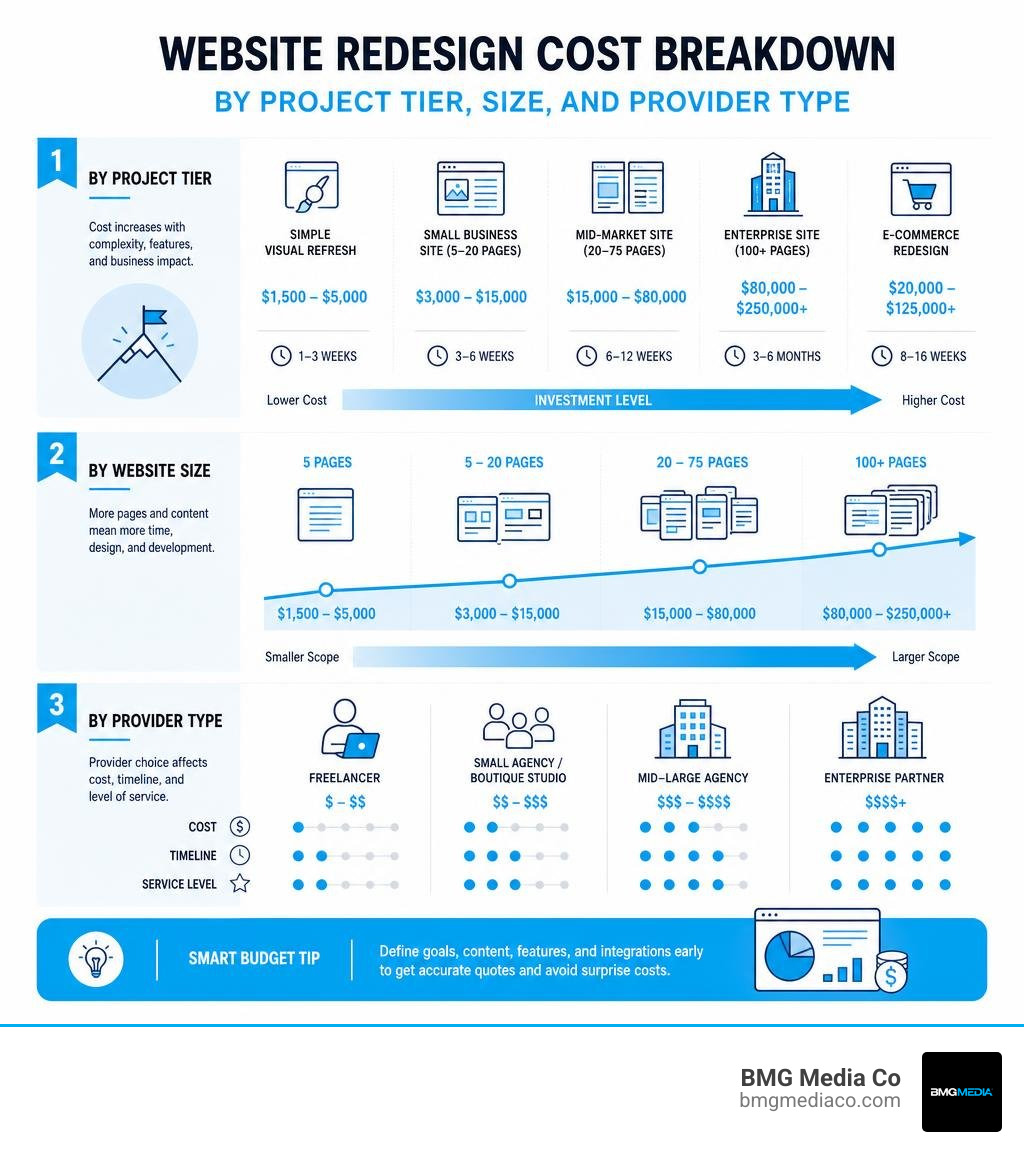
As we navigate June 2026, the digital landscape is more competitive than ever. The average website redesign cost has evolved alongside advancements in AI-driven personalization, headless CMS architectures, and stricter Core Web Vitals requirements. Today, a simple visual update can cost as little as $1,500, while a ground-up custom enterprise build can easily scale past $160,000.
When planning your budget, it is important to understand that a redesign is not just a superficial coat of paint. To remain effective, your site must continuously adapt to modern security standards, mobile-first indexing, and user experience (UX) expectations. For a deeper look into why these updates matter, read our guide on The Significance of Regular Website Updates: How Often Should You Update Your Website?.
The gap between a small business website and an enterprise platform comes down to complexity, scale, and custom engineering.
For growing companies, choosing a cookie-cutter approach instead of a tailored system can limit scalability. To understand the long-term value of custom work, explore Why Your Business Needs a Custom Website Design and Development Strategy.
To help you visualize where your project falls, let’s break down the typical market tiers in 2026. According to industry pricing frameworks, such as the Website Redesign Cost 2026: Pricing Guide & Budget Planning , redesigns generally fall into three primary execution tiers:
| Redesign Tier | Price Range | Average Hours | Core Deliverables |
|---|---|---|---|
| Basic / Visual Refresh | $10,000 – $25,000 | 50 – 150 hours | Cosmetic updates, layout polish, basic CMS theme customization, mobile optimization. |
| Mid-Range / Custom Build | $30,000 – $80,000 | 200 – 600 hours | Completely custom UI/UX design, custom CMS development, CRM integrations, basic SEO migration. |
| High-End / Enterprise | $100,000 – $200,000+ | 800 – 2,000+ hours | Bespoke frontend/backend development, complex API connections, custom e-commerce, strict accessibility compliance. |
For businesses looking for a comprehensive look at how developers structure these projects, you can read more about standard industry rates in Website redesign cost in 2026: How much to redo your site? .
No two website redesign quotes are identical because no two businesses have the same requirements. When agencies calculate your estimate, they look at several distinct cost drivers. For specialized industries like software-as-a-service, you can see how these factors apply in The Ultimate SaaS Website Redesign Guide: Inspiration and Implementation.
A common misconception is that a website’s cost is determined solely by its total page count. In reality, the number of unique page templates is the primary driver of design costs.
A 100-page website that reuse 3 basic templates (e.g., standard blog posts, simple text pages) will cost significantly less to design than a 15-page website where every single page requires a bespoke layout, custom illustrations, and unique interactive elements. Designing and developing a custom homepage, a tailored product catalog page, a specialized checkout experience, and a dynamic resource hub requires separate wireframes, design mockups, and custom frontend code for each.
Basic websites display text and images; high-performing business tools drive actions. If your redesign requires custom functionality, the development hours — and therefore the price — will scale:
Every interactive element must scale seamlessly across all screen sizes. To see how we approach responsive layouts, read The Easiest Way to Make Your Website Look Good on Every Screen.

The initial proposal from an agency or freelancer is rarely the final cost of ownership. Many businesses fail to budget for the critical backend tasks and ongoing tools required to keep a redesigned site healthy and visible. To avoid these surprises, we recommend reviewing our Website Redesign Checklist: Key Considerations for a Successful Revamp.
The single biggest risk of a poorly executed website redesign is the “SEO Trap.” If you change your URL structures, delete old content, or alter page metadata without a strict migration plan, your search engine rankings can plummet, costing you 60% to 80% of your organic traffic overnight.
A professional redesign must include:
Skipping these technical steps to save on upfront costs is a massive financial risk. Learn more about protecting your search rankings during a transition in The No-Nonsense Guide to High Performance Web Launches.
A redesigned website is a living digital asset. It requires ongoing support to remain secure, fast, and functional.
When you invest in a redesign, you are not just purchasing code; you are investing in a business tool designed to generate leads, build trust, and drive revenue. An experienced agency brings a multidisciplinary team—including UX researchers, UI designers, frontend/backend developers, SEO strategists, and project managers—to ensure your site performs at the highest level.
If you are currently evaluating your options, our guide on Finding the Right Web Design Contractor for Your Project offers practical advice on what to look for.
For businesses located in Southeast Michigan, working with a local partner who understands your market can make a major difference. Whether you are looking for local expertise in Oakland County or searching for the Best Web Design in Bloomfield Hills, MI (2026) , partnering with an established agency ensures your brand’s physical sophistication is matched by its digital presence.
Similarly, businesses in neighboring communities like Farmington Hills and West Bloomfield benefit from working with agencies that have deep roots in the Detroit metro area. If you want to explore local options, you can check out resources like the Farmington Hills MI Web Design Company – Bragg Media or connect with West Bloomfield Web Designers – Web 7 Marketing Inc to see how local design standards compare.
While freelancers often quote lower upfront rates—typically ranging from $3,000 to $10,000 per site—they present unique structural risks for business-critical projects.
Most freelancers are specialists, not generalists. A highly talented visual designer may write inefficient, unoptimized code that slows down your load times. Conversely, a brilliant backend developer may build a incredibly fast site that lacks intuitive navigation and fails to convert visitors. Furthermore, if a solo freelancer experiences a personal emergency or takes on another project, your redesign timeline can slip by months.
To compare the capabilities of different design partners, read The 10 Best Web Designers Compared.
It can be tempting to use low-cost DIY website builders or hand the project to an internal marketing team. However, this approach often results in hidden operational costs and technical limitations.
To learn more about why standard platforms often fall short of custom builds, check out our analysis of the Best Website Building Platforms 2024.
A professional website redesign should not be viewed as an expense, but as an investment. To maximize your return and keep your project on budget, consider these strategic approaches:
Most design and technology experts recommend a full website redesign every 3 to 5 years. However, you may need to update your site sooner if you experience falling conversion rates, slow page load speeds, rebranding, or if your competitors have launched significantly more modern digital experiences.
A professional, end-to-end website redesign project includes:
Only if it is done incorrectly. When you partner with an agency that prioritizes technical SEO, a redesign should actually improve your search engine rankings over time. By optimizing page speeds, improving mobile responsiveness, and cleaning up your site architecture, search engines will find your new site easier to crawl and index.
Your website is the digital front door to your business. While the average website redesign cost in 2026 varies based on your specific goals, investing in a high-quality, custom digital presence is one of the most effective ways to scale your brand and drive long-term business growth.
At BMG Media Co., we don’t believe in templates, shortcuts, or page-builder bloat. Founded in 2009 by Blake George in Birmingham, Michigan, our agency has spent over 15 years building 100% custom, high-performance websites for clients across Metro Detroit and worldwide. Every line of code we write is crafted to match your brand, optimize your conversion rates, and support your long-term growth.
Ready to plan your digital glow-up? Explore our Custom Web Design and Development Services and let’s build something exceptional together.
