September 2026

For growing businesses, the best choice is rarely “custom code or WordPress.” It is often a custom website built on WordPress: a tailored design, clean code, and a simple content editor without the bloat of a pre-built theme or page builder.
Choose custom web development over WordPress page builders when your website needs to be fast, scalable, easy to manage, and built around real business needs. A custom WordPress build can include only the features, scripts, and integrations your team uses. Templates often ship with broad styling, unused code, and plugin dependencies intended to serve thousands of unrelated sites.
This difference matters for:
WordPress still powers more than 40% of websites because it is a capable CMS. The issue is not WordPress itself. The issue is relying on a one-size-fits-all theme when your brand, customer journey, and technology needs are anything but standard.
I am Blake George, founder of BMG Media Co. Since 2009, I have led more than 1,000 website projects for organizations ranging from growing businesses to large enterprises. In this guide, I will explain how to evaluate custom web development over WordPress templates and plugins so you can invest in a site built for long-term growth.
Learn more about custom web development over wordpress:
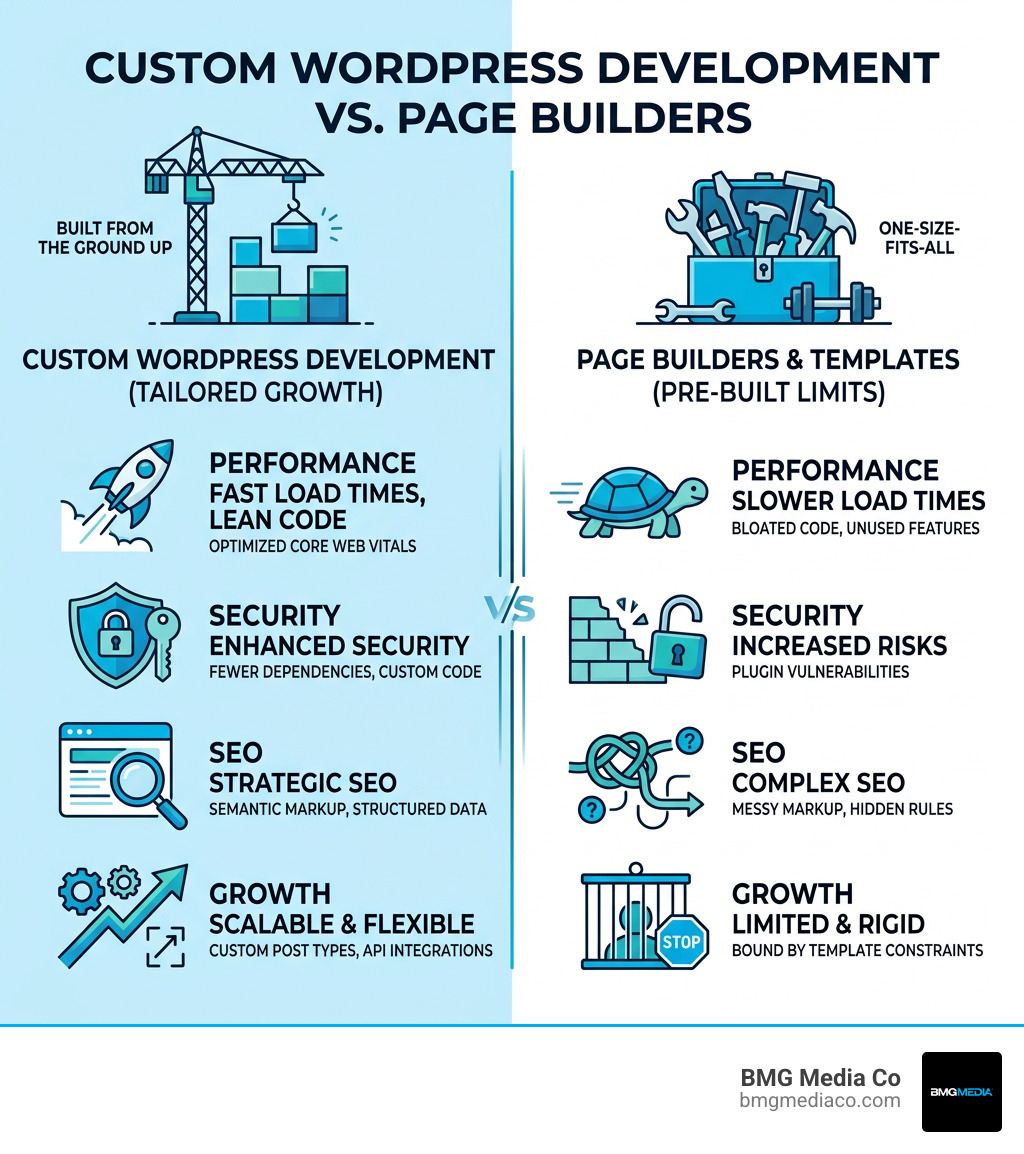
When businesses choose off-the-shelf themes, they are often buying software designed for everyone and tailored to no one. To sell thousands of copies, marketplace themes must bundle every conceivable layout, slider, icon pack, and animation style. While that might sound convenient during an initial pitch, the technical compromises surface immediately in production.
Commercial templates rely heavily on multi-layered page builders, injecting excessive wrappers and inflating Document Object Model (DOM) depth. This structural bloat forces web browsers to process megabytes of unused CSS and JavaScript before rendering a single meaningful element on the screen. The result is sluggish load times, poor mobile responsiveness, and frustrating scores on Google’s Core Web Vitals. Understanding why off-the-shelf templates fail growing brands is essential for businesses seeking a dependable digital footprint.
Beyond slow load speeds, pre-built templates introduce significant security risks through heavy plugin dependency. Site owners often install 30, 40, or even 50 separate plugins to patch missing functionality into a generic framework. Every third-party plugin represents an independent codebase, an external supply chain, and a potential backdoor for malicious attacks. When theme authors abandon updates or plugins develop conflicts after a core update, your site faces downtime. Eliminating bloated templates with bespoke themes protects your brand from these compounding vulnerabilities by keeping your technical foundation intentionally lean.
Page builders like Elementor or Divi promise drag-and-drop freedom, but they accomplish this by introducing architectural overhead. They generate hundreds of lines of visual configuration code per section, which clutters the database and slows down server-side rendering. For enterprise websites with deep content libraries, this overhead translates into noticeable delays for real users.
Custom development replaces visual builders with clean, semantic markup paired with advanced tools like Advanced Custom Fields (ACF Pro) or native Gutenberg custom blocks. By implementing WordPress custom design best practices, our engineering team gives your content editors an intuitive dashboard built exclusively around your specific branding and publishing workflows. Instead of wrestling with nested sliders and broken grid layouts, your team interacts with modular fields that maintain structural integrity across every viewport.
The performance difference between custom web development and off-the-shelf themes is stark. Premium marketplace themes often struggle with Google PageSpeed scores hovering in the 40–65 range, whereas a custom-coded theme regularly secures scores of 90–100. This disparity directly impacts how quickly visitors reach the Time to Interactive (TTI) milestone.

From a security perspective, eliminating plugin sprawl drastically reduces your attack surface. Every external library omitted from the codebase is one fewer vulnerability to manage. Modern development practices leverage tools like GitHub with integrated push protection—which has stopped over 8.3 million secret leaks globally—and automated remediation tools like Copilot Autofix, cutting mean time to remediation (MTTR) by up to 70%. When paired with clean, hand-crafted PHP 8.2+ architecture, custom code provides resilience that off-the-shelf solutions cannot rival.
Choosing custom engineering over a pre-packaged stack means building on an enterprise-grade foundation. A bespoke build treats WordPress strictly as an extensible content management engine, decoupling visual delivery from data handling whenever required.
Our custom builds leverage modern capabilities such as custom plugins, the WordPress REST API, and WPGraphQL. When a project demands ultra-fast, sub-second Largest Contentful Paint (LCP), we engineer headless WordPress setups paired with modern frontends like Next.js. This architecture allows marketing teams to enjoy the familiar WordPress editing experience while end users browse a blazing-fast, statically generated frontend. For additional architectural insights, explore the official WordPress developer documentation.
| Architectural Feature | Off-the-Shelf Theme / Page Builder | Bespoke Custom WordPress Build |
|---|---|---|
| Codebase Origin | Generic marketplace boilerplate | 100% hand-crafted from blank canvas |
| PageSpeed Score | Typically 40–65 on mobile | Consistently 90–100 optimized |
| DOM Tree Depth | Deep, nested wrappers (builder bloat) | Clean, semantic HTML5 structure |
| Plugin Count | 30–50+ plugins for basic features | 5–10 carefully audited utility plugins |
| Vulnerability Surface | High (third-party dependencies) | Low (isolated custom endpoints) |
| Scalability | Struggles under high concurrent traffic | Enterprise-grade caching and data indexing |
| Code Ownership | Locked to theme licenses and ecosystems | 100% owned by the client outright |
A custom website is an active asset engineered to generate revenue, not just a digital brochure. Sluggish page load times destroy paid advertising returns and organic rankings. Custom web development can reduce ad cost-per-conversion by up to 22% compared to bloated template sites because faster loading pages earn higher Google Ads Quality Scores and capture users before they bounce.
Investing in tailored code eliminates the compounding costs of technical debt. With an off-the-shelf theme, every future pivot or redesign requires awkward workarounds and expensive hotfixes. Learn how custom software development drives business growth by providing an expandable architecture that handles traffic spikes, campaigns, and evolving conversion funnels. Furthermore, scaling with advanced SEO and custom web builds ensures that structured data schema, automated XML indexing, and metadata modules like Rank Math operate with zero server-side drag.
Enterprise operations often rely on complex internal systems, including custom CRMs, third-party logistics tools, and ERP platforms. Off-the-shelf themes frequently break when forced to communicate with external webhooks or handle non-standard database queries.

Custom development allows for deep data modeling using tailored custom post types, custom database tables, and optimized WP_Query loops. Whether your business requires frictionless multi-step checkouts in WooCommerce, complex inventory synchronization, or tailoring site architecture for complex manufacturing needs, our engineers build dedicated endpoints tailored to your operations. Learn more about integrating custom software solutions to streamline workflows and unlock full data synchronization across your tech stack.
Delivering an enterprise custom site requires a structured, transparent engineering process. We do not rely on guesswork; our workflow follows proven software development lifecycles that guarantee precision at every stage.
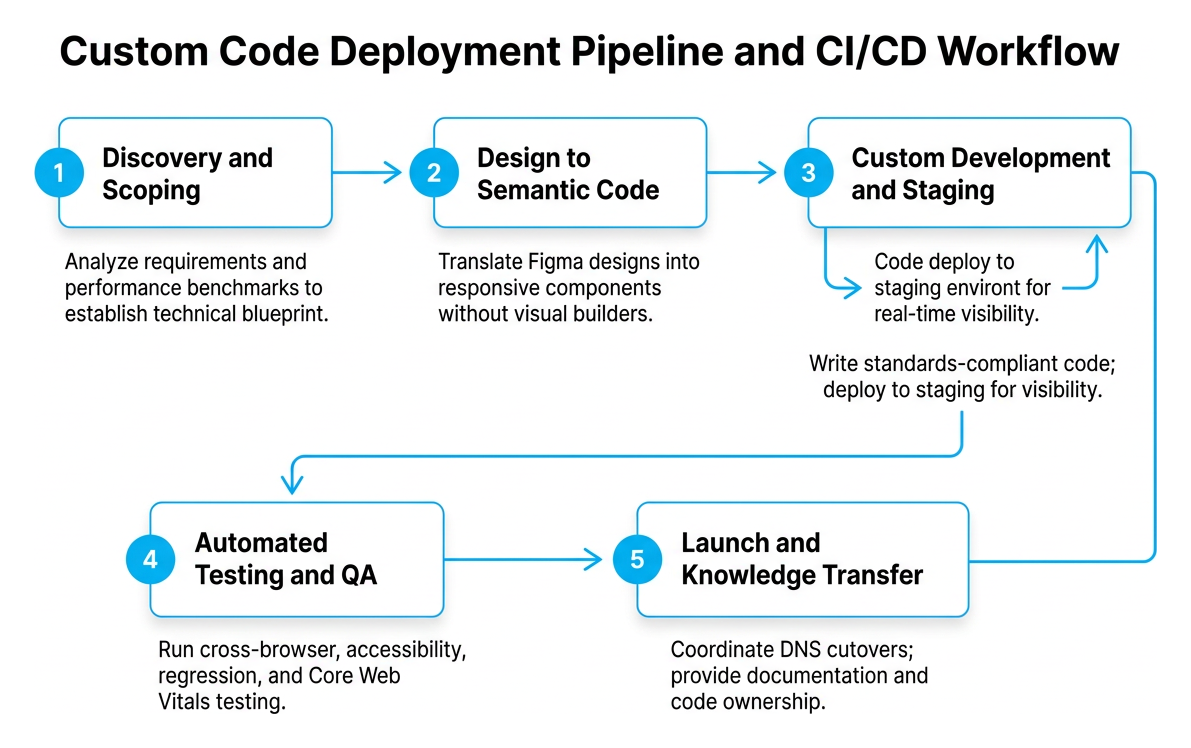
Understanding these phases is straightforward when navigating the complete guide to custom software developers. With our team, you receive 100% ownership of your clean repository—no proprietary locks, no hidden license fees, and no hostage code.
When evaluating your tech stack, it helps to weigh custom WordPress against proprietary website builders like Webflow or Shopify, as well as modern headless architectures. Proprietary SaaS platforms offer simplified hosting, but they lock you into closed ecosystems with strict database limitations, recurring platform fees, and restricted backend customization.
A custom WordPress build delivers complete flexibility, while a headless Next.js stack provides exceptional frontend rendering speed. When selecting the right custom CMS or ecommerce build, consider your long-term content strategy, internal team workflows, and technical governance requirements. Custom development ensures you retain control over your data, your infrastructure, and your digital future.
Custom development eliminates bloat by loading only the exact CSS, JavaScript, and database queries required for each page template. Pre-built themes bundle hundreds of unused styling rules and scripts designed for generic use cases. By writing lean semantic code, optimizing asset delivery, and configuring server-level caching, custom builds consistently achieve Google PageSpeed scores of 90–100.
A standard custom theme build typically takes 3 to 6 weeks from approved design files to staging delivery. More complex projects involving custom WooCommerce architectures, headless Next.js configurations, or bi-directional enterprise API integrations usually range from 6 to 12 weeks. Every phase includes comprehensive quality assurance, mobile responsiveness tuning, and performance testing.
Custom builds reduce third-party plugin counts from dozens down to a handful of audited utilities, eliminating the primary entry point for WordPress vulnerabilities. Custom endpoints and forms feature tailored data sanitization and nonces to prevent unauthorized database execution. Modern continuous integration pipelines and automated remediation tools further protect code repositories against leaks and security regressions.
Your website is the center of your digital brand and your most important sales engine. Settling for a generic off-the-shelf theme or an unstable page builder creates technical debt that slows down growth, frustrates visitors, and exposes your organization to avoidable risks. Custom web development unlocks the full power of WordPress by combining intuitive content management with high-performance, secure, hand-crafted code.
Founded in Birmingham, Michigan in 2009 by Blake George, BMG Media Co. was built on a simple principle: every website must be engineered from scratch to match the client’s business objectives. With more than 1,000 completed builds across the nation, we combine boutique design craftsmanship with enterprise-grade development depth. Accelerate your organization’s digital growth by partnering with experts for custom web design and development services that elevate your brand and outpace the competition.
