July 2026
Bespoke application development is the process of building software from scratch, designed specifically around your business — your workflows, your users, and your goals. Unlike off-the-shelf software, nothing is pre-built or borrowed from a generic template.
Here’s a quick breakdown of what that means in practice:
| Bespoke Software | Off-the-Shelf Software | |
|---|---|---|
| Built for you? | Yes — 100% custom | No — built for the mass market |
| You own the code? | Yes | No |
| Fits your workflow? | Exactly | Partially, with workarounds |
| Scales with you? | Yes | Limited by vendor roadmap |
| Upfront cost | Higher | Lower |
| Long-term ROI | Up to 4x return per dollar | Recurring fees, rising license costs |
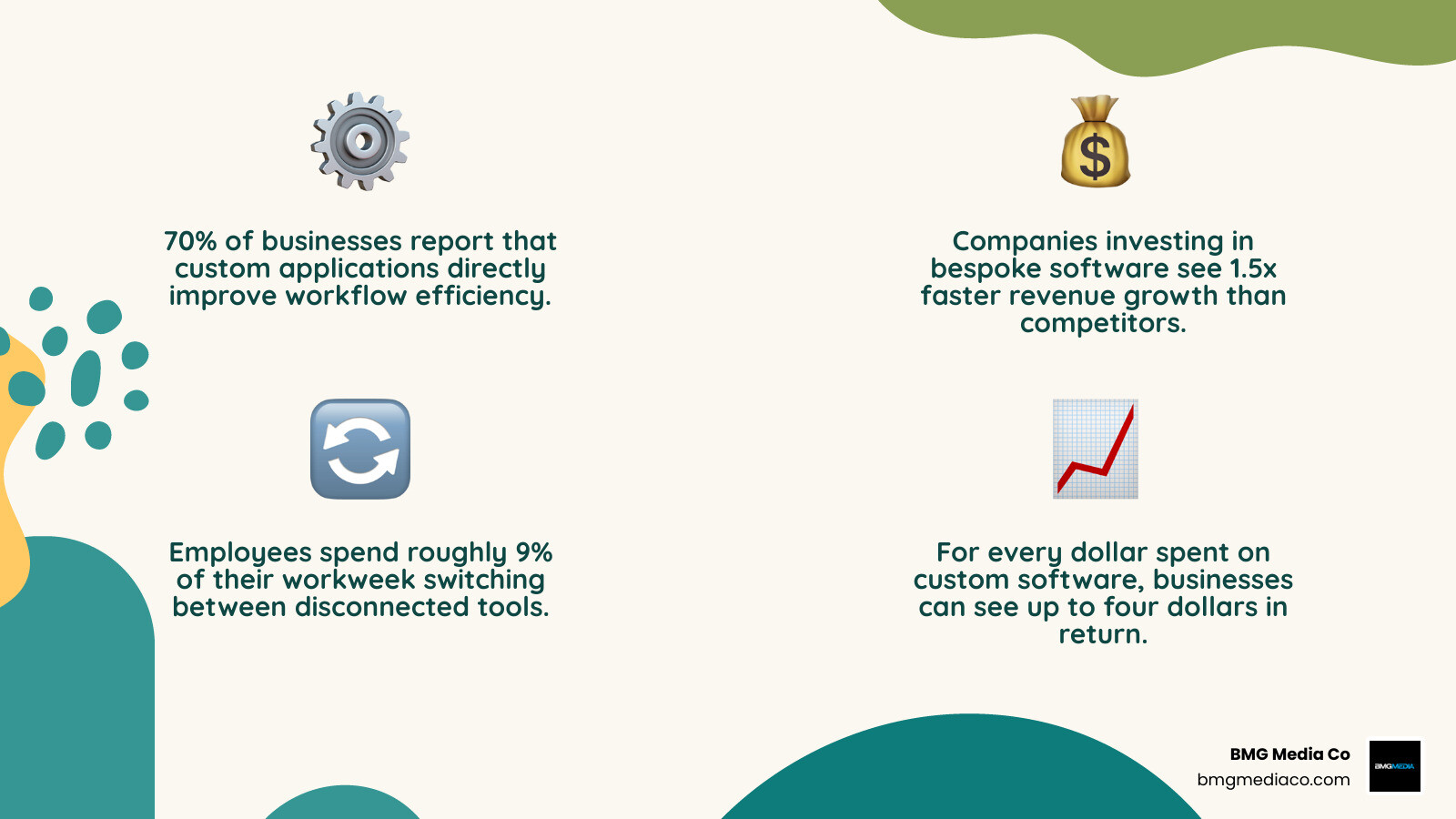
Most businesses start with off-the-shelf tools. They’re fast, affordable, and good enough — at first. But at some point, the software stops fitting the business. You’re building workarounds. You’re paying for features you don’t use. Your team is switching between five different apps just to finish one task. In fact, employees spend roughly 9% of their workweek just switching between disconnected tools.
That’s the moment bespoke development stops being a luxury and starts being a competitive advantage.
The numbers back this up. Around 70% of businesses report that custom applications directly improve workflow efficiency. Companies investing in tailored tools see 1.5x faster revenue growth than their competitors. And for every dollar spent on a custom solution, businesses can see up to four dollars in return.
I’m Blake George, founder of BMG Media Co. — a custom web design and development agency I’ve built over 15+ years and 1,000+ hand-coded projects across industries ranging from healthcare to manufacturing. My experience leading bespoke application development projects for businesses at every stage — from funded startups to multi-billion-dollar enterprises — gives me a front-row view of what separates software that drives growth from software that just gets in the way. In this guide, I’ll walk you through everything you need to know to make the right decision for your business.
Basic bespoke application development glossary:
To truly understand why custom software is a catalyst for growth, we must first look at the fundamental differences between tailored systems and commercial off-the-shelf (COTS) software.
When you purchase an off-the-shelf SaaS tool, you are buying a license to use someone else’s product. You do not own the software, you cannot modify its core architecture, and you are entirely dependent on their product roadmap. If the vendor decides to deprecate a feature your team relies on, or raise subscription fees by 30%, you have no choice but to adapt or migrate. It is a model built on compromise. You are forced to bend your unique, competitive workflows to fit the rigid constraints of a pre-packaged template.
In contrast, choosing custom software means engineering a solution designed around your reality. We discuss this dynamic extensively in our guide on Bespoke Tailored or Custom Demystifying Custom Software Development Solutions. With a bespoke build, you own the intellectual property (IP) entirely. There are no scaling license fees as your team grows from 10 to 1,000 users. Your workflows remain proprietary, protected, and fully optimized for how your business actually operates.
The business case for bespoke engineering goes far beyond simply avoiding monthly subscription fees. It is about unlocking massive workflow efficiencies, accelerating revenue growth, and creating experiences your users will love.
Consider the impact of design on your bottom line. A clean, intuitive user interface (UI) can raise conversion rates by up to 200%, while a superior, hand-crafted user experience (UX) can increase conversions by as much as 400%. Industry data shows that every single dollar invested in UX yields an estimated $100 in long-term return. When your internal tools or customer-facing portals are designed with this level of precision, friction disappears.
By partnering with experienced custom software developers, you gain a platform built for your exact operational reality. You can read more about why this approach is essential in our breakdown of Why Your Business Deserves Custom Web Development Solutions. From streamlining internal logistics to creating seamless customer touchpoints, custom software removes the operational bottlenecks that hold your business back.
Bespoke development is particularly powerful when applied to high-impact business systems. Rather than relying on rigid, generic platforms, companies use custom builds to gain complete control over their data and user journeys.
Common use cases include:
To see what these looks like in practice, check out our collection of Not Your Average App Inspiring Customized Software Examples for Businesses.
For specialized industries, off-the-shelf software is rarely even an option. The unique compliance, safety, and operational requirements of these sectors demand engineered precision.
In manufacturing, for example, generic software cannot easily bridge the gap between legacy shop-floor machinery and modern cloud databases. Custom manufacturing software allows businesses to integrate Internet of Things (IoT) sensors directly into their workflows. This enables predictive maintenance, which can reduce overall operational costs by 20% to 30%.
We dive deep into these complex requirements in our specialized guides on Custom Site Development for Complex Manufacturing Needs and Custom Manufacturing Software Tips for Precision and Profit. For businesses looking to connect physical devices to digital dashboards, our resource on The Ultimate Guide to Custom IoT Development in 2026 offers a comprehensive roadmap.
Building a successful bespoke application requires a highly disciplined, structured engineering process. It is not about writing code immediately; it is about mapping out the business logic and validating assumptions early to avoid costly mistakes. Finding and fixing a bug in production can cost ten times more than catching and resolving it during the initial design phase.
Our engineering methodology follows a rigorous seven-step lifecycle:
To ensure a project stays on time and on budget, we utilize collaborative frameworks that bridge the gap between business logic and technical execution. Strong collaboration can result in up to a 30% increase in overall team effectiveness.
One of the most powerful tools we use during the planning phase is Business Process Model and Notation (BPMN) mapping. BPMN is the global industry standard for workflow mapping, used to visually document business processes before development begins. By laying out every step, decision point, and user role visually, we ensure that our developers and your business leaders are speaking the exact same language from day one.
We also maintain direct lines of communication between our clients and our lead developers. We do not hide our engineering talent behind layers of account managers. This direct access ensures that technical decisions align perfectly with your strategic business goals, maintaining the highest standards of engineering excellence throughout the project lifecycle.
With the average cost of a corporate data breach reaching an all-time high of $4.45 million, security cannot be an afterthought. Mass-market, off-the-shelf software is a massive target for hackers because a single vulnerability can compromise thousands of companies at once. In fact, over 91% of organizations using APIs have suffered a security incident due to vulnerabilities in generic, mass-market software.
Bespoke applications, when engineered correctly, are inherently more secure because their underlying code is proprietary and not accessible to the public. However, they must still be built on a foundation of modern security protocols. We align security planning with recognized guidance such as the NIST Cybersecurity Framework, then tailor implementation to the specific risk profile, compliance needs, and architecture of each business.
We implement several key security and scalability protocols in every build:
In recent years, visual development and low-code platforms have gained traction as fast ways to build applications. For instance, some enterprises have successfully used tools like WeWeb to rapidly prototype internal tools, dramatically reducing initial timelines.
While visual builders have their place for simple prototypes or basic internal utilities, they present significant risks for core business applications. The limitations of visual page builders include:
At BMG Media Co., our non-negotiable standard is that every application we build is crafted 100% custom from scratch. No templates. No page builders. No shortcuts. By hand-coding our software using modern, clean frameworks, we ensure your application is blazingly fast, endlessly scalable, and completely owned by you.
Bespoke software is custom-built from the ground up to match your exact business processes, giving you complete ownership of the source code and zero recurring licensing fees. Off-the-shelf software is a pre-built, mass-market product that you license monthly, requiring you to adapt your workflows to fit its rigid limitations.
The timeline varies depending on the complexity of the project. A focused application can take anywhere from a few weeks to several months. We begin every project with a dedicated discovery and scoping sprint to map out the exact architecture, ensuring a clear roadmap and timeline before development begins.
When you partner with us, you own the intellectual property and the source code completely. Your GitHub, your cloud, your decisions. We believe in absolute ownership with no vendor lock-in.
In a business landscape where efficiency, speed, and customer experience dictate who wins, relying on the same generic software as your competitors is a recipe for stagnation. Bespoke application development is the ultimate tool to break free from those limitations, streamline your operations, and build a proprietary asset that drives long-term valuation.
At BMG Media Co., we have spent more than 15 years helping businesses across Metro Detroit and nationwide turn complex operational challenges into elegant, high-performance software. From our headquarters in Birmingham, Michigan, to our active markets in Chicago, Dallas, New York, and Los Angeles, we build software the way it should be built: hand-crafted, exceptionally designed, and engineered to scale.
If you are ready to stop adapting to your software and start engineering a solution that works for you, explore our Web Design Services Custom Software and let’s build something remarkable together.
