March 2026
Manufacturing website design is the process of building a website that clearly communicates what you make, who you serve, and why buyers should choose you — optimized for the technical, complex sales process unique to industrial companies.
Here’s what an effective manufacturing website must do:
This matters more than most manufacturers realize. 70% of a buyer’s journey happens online before they ever contact your sales team. If your website can’t do its job in those early research stages, you’re already losing deals you don’t even know about.
The shift is real. B2B eCommerce in manufacturing now pulls in over $620 billion annually in the U.S. alone. Yet many manufacturing sites still look and function like they were built a decade ago — vague messaging, buried product info, and no clear path to get a quote.
Your website isn’t a brochure. It’s your best salesperson, working 24/7.
I’m Blake George, founder of BMG MEDIA Co., and over more than a decade building 1,000+ custom websites — including many in the manufacturing sector — I’ve seen how strategic manufacturing website design separates companies that grow from those that stagnate. In this guide, I’ll walk you through exactly what it takes to build a site that converts serious industrial buyers.
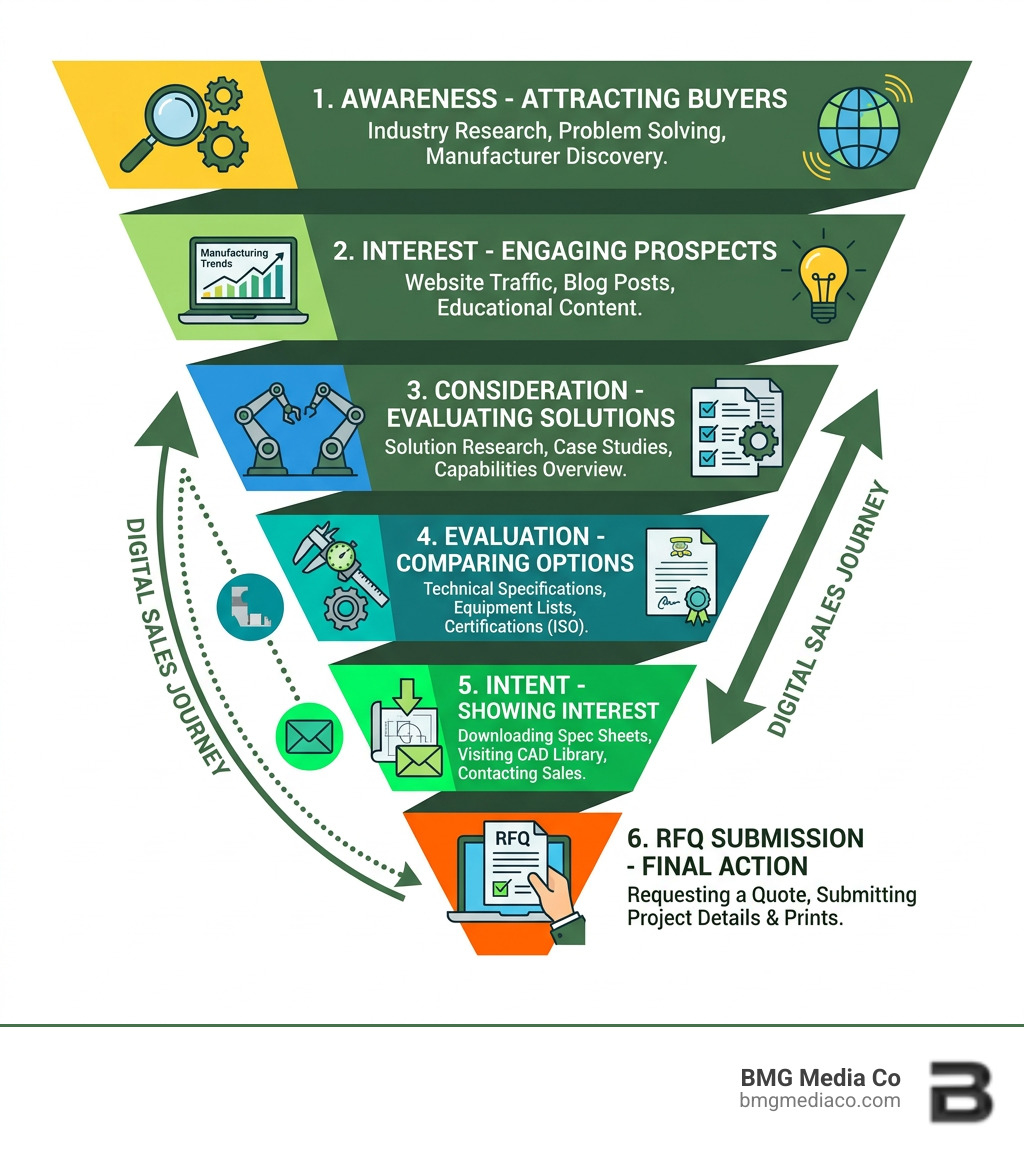
When we sit down to map out a blueprint for a new project, we don’t just think about colors and fonts. We think about the shop floor, the procurement office, and the engineering bay. A high-performing site needs to speak the language of industry.
The data is clear: over 80% of B2B customers prefer using eCommerce to place orders. If your site makes it difficult to browse parts or request a quote, you are essentially closing your doors to the majority of the market. At BMG Media, we specialize in manufacturing web design that bridges the gap between complex engineering and a seamless user experience.
Every high-performing site should include these core elements:
A common mistake in manufacturing website design is trying to speak to everyone with the same voice. In reality, your site must satisfy two very different types of visitors:
| Feature | Technical Buyer (Engineer) | Economic Buyer (Procurement/Exec) |
|---|---|---|
| Primary Goal | Feasibility and precision | Cost, reliability, and speed |
| Needs | Specs, CAD files, tolerances | Certifications, capacity, lead times |
| Content Type | Data tables, technical whitepapers | Case studies, ROI calculators, testimonials |
| Decision Factor | Can they make this part? | Can they deliver on time and budget? |
The journey of a technical buyer is often long—sometimes lasting 6 to 12 months. They aren’t impulse buying; they are conducting deep due diligence. This is why intuitive navigation and a “Two-Click Data Rule” are essential. If an engineer can’t find your material specs or machine capacity within two clicks, they’re likely to bounce.
Large manufacturers often serve multiple industries. Take a great example from BASF; they use sophisticated dropdown side menus to segment users by market. We applied similar principles in our SME USA project, ensuring that visitors could immediately find the specific technical resources relevant to their niche.
Don’t assume your buyers are only sitting at mahogany desks. Many engineers and shop foremen access websites from the factory floor using tablets or smartphones. With mobile users now accounting for over half of all web traffic, responsive design is a baseline requirement. A site that breaks on a mobile screen suggests a company that doesn’t pay attention to detail—a death knell in precision manufacturing.
In industrial B2B, “show, don’t tell” is the gold standard. High-quality visuals of your facility in action provide an “authenticity” that stock photos can never replicate.
While your machines are impressive, your results are what sell. Statistics show that 86% of business buyers make purchasing decisions based on testimonials. We’ve seen this work wonders in our Simiron portfolio, where clean, professional layouts highlight real-world applications.
A good manufacturing case study isn’t just a “thank you” note. It should follow a specific formula:
We utilized this data-driven approach for the Cold Heading project, creating a gallery that speaks directly to the expertise required for high-volume fastener production.
A beautiful website is useless if no one finds it. Manufacturing website design must be built on a foundation of technical SEO. This means using Schema markup so Google understands your product specs and utilizing “technical accordions” to organize deep data without cluttering the UI.
Your website should be an extension of your shop floor, not an island. Modern manufacturing sites often need to sync with:
For our Dijet USA project, we focused on ensuring the digital presence matched the high-performance nature of their cutting tools. By integrating lead generation tools and clear ROI metrics, the site became a measurable driver of growth.
The most frequent “sins” we see are:
In our work on the BA Forging project, we focused on eliminating these frictions to create a direct path from landing to lead.
WordPress is the “workhorse” of the web. It offers incredible scalability and is highly SEO-friendly. Most importantly, it provides an easy CMS (Content Management System) that allows your team to update equipment lists or add new certifications without needing a developer every time. When we built the B-File Systems project, we used a custom WordPress theme to ensure the site was both unique and easy to manage internally.
A professional manufacturing website design project typically takes between 3 to 6 months. This allows for deep discovery, stakeholder interviews, and technical integrations. Budget varies based on the complexity of your product catalog and ERP needs, but it should be viewed as a capital investment—much like a new piece of CNC equipment. We managed this timeline and scope effectively for the Palltronics project, ensuring a launch that aligned with their strategic business goals.
At BMG Media Co., we believe your website should work as hard as your machines do. Based right here in Birmingham, Michigan, we don’t believe in templates or “one-size-fits-all” industrial sites. We build fully custom, high-performance digital engines that turn technical expertise into a competitive advantage.
With over 1,000 sites completed and a focus on measurable ROI, we understand the nuances of the Michigan manufacturing landscape. Whether you are a machine shop in Troy or a global supplier in Detroit, your digital blueprint starts here.

