June 2026

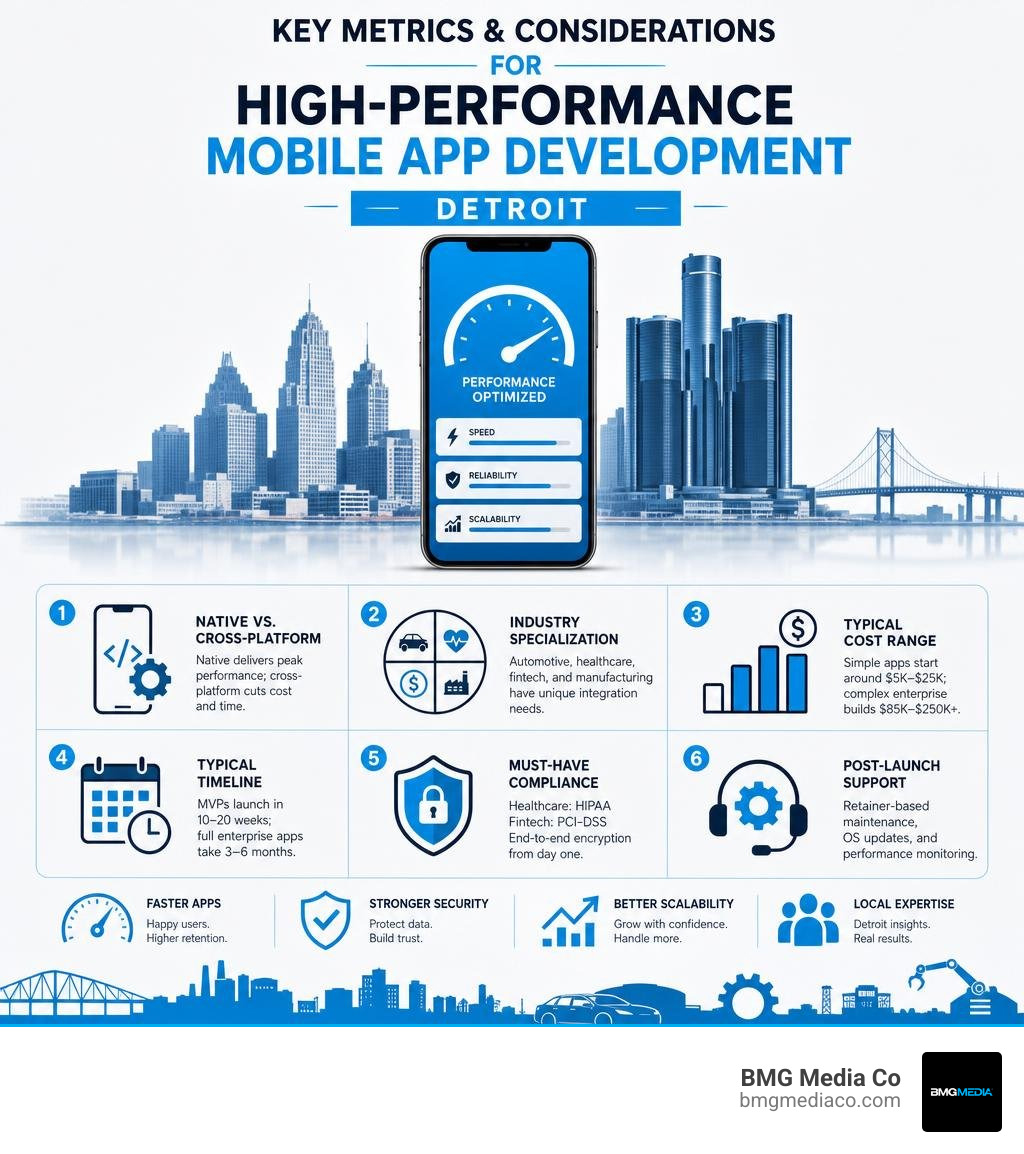
If you’re looking for high-performance mobile app development Detroit studios and agencies, here’s a quick-reference list of what to look for — and what the Detroit market actually offers:
Top things to know before hiring a Detroit mobile app developer:
Detroit is no longer just the Motor City. It’s a growing tech hub — home to automotive giants like Ford, GM, and Stellantis, a booming fintech scene anchored by Rocket Companies, and a healthcare corridor expanding rapidly across the metro. All of these industries share one common need: mobile apps that actually perform.
And performance isn’t a nice-to-have. According to industry data, 85% of users expect a seamless mobile experience — and they’ll abandon an app that doesn’t deliver it within seconds. With Android powering over 70% of global mobile users, and Detroit’s enterprise sector demanding deep integrations with telematics, ERP systems, and IoT devices, the bar for “good enough” has never been higher.
This guide breaks down exactly what separates a fast, reliable mobile app from one that frustrates users and costs you business — Detroit style.
I’m Blake George, founder of BMG Media Co. and a Michigan-based entrepreneur with over 15 years of experience delivering custom digital products — including high-performance mobile app development for Detroit-area businesses across real estate, healthcare, manufacturing, and beyond. I’ll walk you through everything you need to make a smart decision on your next mobile app project.
When we talk about “high-performance” in the context of mobile apps, we aren’t just throwing around tech buzzwords. In Southeast Michigan, where manufacturing precision and split-second logistics dictate daily profit margins, a slow app is a broken business tool.
Whether your users are scanning inventory barcodes in a cold warehouse in Warren or a patient is trying to access their virtual care portal in Midtown, performance is the single biggest factor determining your app’s success.
To build an app that users love, you must design it with local realities in mind. In a region where users frequently move between high-speed Wi-Fi and spotty cellular coverage on I-75, offline resilience and optimized data synchronization are critical. This is why specialized Web Design Services Mobile App Development for Android and iOS are so vital for capturing the regional market.
Let’s look at the cold, hard numbers. A delay of even a single second in your app’s response time can cause conversion rates to plummet by up to 20%. In the fast-moving B2B and consumer landscapes of Metro Detroit, mobile users have zero patience for lag.
If your field service application takes ten seconds to load a work order, your technicians lose hours of billable time over a week. If your e-commerce platform stutters during checkout, your customer will close the app and buy from a national competitor.
A high-performing app acts as your brand ambassador. A sluggish, template-built app suggests your business is behind the times. To avoid these pitfalls, smart companies look for custom solutions that bypass generic builders, focusing instead on Not Your Average App Inspiring Customized Software Examples for Businesses to see how custom-built code keeps engagement high and bounce rates low.
For hybrid apps, Progressive Web Apps (PWAs), and APIs feeding native apps, performance standards are heavily measured by Core Web Vitals and mobile responsiveness. These metrics focus on three main areas:
To hit these benchmarks, your mobile architecture must be incredibly clean. There is no room for bloated code or unoptimized imagery. For a deep dive into how performance metrics and search visibility tie together, check out our guide on The Developers Guide to SEO Driven Web Apps and learn more about Google’s Core Web Vitals standards.

Detroit is a heavy-industry town that has successfully transitioned into a digital powerhouse. From the historic automotive corridors of Dearborn and Auburn Hills to the medical centers of Midtown and the fintech offices of downtown Detroit, mobile applications are the primary interfaces driving modern business operations. To design an app for this market, you must understand the specific technical demands of these key sectors. You can explore how we approach these unique demands and Build your high-performance iOS app with BMG Media Co..
The automotive capital of the world demands mobile apps that talk to machines. Whether you are building a consumer EV companion app, a fleet management tool, or a dealer service application, your app must interface seamlessly with vehicle hardware.
This means integrating with On-Board Diagnostics (OBD-II) data streams, OEM APIs, and real-time GPS telematics. A high-performance app in this space must process thousands of data points per second without draining the user’s phone battery or causing latency. For a detailed look at how to build these complex connections, read The Missing Link A Guide to Software Integration Web Apps.
The Detroit healthcare corridor—including major hospital systems in Oakland, Macomb, and Wayne counties—relies heavily on clinical mobility tools. High performance here isn’t just about speed; it is about secure, instant access to life-saving data.
Patient portals, secure clinical messaging apps, and telemedicine platforms must load medical records instantly while maintaining strict HIPAA compliance. This requires secure local data encryption, role-based access control, and robust audit logs. To learn how we design medical tech sites that balance speed with regulatory compliance, read The Developers Guide to Healthy Medical Tech Sites.
On the factory floors of Macomb County and Southeast Michigan, mobile apps are replacing paper clipboards. Modern floor managers and logistics teams use custom mobile apps to track inventory, monitor assembly lines, and log quality control data in real time.
These apps must connect directly to massive Enterprise Resource Planning (ERP) and Customer Relationship Management (CRM) systems like SAP, Oracle, or custom databases. Because factory environments often have poor cellular signals, these apps must also support robust offline-first functionality, queuing data locally and syncing it automatically when a connection is re-established. Explore our expert tips on Custom Manufacturing Software Tips for Precision and Profit to see how we build these high-efficiency industrial interfaces.
Choosing the right technical architecture is the most important decision you will make for your mobile app. It dictates your development timeline, your budget, and—most importantly—the performance ceiling of your application.
| Metric / Feature | Native (Swift / Kotlin) | Cross-Platform (React Native / Flutter) |
|---|---|---|
| Performance Limit | Maximum (Direct access to GPU/CPU) | High (Excellent for 95% of business apps) |
| Codebase | Separate (one for iOS, one for Android) | Single (shared across platforms) |
| Development Cost | Higher | Lower to Moderate |
| Time to Market | Longer (16–24 weeks) | Shorter (10–16 weeks) |
| Device Hardware Access | Instant, complete access | Mediated via plugins |
| Offline Performance | Exceptional | Very Good (requires careful architecture) |
For projects where compromise is not an option, native development is the gold standard. Native apps are written in the platform’s primary language—Swift and SwiftUI for iOS, and Kotlin and Jetpack Compose for Android.
By building native, your app communicates directly with the operating system without any translation layers. This results in incredibly smooth animations, instantaneous load times, and superior memory management. If your app requires complex 3D rendering, heavy data processing, or deep integration with device sensors, native is the only way to go.
For a step-by-step roadmap on building for Apple’s ecosystem, read Native iOS App Development From Zero to App Store Hero. For Android-focused projects, you can learn how to set up your backend architecture by reading Setting Up Firebase Ignite Your Android App Development.
For many businesses, building two separate apps (one for iOS and one for Android) is cost-prohibitive. That is where modern cross-platform frameworks like React Native and Flutter come in. In 2026, React Native (often paired with Expo and EAS Build) has become the default choice for most consumer-facing and corporate applications.
These frameworks allow you to write a single codebase that runs beautifully on both platforms, cutting development time and costs by up to 40%. While there is a slight performance trade-off compared to native code, it is virtually imperceptible for standard business, e-commerce, and SaaS applications.
To explore our regional development capabilities and see how we serve local businesses from our Birmingham headquarters, visit our Locations page. You can also research how cross-platform apps scale by visiting the official React Native documentation.
Building a high-performance app requires a structured approach. You cannot rush quality code, and you certainly cannot cut corners on security. In Metro Detroit, where businesses handle sensitive automotive IP, patient data, and financial transactions, security must be baked into the architecture from day one.
What does it actually take to bring a high-performance app to life? While simple, template-based apps can be spun up quickly, a custom, high-performance mobile application requires a dedicated engineering process.
For a realistic look at costs, a high-performance MVP (Minimum Viable Product) typically starts around $60,000 to $85,000, while complex enterprise solutions with deep ERP or IoT integrations can range from $100,000 to $250,000+. To understand why custom work is worth the investment, check out our guide on how to Stop Being Boring with Ann Arbor Website Design.
If your app handles payments, personal data, or medical records, security is your highest priority. High-performance apps must secure data both in transit and at rest. This involves:
If you are planning a healthcare-focused app, make sure to read The Ultimate Agency Guide to Medical Web Design Success to learn how we successfully navigate strict regulatory landscapes.
Launching your app on the Apple App Store and Google Play Store is not the finish line—it is the starting line. Mobile operating systems update constantly, and user behaviors shift. To maintain high performance, your app requires continuous care.
A professional mobile app partnership must include post-launch support. This means setting up real-time crash reporting (using tools like Crashlytics), monitoring API latency, and releasing regular updates to ensure compatibility with the latest versions of iOS and Android.
Additionally, we implement App Store Optimization (ASO) strategies to ensure your app is visible to your target audience, using keyword-rich descriptions and optimized visuals to drive organic downloads.
When selecting an app developer, look for a team that treats your project as a strategic partnership, not a one-off transaction. Avoid agencies that rely on cheap templates or outsourced junior developers who do not understand your business goals.
Look for a partner with a deep portfolio of custom work, clear communication channels, and a proven track record of building high-performance products. You can read more about what makes a custom software partner stand out by reviewing BMG Media’s custom software solutions.
A custom, high-performance mobile app typically ranges from $85,000 to $250,000+ depending on complexity, integrations, and compliance requirements. Simple MVPs can start lower, around $30,000 to $60,000, while complex enterprise platforms with heavy IoT or ERP integrations will sit at the higher end of the spectrum.
If your app requires maximum processing power, complex 3D rendering, or deep hardware integration (like OBD-II or complex Bluetooth sensors), native Swift and Kotlin is the best route. For most business, e-commerce, and SaaS applications, cross-platform frameworks like React Native or Flutter offer a near-native experience at a significantly lower cost and faster development timeline.
We build compliance into the core architecture of the app. This includes implementing end-to-end data encryption, secure biometric logins (FaceID/TouchID), role-based user permissions, and automatic audit logging. This ensures all patient data and financial transactions remain completely secure and fully compliant with federal regulations.
At BMG Media Co., we don’t believe in shortcuts. We don’t use templates, we don’t use bloated page builders, and we don’t write lazy code. Based in Birmingham, Michigan, we build 100% custom mobile applications from scratch, hand-crafting every line of code to match your specific business goals and performance requirements.
Whether you need a high-performance logistics app, a secure medical portal, or an innovative consumer experience, our team is ready to bring your vision to life. Ready to build something incredible? Build your high-performance iOS app with BMG Media Co. today.
