April 2026

A medical website developer builds and maintains websites specifically designed for healthcare providers — combining patient-focused design, strict compliance standards, and technical integrations that general web agencies rarely handle well.
Here’s what to look for when choosing one:
Healthcare websites aren’t like other websites. They carry legal weight, handle sensitive data, and serve patients who are often stressed and need answers fast. A site that loads slowly, looks outdated, or lacks compliance features doesn’t just lose traffic — it loses trust.
The stakes are real. Studies show websites have less than four seconds to capture a visitor’s attention, and A/B-tested sites can outperform untested ones by anywhere from 23% to 90%.
I’m Blake George, Founder of BMG Media Co, and with over a decade of experience as a medical website developer and digital strategist — including custom healthcare builds across Michigan and nationwide — I’ve seen how the right site can transform a practice’s growth. Below, I’ll walk you through everything you need to build or upgrade a high-performing medical website.
Handy medical website developer terms:

Selecting a medical website developer isn’t like hiring a neighborhood kid to build a blog. In the healthcare space, your developer is effectively a partner in your clinical operations. You need someone who understands that a “broken link” isn’t just a nuisance—it could be a patient unable to access urgent care instructions or a breach of federal law.
When we talk about healthcare services, we’re looking for developers who speak the language of the industry. This means deep familiarity with standards like HL7 (Health Level Seven) and FHIR (Fast Healthcare Interoperability Resources), which allow different medical software systems to talk to each other. Without this expertise, your website remains an island, disconnected from the tools you use to actually treat patients.
Expert insights from industry leaders like Maria Zannes emphasize that research-based UX/UI is the foundation of any successful medical platform. It’s not just about looking “clean”; it’s about mapping the patient journey so a worried parent can find a provider in two clicks or less. We’ve seen the impact of this in our work, such as the Legacy Dermatology Group portfolio, where a unified digital front door replaced fragmented systems to create a seamless experience for both staff and patients.
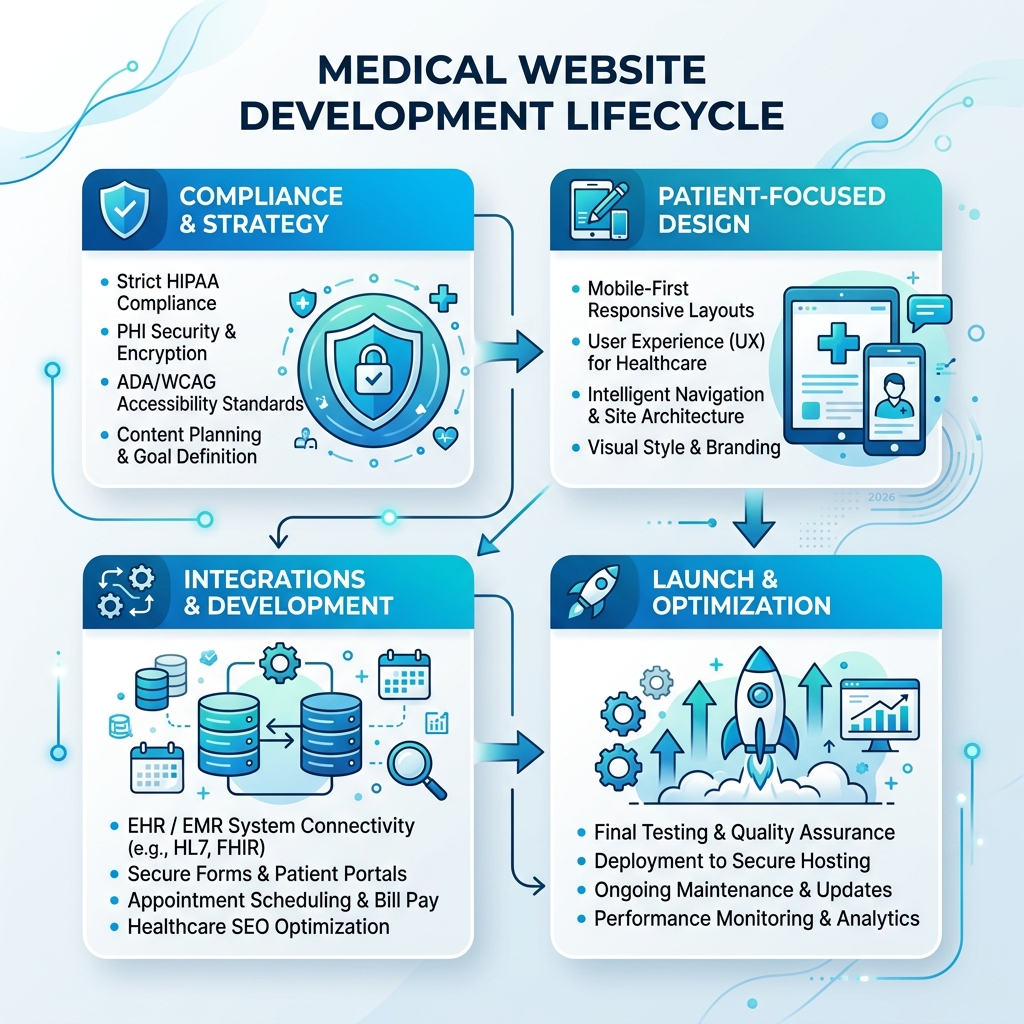
A specialized developer provides a “full-cycle” approach. This isn’t just coding; it’s a comprehensive strategy that includes:
The “back-end” of a medical site is where the real heavy lifting happens. Interoperability is the name of the game. Your site needs to securely pull and push data to EMR (Electronic Medical Record) and EHR (Electronic Health Record) systems. This requires sophisticated API management and data encryption protocols that exceed standard retail security.
For example, in our Motor City Orthopedics case study, we focused on creating a high-performance environment that could handle complex patient data while maintaining a lightning-fast interface. Often, this involves legacy system migration—taking old, clunky databases and moving them into a modern, web-accessible format without losing a single patient record or violating privacy.
In medical tech, compliance isn’t an “add-on”—it’s the bedrock. If your website collects even a name and a phone number for an appointment request, you are likely handling Protected Health Information (PHI).
A professional medical website developer implements several layers of security to stay within Medical Healthcare Web standards:
Accessibility is a legal and ethical requirement. Healthcare is for everyone, including those with visual, auditory, or motor impairments. We build sites to meet WCAG 2.1 AA standards, which includes:
Failing to meet these standards doesn’t just alienate patients; it opens your practice to significant legal risk.
The modern patient is a “mobile-first” consumer. Statistics show that roughly 82% of patients access medical websites via mobile devices. If your site doesn’t work perfectly on a smartphone, you’ve already lost the majority of your audience. Furthermore, you have less than 4 seconds to capture a visitor’s attention before they bounce to a competitor.
To keep patients engaged, your medical website developer should integrate features that provide immediate value:
True digital transformation happens when your website becomes an extension of your clinic. By integrating with EHR/EMR systems, you can automate document management and order processing. Imagine a system where lab results are shared automatically to a patient’s secure portal the moment they are ready, or where remote monitoring devices (like wearables) feed vitals directly into a doctor’s dashboard. This level of interoperability—built on HL7 and ICD-10 compliance—reduces administrative overhead and allows your staff to focus on care rather than data entry.
One of the biggest questions we hear is whether a practice should use a template (like Wix or Squarespace) or go with a custom build. For a serious medical practice, the “cheap” option often becomes the most expensive in the long run due to security gaps and limited scalability.
| Feature | Custom Medical Website | Template-Based Solution |
|---|---|---|
| HIPAA Compliance | Built-in, audited, and guaranteed | Often requires risky third-party plugins |
| Scalability | Unlimited; grows with your practice | Limited by the platform’s constraints |
| Brand Identity | 100% unique to your practice | Looks like thousands of other sites |
| Ownership | You own the code and the data | You are “renting” the platform |
| Integrations | Custom-built for your specific EHR | Often impossible or very limited |
| ROI | High; designed for conversion | Low; often just a “digital brochure” |
Our commitment to high-performance, fully custom work is why BMG Media earns Clutch Leader Award for top web designers in the healthcare space. We don’t use templates because we know they can’t provide the security or the results that Michigan medical professionals require.
A professional medical website isn’t built overnight. While a simple landing page might take a few weeks, a full-scale custom medical site typically takes between 30 and 90 days.
The process involves:
Cost ranges vary significantly based on complexity. A small practice might spend $5,000 to $15,000 for a high-performance site, while large hospital systems with deep integrations can invest hundreds of thousands.
A beautiful website is useless if no one can find it. This is where Medical SEO comes in. Your medical website developer must optimize the site’s structure, speed, and content so that you appear at the top of local search results. Whether a patient is searching for a “dermatologist in Birmingham” or trying to find a local dentist, your site needs to be the first thing they see.
We use A/B testing to ensure your site is a “patient generator.” By testing different layouts and calls to action, we can improve conversion rates by up to 90%. But the work doesn’t stop at launch. Medical websites require constant maintenance, including:
Typically, a custom build takes 30 to 90 days. Small practices might see a launch in about a month, while complex systems with telemedicine and EHR integrations require more time for development and rigorous testing.
For a professional, patient-generating solution, the first-year investment usually starts around $5,000. For larger groups or systems requiring custom web apps and enterprise-level integrations, the cost can range from $40,000 to over $100,000.
HIPAA compliance is a federal requirement for any entity handling PHI. Beyond avoiding massive fines, it builds patient trust. In an era of frequent data breaches, showing your patients that you take their privacy seriously is a key competitive advantage.
Building a healthy medical tech site requires more than just code—it requires a partner who understands the unique pressures of the healthcare industry. At BMG Media Co, we specialize in creating custom, high-performance digital solutions that help Michigan practices grow while staying secure and compliant.
From award-winning design to deep technical integrations, we provide the “digital front door” your patients deserve. Ready to take your practice to the next level? Launch your medical web project with a team that knows how to deliver results.
