June 2026

Customized software examples are everywhere once you know where to look — from the kiosk you tapped at McDonald’s to the app that remembered your last Netflix binge. Here’s a quick overview of the most common types:
| Type | Real-World Example |
|---|---|
| Streaming software | Netflix’s custom content delivery network |
| Fast food POS software | McDonald’s self-service kiosk system |
| Banking software | Bank of America’s AI assistant, Erica |
| Healthcare software | Custom hospital management and patient monitoring systems |
| CRM software | Custom sales pipeline tools built around unique workflows |
| ERP software | Starbucks’ real-time inventory and supply chain platform |
| E-commerce software | Amazon’s personalized product recommendation engine |
| Logistics software | AI-powered route optimization and customs declaration tools |
| Real estate software | Zillow’s AI property valuation and virtual tour platform |
Most businesses start with off-the-shelf software. It’s fast, affordable, and works fine — until it doesn’t.
As your business grows, generic tools start to show their limits. You’re paying for features you never use. Your team builds workarounds just to get through the day. And the software that was supposed to save time starts costing it.
That’s exactly when businesses start asking a better question: what if the software was built around us, not the other way around?
The global custom software development market is projected to reach $85.9 billion by 2028 — and that growth isn’t driven by big tech alone. It’s driven by businesses of every size realizing that the right custom tool can be a genuine competitive advantage.
But it’s not all smooth sailing. Only 16.2% of software projects are considered successful, according to the Standish Group — mostly because teams jump into building before they know exactly what they need.
This guide walks through real, concrete examples of custom software across industries so you can see what’s possible — and what actually works.
I’m Blake George, founder of BMG Media Co., where I’ve spent over 15 years leading custom web and software development projects for more than 1,000 businesses across industries including healthcare, real estate, manufacturing, and e-commerce — many of which are among the customized software examples we’ll cover here. That experience shapes everything in this guide.
Quick customized software examples terms:
To understand why companies invest in bespoke development, we must first look at the alternative: Commercial Off-The-Shelf (COTS) software. COTS products are pre-built applications designed for the mass market. Think of them as a “one-size-fits-all” suit. They are readily available, quick to deploy, and have lower upfront costs.
However, COTS limitations quickly become apparent as your operations mature. When you rely solely on off-the-shelf platforms, you often pay for bloated feature sets you do not use, while missing the exact, niche functionalities your team needs to work efficiently.
This is where software customization and custom builds enter the picture. While software customization involves tweaking an existing commercial product (like writing custom scripts for Salesforce), building custom software means creating a proprietary system from the ground up. If you want to dive deeper into how modern agencies handle this, check out The Complete Guide to Custom Software Developers.
Here is a direct comparison to help you understand where each option shines:
| Feature | Custom Software Solutions | Commercial Off-the-Shelf (COTS) |
|---|---|---|
| Upfront Cost | Higher initial investment | Lower initial cost |
| Long-Term Cost | No ongoing per-user licensing fees | Recurring subscription and licensing fees |
| Workflow Fit | 100% aligned with your business processes | Forces you to adapt your processes to the tool |
| Scalability | Unlimited; grows seamlessly with your company | Limited by tier structures and API call caps |
| Integration | Built to connect natively with any legacy system | Relies on pre-built connectors or rigid APIs |
| Competitive Edge | High; proprietary tech your competitors can’t buy | Zero; your competitors use the exact same tool |
The most critical architectural differentiator between these two paths is source code ownership. When you purchase a COTS license, you are essentially renting the right to use someone else’s intellectual property. If that vendor decides to raise prices, discontinue a feature, or shut down entirely, your business is left vulnerable.
With custom development, your business owns the proprietary system and its underlying source code. This ownership gives you complete control over security patches, updates, and feature roadmaps.
Furthermore, custom architecture allows for seamless software integration. Instead of trying to connect five different subscription tools with brittle webhooks, a custom-built solution consolidates your databases into a single, cohesive engine. To learn how unified web apps eliminate data silos, read The Missing Link: A Guide to Software Integration & Web Apps.
Choosing to build custom software is a major strategic decision. To make an informed choice, you must weigh the substantial benefits against the real-world challenges of bespoke development.
To explore how these benefits translate to long-term business value, see Why Your Business Deserves Custom Web Development Solutions.
It is no secret that custom software projects carry risk. As noted by the Standish Group, only 16.2% of software projects are fully successful, with many suffering from budget overruns, missed deadlines, or outright cancellation.
Historically, massive failures have made headlines. For instance, the BBC famously cancelled a £100 million custom digital media project when it realized that commercial off-the-shelf software had evolved to meet its needs at a fraction of the cost.
Custom software projects exist in a delicate balance: you cannot simultaneously fix scope, time/cost, and quality. If you try to lock all three, something inevitably breaks, leading to uncertainty in either final costs or delivered benefits.
To overcome these risks, successful businesses focus on:
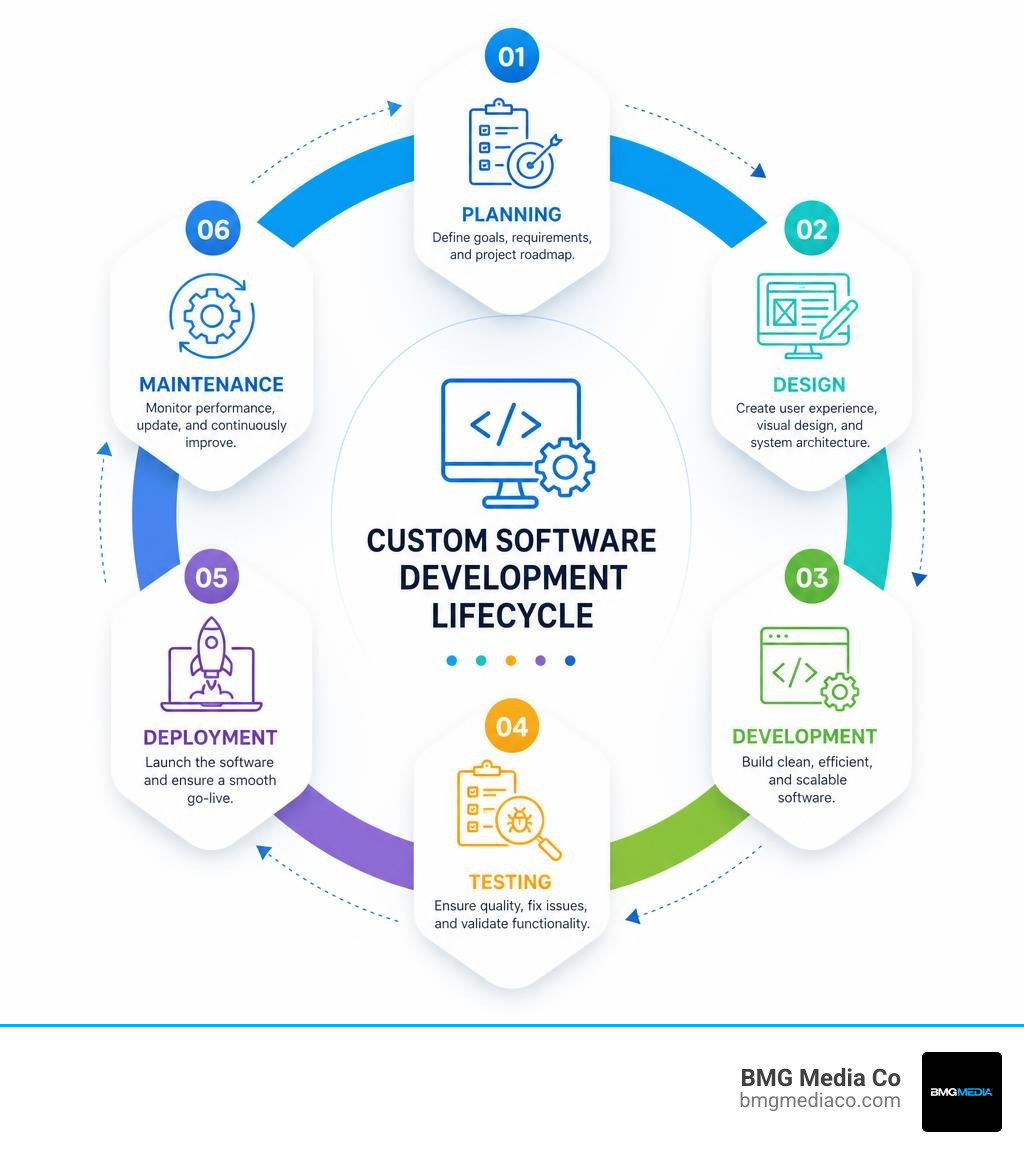
For a step-by-step breakdown of how to guide a project from initial concept to a stable release, check out From Zero to Hero: Building Web Applications That Actually Work.
Custom software is not a single product; it is a category of tailored solutions. Depending on your business model, custom applications generally fall into one of four buckets:
For many companies, the journey starts with an e-commerce platform or custom content management system (CMS) that off-the-shelf site builders cannot support. If your business has unique transaction rules, inventory flows, or content structures, see Why Your Business Needs a Custom CMS or Ecommerce Build.
To understand the power of bespoke applications, let us look at how global leaders use custom software to dominate their markets:
You do not need an enterprise-sized budget to benefit from custom software. Mid-market businesses across our active regions are using tailored solutions to streamline operations:

How do you decide whether to buy a ready-made platform or build a custom one? This decision framework can help guide your choice:
These trade-offs are especially common in manufacturing and specialized industrial operations. To see how custom software addresses these unique challenges, read Custom Site Development for Complex Manufacturing Needs.
When evaluating costs, do not look only at the initial price tag. You must calculate the Total Cost of Ownership (TCO) over a three-to-five-year period.
A commercial off-the-shelf tool might cost $50 per user, per month. That sounds reasonable — until you grow to 150 employees. Suddenly, you are spending $90,000 per year on software licenses. Over five years, that is $450,000 spent on a tool you will never own, which still does not perfectly fit your business.
A custom platform might cost $150,000 upfront. But once it is built, your licensing fees drop to zero. Your only ongoing expenses are hosting and maintenance. More importantly, you have created a proprietary business asset that adds real value to your company’s balance sheet.
To ensure you choose a development partner who understands these long-term financial dynamics, review The Ultimate Guide to Picking a Web App Partner.
As we move through 2026, the custom software landscape is undergoing a massive shift driven by agentic engineering and multi-agent architectures.
We are moving past simple chat interfaces and basic automation. Today’s custom software is built with coordinated AI agents that execute complex, multi-step workflows with full explainability.
A prime example of this trend is Nova Core, an open-source, workspace-based customer intelligence platform. Nova Core uses eight coordinated AI agents to process raw customer data through a dependency-ordered pipeline. Instead of just giving a generic churn probability, its “ChurnAgent” uses SHAP (SHapley Additive exPlanations) to identify the exact factors driving each customer’s risk, while an “AuditAgent” validates all outputs against 45 cross-system checks.
This level of deep, explainable AI is something generic SaaS platforms simply cannot offer. You can explore the repository and system capabilities here: mason-cao/multi-agent-customer-intelligence-dashboard.
As custom systems become more intelligent, they must also be engineered to perform exceptionally well on search engines and public facing networks. To understand how modern developers build high-performance, search-optimized web applications, read The Developer’s Guide to SEO-Driven Web Apps.
Custom software requires a dedicated team of specialists (architects, UI/UX designers, developers, and QA engineers) to build a proprietary system from scratch. You are paying for a highly tailored business asset designed specifically for your workflows, which eliminates long-term licensing fees and provides a distinct competitive edge.
A typical custom software project runs between 8 to 14 weeks for a focused initial launch (the Minimum Viable Product phase), followed by a 60-to-90-day stabilization period. Highly complex enterprise systems can take six months to a year of iterative development.
The primary reasons for project failure are unclear initial requirements, scope creep, and a lack of clear communication between the business and the development team. Working with an experienced agency that uses an iterative, Agile development approach is the best way to mitigate these risks.
At BMG Media Co., we believe your software should adapt to your business — not the other way around. Founded in 2009 by Blake George during the height of the Great Recession, our agency was built on a simple, non-negotiable promise: every single project we build is 100% custom from scratch.
We don’t use templates, page builders, or shortcuts. Our distributed team provides continuous project momentum to deliver enterprise-grade, speed-optimized, and hand-crafted custom software solutions tailored to your brand’s long-term growth.
Whether you are based near our headquarters in Metro Detroit (including Birmingham, Troy, and West Bloomfield) or in our active national markets like Chicago, Dallas, Austin, New York, Denver, Miami, or Los Angeles, we are ready to help you build software that works the way your business actually operates.
Ready to take your operations to the next level? Explore our Web Design Services: Custom Software and let’s build something exceptional together.

