July 2026

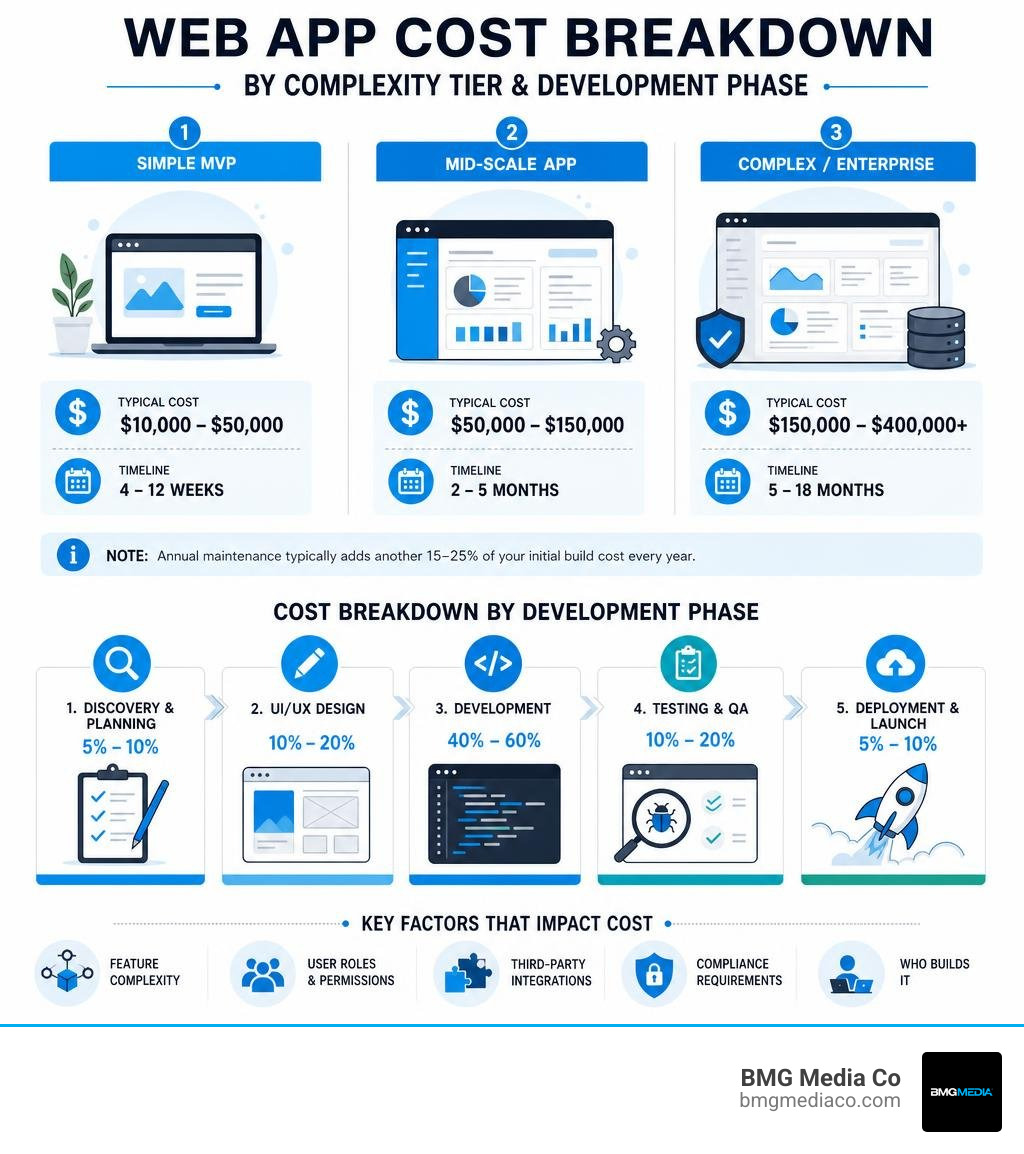
The cost to build a web app in 2026 ranges widely — from around $10,000 for a simple MVP to well over $400,000 for a full enterprise platform. Here’s a quick breakdown by complexity:
| Complexity | Typical Cost Range | Timeline |
|---|---|---|
| Simple MVP | $10,000 – $50,000 | 4 – 12 weeks |
| Mid-Scale App | $50,000 – $150,000 | 2 – 5 months |
| Complex / Enterprise | $150,000 – $400,000+ | 5 – 18 months |
Note: Annual maintenance typically adds another 15-25% of your initial build cost every year.
Most people searching for web app costs expect a single number. There isn’t one — and any agency that gives you one without asking about your scope first is guessing.
What actually drives the price? A few big things:
The web development services market is expected to reach roughly $80.6 billion by 2025. That growth reflects how seriously businesses now treat web apps — not as websites, but as operational infrastructure that automates workflows, manages data, and drives revenue.
A quote of $15,000 and a quote of $200,000 for the same project aren’t unusual. They’re often both “right” — they just define the project differently.
I’m Blake George, founder of BMG Media Co., a custom web design and development agency based in Birmingham, Michigan, where I’ve spent 15+ years helping businesses across industries understand the true cost to build a web app — and build them right the first time. This guide will walk you through every cost driver, phase, and decision point so you can budget with confidence, not guesswork.
Simple guide to cost to build a web app:
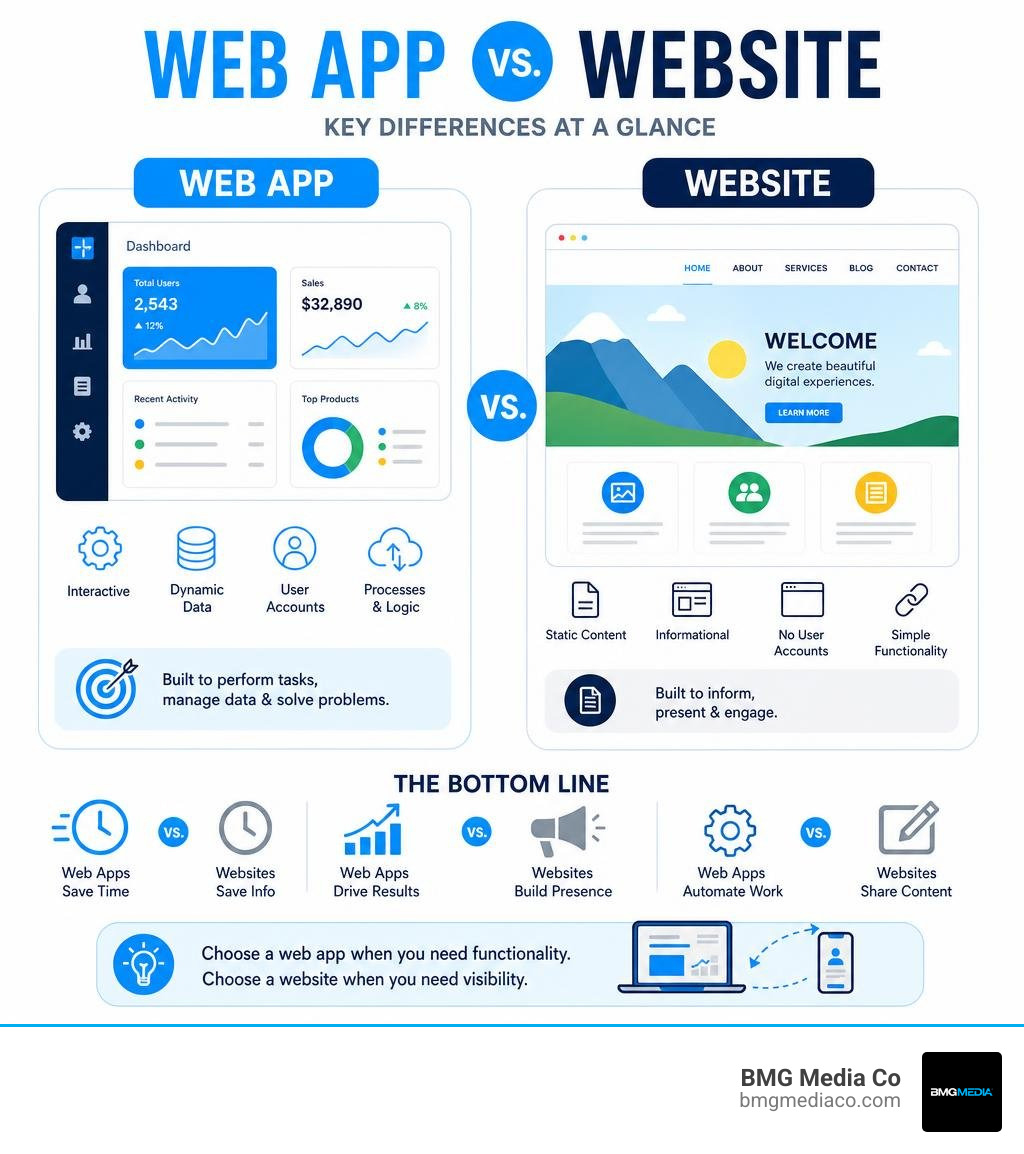
As we navigate July 2026, the distinction between a simple website and a true web application has never been clearer. A website displays static information, while a web app is an interactive, dynamic system designed to automate processes, handle transactions, and process user data. From customer portals in Detroit, MI to complex SaaS architectures deployed globally, businesses are leveraging web apps as core operational infrastructure.
This massive wave of digital transformation is fueled by a rapidly expanding web development services market. Building a web application is no longer a technical luxury; it is a strategic necessity for businesses looking to scale operations, eliminate manual data entry, and improve user engagement.
When we look at the cost to build a web app, we must view it as a strategic investment. A custom-built tool that streamlines internal workflows can save thousands of human hours, while a customer-facing portal can significantly lift desktop conversion rates—which remain roughly 1.7 times higher than mobile conversion rates.
The overall cost to develop a web application is highly variable. If you search the internet, you will find wild differences in pricing. To establish a realistic budget, you must first understand where your project fits within the complexity tiers.
According to data-backed industry benchmarks, custom web applications generally range from $15,000 to over $300,000. The median custom software project for small-to-midsize businesses typically lands between $100,000 and $180,000.

If you are launching a brand-new software concept, we almost always advise starting with a Minimum Viable Product (MVP). An MVP focuses strictly on your core workflow—the one feature that actually solves your user’s primary pain point.
As explored in the Web App Development Cost 2026 — MVP to Full Product guide, a standard MVP typically runs between $10,000 and $40,000. At this budget level, you are building a simple Create, Read, Update, Delete (CRUD) application. It will have a basic login system, a clean but straightforward user interface, and a single core workflow.
Starting with an MVP is the smartest way to validate your product hypothesis with real user feedback before investing six figures into advanced features that your target audience might not even use.
Once your product is validated, or if you are an established business in Metro Detroit modernizing an existing system, you will quickly cross into the mid-scale or enterprise tier.
For projects of this scale, relying on generic templates or cheap page builders is a recipe for disaster. This is Why Your Business Deserves Custom Web Development Solutions—custom code ensures that your enterprise architecture can scale infinitely as your transaction volume grows, with zero technical limitations.
To accurately estimate your development costs, you have to look under the hood. There are specific architectural decisions that act as cost multipliers.
The primary driver of software cost is functional complexity. A simple formula to keep in mind: more screens + more user types = more hours.
Every distinct user role you add (such as Super Admin, Manager, Vendor, and Customer) requires its own custom permissions, conditional views, and administration logic. Adding just one extra user role can increase the total build cost by 15% to 25% because developers must write and test custom access control lists across every single page of the application.
If you are ready to stop planning and start coding, you can check out our guide on how to Stop Procrastinating and Start Building a Web App with JavaScript to learn how to structure your initial data models cleanly from day one.
Integrating third-party software is rarely as simple as “plug and play.” Each external API integration adds an average of 40 to 80 hours of development time to account for edge cases, error handling, retry logic, and background synchronization.
Furthermore, security is a massive cost driver. If your application handles medical records in Oakland County or credit card transactions in Chicago, you must budget for strict compliance frameworks (like HIPAA or PCI-DSS). Implementing end-to-end encryption, multi-factor authentication, and audit logs can add $15,000 to $50,000 to your initial build budget.
To understand how to safely connect your application to external databases and legacy systems, read The Missing Link: A Guide to Software Integration & Web Apps.
When deciding how to build your web app, you will generally face three paths: custom development, no-code/low-code platforms, or buying off-the-shelf software.
| Metric | Custom Development | No-Code Platforms | Off-the-Shelf SaaS |
|---|---|---|---|
| Upfront Cost | High ($20K – $300K+) | Low ($2K – $15K) | None (Subscription only) |
| Time to Market | 2 – 6 months | 2 – 6 weeks | Immediate |
| Scalability | Infinite | Highly limited | Limited by vendor roadmaps |
| Data Ownership | 100% yours | Tied to platform | Hosted by vendor |
| Long-Term ROI | High (No per-user fees) | Low (Scaling subscription fees) | Low (Compounding monthly fees) |
No-code platforms are highly appealing to early-stage startups because of their low upfront costs. However, they come with a massive catch: long-term technical debt and scalability limits.
As your user base grows, no-code subscription costs scale aggressively. Even worse, you are entirely locked into their ecosystem. If the platform goes down, your business goes down. If you need a highly specific custom workflow that their system doesn’t support, you are out of luck.
With custom development, the upfront cost is higher, but you own the intellectual property completely. There are no licensing fees, no per-user monthly surcharges, and you have the freedom to scale your database architecture however you see fit.
In 2026, AI-powered prototyping tools (like Vercel v0 or Lovable) have made it incredibly easy to spin up interactive mockups in hours. These tools are fantastic for rapid prototyping and getting your idea in front of investors.
However, AI-generated code is often bloated, lacks proper security protocols, and cannot handle complex backend business logic. Using an AI builder to launch a production-grade application handling real customer transactions is highly risky. Think of AI as a tool to accelerate the design phase, not as a replacement for professional engineering.
A professional software build follows a structured lifecycle. Understanding how your budget is distributed across these stages helps prevent unexpected financial surprises.
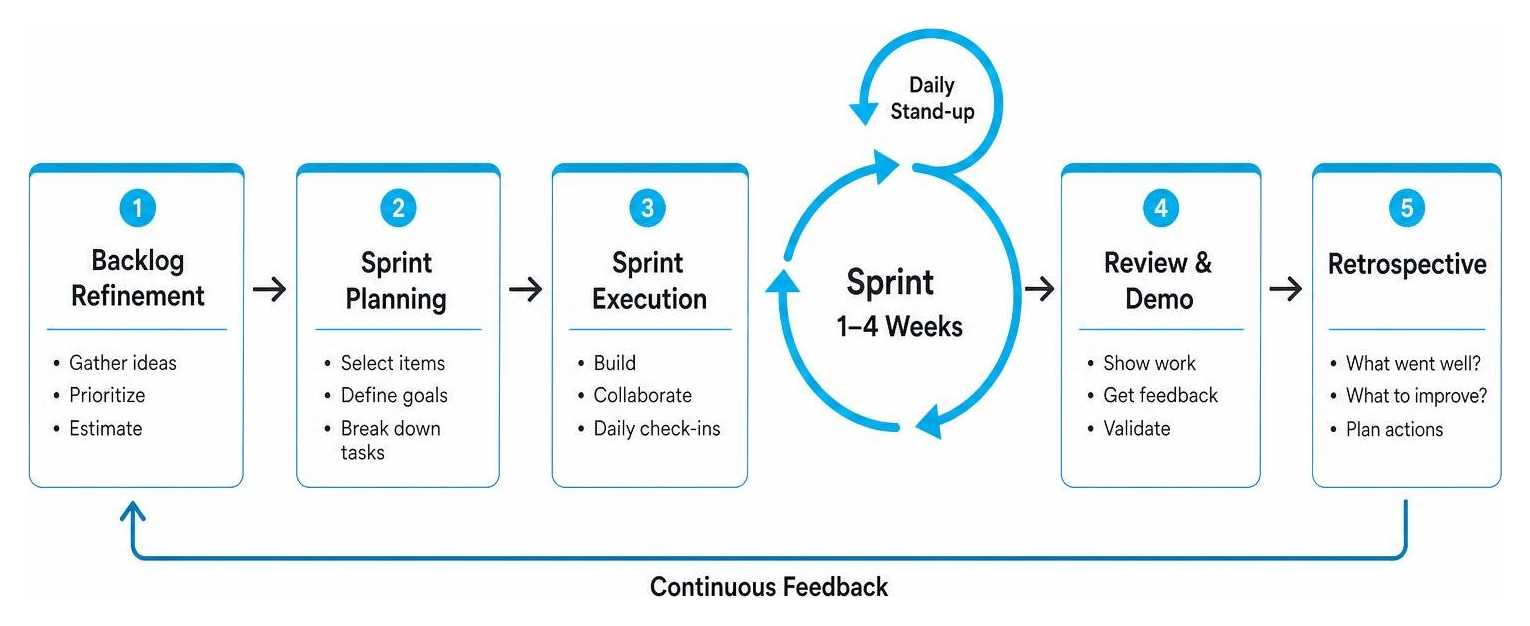
If you work with an established agency, your budget will generally be distributed across the following phases:
Early estimates usually fail because of “scope creep”—the slow, gradual addition of features that weren’t in the original agreement.
To avoid this, you must choose the right estimation model:
Who you hire to build your software has a massive impact on both the upfront price and the final quality of the code.
Understanding how different team structures affect pricing is critical when planning your development budget and choosing the right execution model.
Hiring an in-house developer in the United States in 2026 carries a high financial burden. The average salary for a senior software engineer easily exceeds $110,000 per year—not including benefits, taxes, equipment, and recruiting costs. And remember, a single developer cannot design, code, test, and manage a project all on their own.
Outsourcing to a dedicated agency provides you with an entire product team—including a Project Manager, UI/UX Designer, Frontend Developer, Backend Developer, and QA Engineer—for a fraction of the cost of hiring that team in-house. To help you navigate this decision, we put together The Ultimate Guide to Picking a Web App Partner.
Developer hourly rates vary drastically by geographic location:
While global outsourcing offers significant cost savings on paper, you must carefully weigh the communication overhead, timezone differences, and quality risks.
Data from Web App Development Cost in 2026: What 9,307 Firms Actually Charge shows that while 69% of global development firms charge under $50/hour, projects built at ultra-low rates often suffer from poor documentation and architectural mistakes. In fact, many budget builds under $50,000 require a complete rewrite within 18 months due to unscalable code.
The launch of your web application is not the finish line—it is the starting line. A common mistake is spending 100% of your budget on the initial build, leaving nothing for ongoing operations.
A simple MVP typically takes 4 to 12 weeks to design, build, and launch. A mid-scale business application with custom integrations usually requires 2 to 5 months. Complex, enterprise-grade platforms with deep security requirements can take anywhere from 5 to 18 months of continuous development.
In year one, buying an off-the-shelf SaaS solution is almost always cheaper. However, by year two or three, as your team grows and you pay compounding per-user monthly fees, SaaS can become incredibly expensive. More importantly, off-the-shelf software cannot be customized to your exact proprietary workflows. Custom development represents a higher upfront cost but delivers a significantly higher long-term ROI and asset valuation.
While you can find freelancers willing to build basic prototypes for $5,000, a secure, production-ready custom web application built by a professional agency typically starts at a minimum of $15,000 to $25,000. To run some rough numbers for your specific idea, you can work with an experienced agency to map out your requirements and get a baseline estimate.
At BMG Media Co., we have spent more than 15 years building custom digital solutions that drive real business growth. Founded in Birmingham, Michigan, in 2009 by MSU graduate and Shark Tank alumnus Blake George, our agency was born in a recession—a origin story that instilled in us a deep respect for capital efficiency, resourcefulness, and a bias toward action.
Over 1,000+ completed projects, we have maintained one uncompromising rule: every single line of code we write is 100% custom, built from scratch. We do not use generic templates. We do not use bloated page builders or Elementor shortcuts.
When you partner with us, you are not buying a cookie-cutter website; you are investing in a high-performance, secure, and infinitely scalable web application designed to match your brand and scale with your business across Metro Detroit, Southeast Michigan, or nationwide.
If you are ready to stop guessing and get a clear, realistic estimate for your project, explore our Custom Web Design and Development Services and schedule a consultation with our team today. Let’s build something incredible together.

