October 2026

Partnering with an industrial website design agency boosts qualified leads by implementing custom parametric search, technical spec architectures, and RFQ-optimized workflows that speak directly to engineering and procurement teams. Manufacturing procurement operates in a completely different universe than consumer retail. When an engineer, plant manager, or procurement director lands on your site, they are not browsing for impulse purchases. They are validating whether your facility can hold a ±0.0005-inch tolerance, source medical-grade titanium, or deliver 50,000 units on a rigid delivery schedule.
These transactions involve multi-stakeholder buying committees, strict compliance mandates, and sales cycles that often span multiple months. A generic digital storefront simply cannot address the rigorous scrutiny of an enterprise purchasing team.
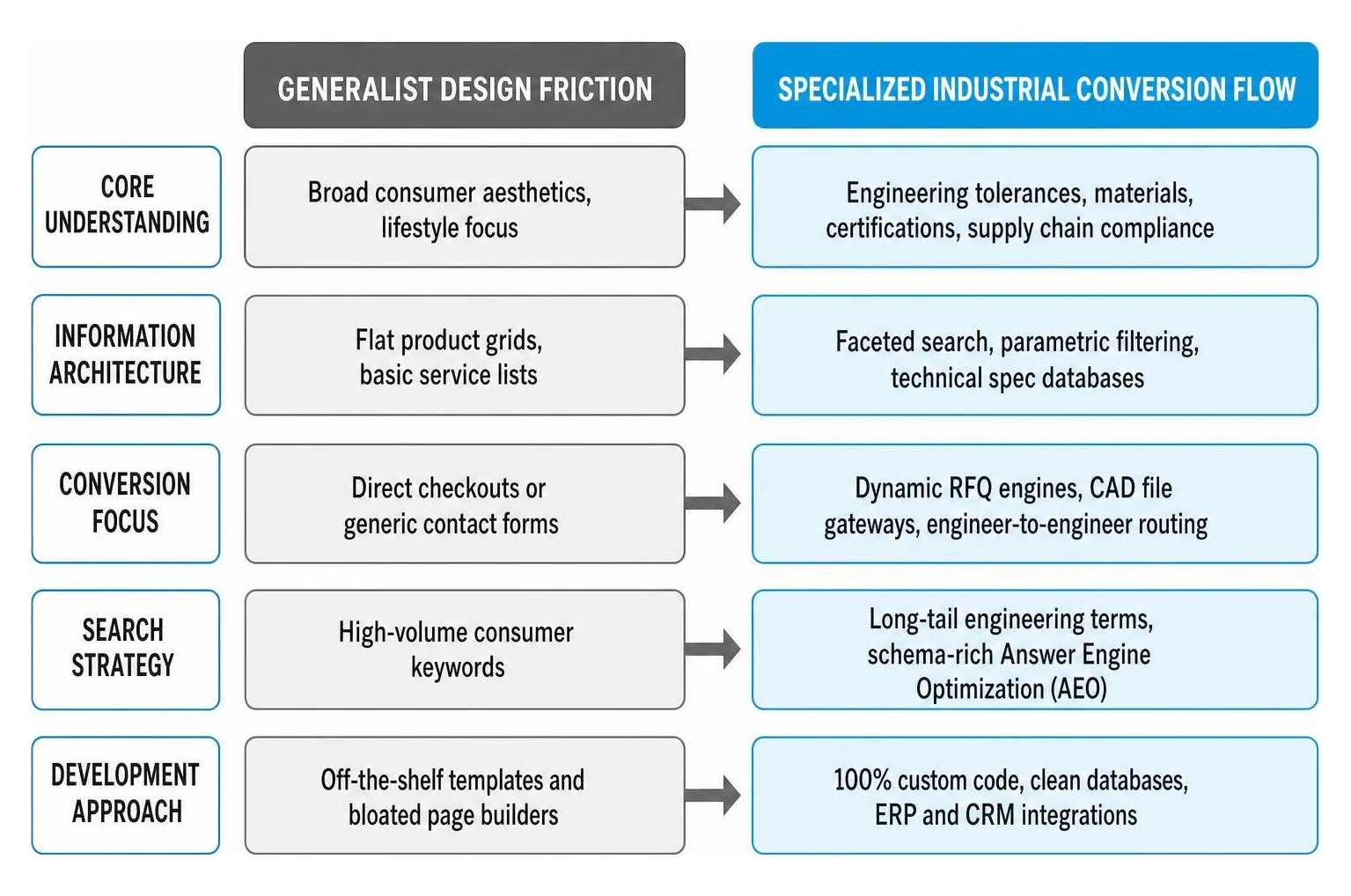
| Feature / Capability | Generalist Web Design Agency | Specialized Industrial Web Design Agency |
|---|---|---|
| Core Understanding | Broad consumer aesthetics, lifestyle focus | Engineering tolerances, materials, certifications, supply chain compliance |
| Information Architecture | Flat product grids, basic service lists | Faceted search, parametric filtering, technical spec databases |
| Conversion Focus | Direct checkouts or generic contact forms | Dynamic RFQ engines, CAD file gateways, engineer-to-engineer routing |
| Search Strategy | High-volume consumer keywords | Long-tail engineering terms, schema-rich Answer Engine Optimization (AEO) |
| Development Approach | Off-the-shelf templates and bloated page builders | 100% custom code, clean databases, ERP and CRM integrations |
Generalist design agencies frequently lean on pre-packaged templates and visual trends that look great in a creative portfolio but fall apart on the factory floor. When complex manufacturing specifications are shoehorned into a lightweight theme, the result is slow performance, confusing navigation, and broken user journeys.
B2B manufacturing buyers demand instant access to technical spec sheets, material compatibility data, ISO/AS9100 certifications, and downloadable CAD/STEP models. If an aerospace procurement officer cannot quickly verify your quality management system, they hit the back button and visit your competitor.
At BMG Media Co., we approach every project with zero templates and zero page builders. Navigating the process of rebuilding your manufacturing brand image requires structuring complex engineering capabilities into an intuitive, custom-engineered interface that speaks directly to technical decision-makers.
Just like machinery left exposed on a warehouse floor, legacy websites accumulate what we call digital rust: outdated user experiences, broken PDF links, slow mobile performance, and invisible technical errors that erode buyer confidence. This legacy drag prevents high-precision manufacturers from winning top-tier commercial and industrial contracts.
Specialized design strategies solve distinct challenges across diverse precision verticals:
Reviewing curated industrial website inspiration for modern brands shows how leading industrial manufacturers replace legacy digital rust with sharp, responsive platforms that convert high-value engineering traffic.
A high-performing industrial website is an operational asset that acts as an automated sales engineer. Achieving this level of performance requires custom WordPress development, tailored Advanced Custom Fields (ACF Pro) architecture, and clean code built from scratch to support deep product hierarchies and heavy data requirements.
Investing in custom site development for complex manufacturing needs ensures that your web infrastructure loads quickly, protects sensitive proprietary engineering data, and scales alongside your production floor.
The primary goal of an industrial website is capturing detailed, high-intent Request for Quotes (RFQs). Standard contact forms that only ask for a name and email deliver low-quality, unqualified inquiries that waste your estimating team’s time.
An industrial agency implements spec-heavy user journeys, faceted catalog searches, and intuitive quoting workflows. This includes:
Reviewing practical industrial website design ideas that drive leads helps manufacturers understand how clear conversion pathways turn passive technical readers into qualified sales discussions.
Search habits have shifted dramatically. While ranking in traditional Google search results remains vital, procurement teams and design engineers increasingly use AI-powered answer engines like ChatGPT, Google Gemini, and Perplexity to source certified vendors.
Capturing these complex, high-value queries requires an advanced approach to technical SEO and Answer Engine Optimization (AEO):
robots.txt paths for technical subdirectories, and ensuring Googlebot renders every technical data table cleanly.Purpose-built code is critical for competing with template-reliant websites in both traditional and AI-driven search environments.
A custom website overhaul should deliver measurable, bottom-line value. By aligning your digital presence with actual engineering capabilities, an industrial website redesign eliminates digital friction and gives your team a clearer inbound pipeline to measure.
Following a proven framework for manufacturing website design from blueprint to launch ensures every digital touchpoint serves an operational purpose: driving pipeline growth, protecting margins, and elevating brand authority.
Rather than relying on generic vanity metrics, manufacturers should establish a pre-launch baseline and track the indicators that directly affect quoting efficiency and sales quality:
External directories such as the Top Web Design Agencies in Michigan – Sep 2026 Rankings can be one reference point, but manufacturers should prioritize technical fit, custom development quality, and RFQ performance when selecting a partner.
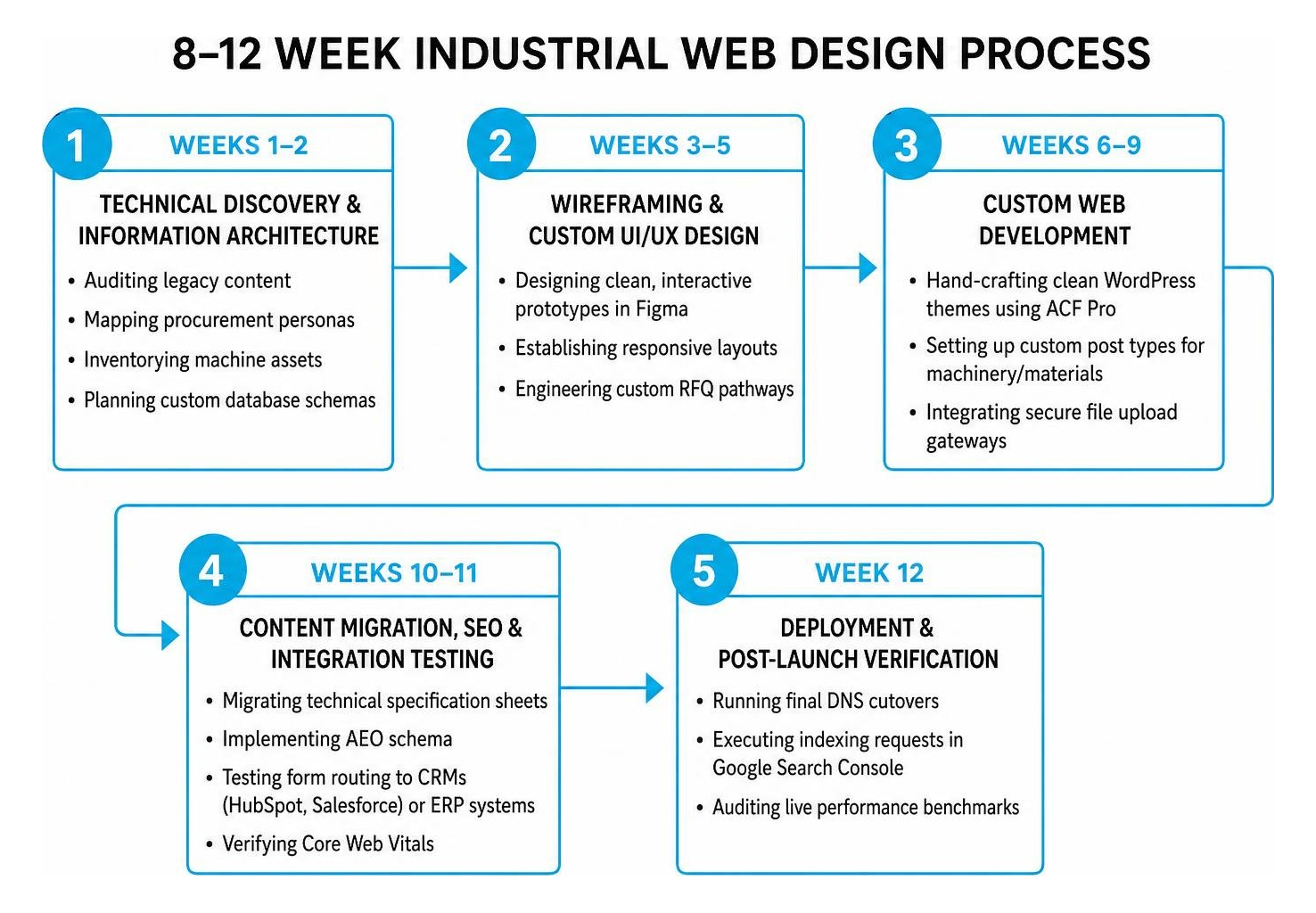
Building an enterprise-grade industrial website requires disciplined project management and deep collaboration. A standard build typically spans 8 to 12 weeks:
Manufacturers can explore our websites for manufacturing companies gallery to see how precision engineering principles translate into high-performing digital platforms.
Choosing an agency partner is a long-term strategic decision. Selecting the wrong agency often results in wasted capital, missed quoting deadlines, and a website that must be completely rebuilt within two years.
When evaluating digital agencies, ask targeted questions to separate genuine technical craftsmen from general marketing firms:
For an industrial example, review BMG Media Co’s Detroit Edge Tool Company project alongside any proposal so stakeholders can evaluate fit against a real manufacturing engagement.
Your website should serve as an accurate, digital mirror of your physical production floor:
A specialized agency implements structured, multi-step RFQ workflows that guide buyers to input essential project parameters—including target volumes, material grades, tolerance requirements, and production deadlines. By integrating secure CAD/drawing upload fields and automatic filtering rules, the site weeds out low-value inquiries, ensuring your sales engineers focus entirely on high-probability, high-margin opportunities.
A custom, enterprise-grade industrial website build typically takes between 8 and 12 weeks from initial discovery to final deployment. This timeline accounts for information architecture planning, technical spec sheet structuring, custom UI/UX design, custom WordPress development, CRM/ERP integrations, and comprehensive SEO/AEO validation.
Answer Engine Optimization structures your website’s content using specialized JSON-LD schema, clean semantic HTML, and clear technical hierarchies. When procurement teams ask AI search engines (like ChatGPT, Perplexity, or Google Gemini) for specialized supplier recommendations, structured AEO ensures these platforms accurately identify your certifications, machinery capabilities, and service regions, placing your facility directly into AI-generated vendor shortlists.
Your manufacturing facility invests millions in cutting-edge machinery, rigorous quality control, and world-class engineering talent. Your digital presence should reflect that same standard of precision and craft.
At BMG Media Co., we engineer custom web solutions for high-performance businesses. 1000+ websites since 2009. We build every platform 100% custom from scratch—no templates, no bloated page builders, and no shortcuts. From our headquarters in Birmingham, Michigan, to manufacturing hubs across North America, we help industrial leaders replace digital rust with high-speed digital assets that dominate search results and capture high-value contracts.
Ready to modernize your manufacturing website and scale your qualified RFQs? Request your custom web strategy session today.
