August 2026

Chiropractor website development done right means building a site that turns local searchers into booked patients — fast.
Here’s what an effective chiropractic website needs:
Most chiropractic websites fail not because they look bad, but because they’re built without a strategy. They’re slow, hard to navigate on mobile, and buried on page two of Google — where nobody looks.
Your website is usually the very first impression a potential patient gets of your practice. If it doesn’t communicate who you help, what you treat, and how to book — within a few seconds — that patient will move on to the next result.
I’m Blake George, founder of BMG Media Co, a web design and development agency with over a decade of experience building custom, high-performance websites across healthcare and beyond — including chiropractor website development projects that prioritize patient acquisition, not just aesthetics. Let’s walk through exactly what it takes to build a chiropractic site that consistently brings in new patients.
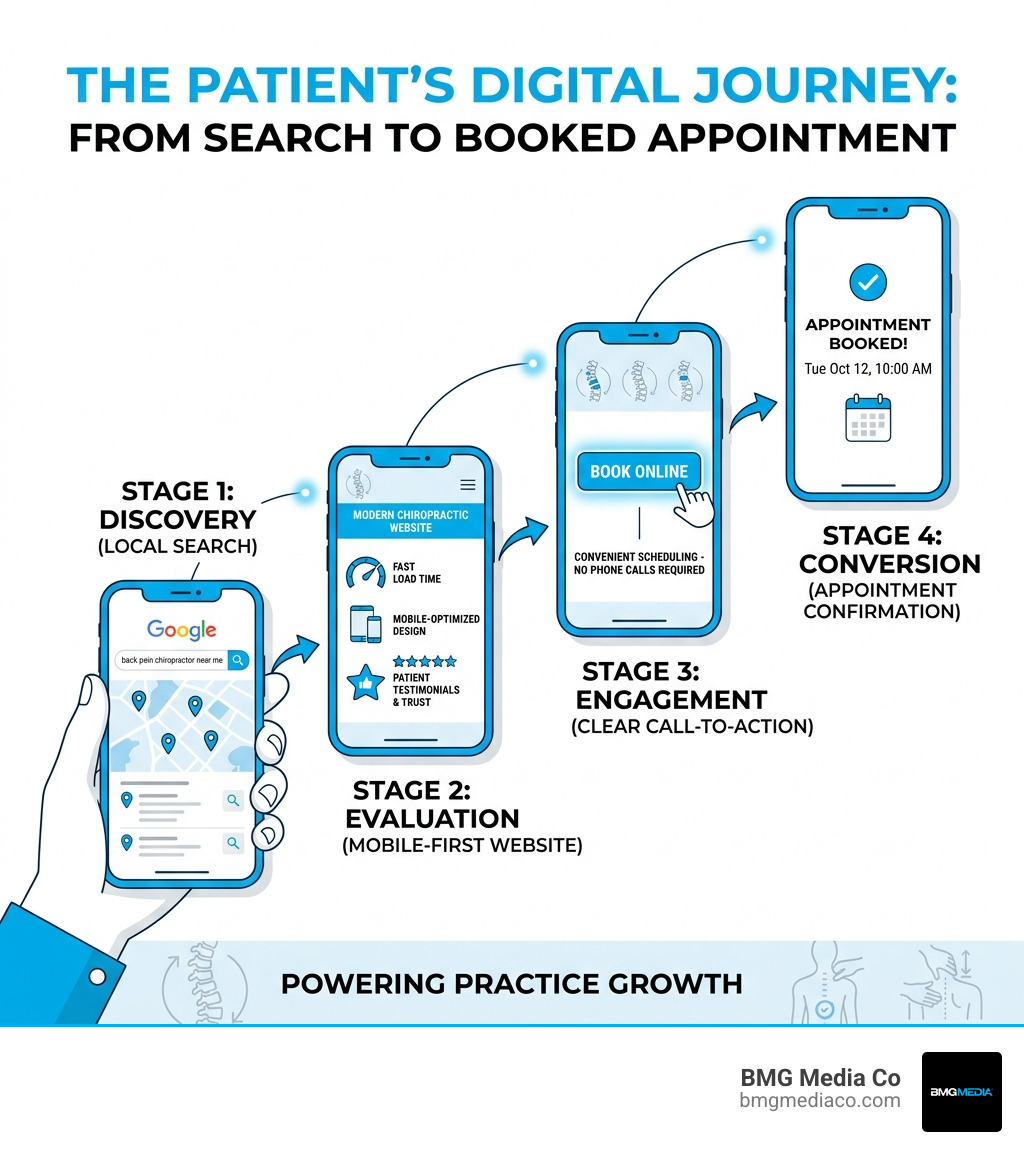
Chiropractor website development definitions:
When we talk about chiropractor website development, we aren’t just talking about a digital brochure. We are talking about a high-performance engine designed to grow your practice. In April 2026, the digital landscape is more competitive than ever, and a “good enough” website is essentially invisible.
The first pillar is custom branding. Your practice has a unique “spirit”—whether you focus on sports medicine, pediatric care, or holistic family wellness. A template can’t capture that. Custom design ensures that your site reflects your specific expertise and aesthetic, which builds immediate trust.
Next is responsive design. With approximately 60–70% of all web searches originating from mobile devices, your site must look and function perfectly on a smartphone. If a potential patient has to “pinch and zoom” to find your phone number, they’ve already moved on to the next chiropractor. For a deeper dive into this, check out our guide on How to Build a Mobile-Friendly Medical Site.
Finally, we have the “5-second rule.” Research shows that if a visitor doesn’t take action or find what they need within 5 seconds of landing, they are likely to leave and never return. This is why fast loading speed and intuitive navigation are non-negotiable. Every second of lag time kills your conversion rate and hurts your SEO.
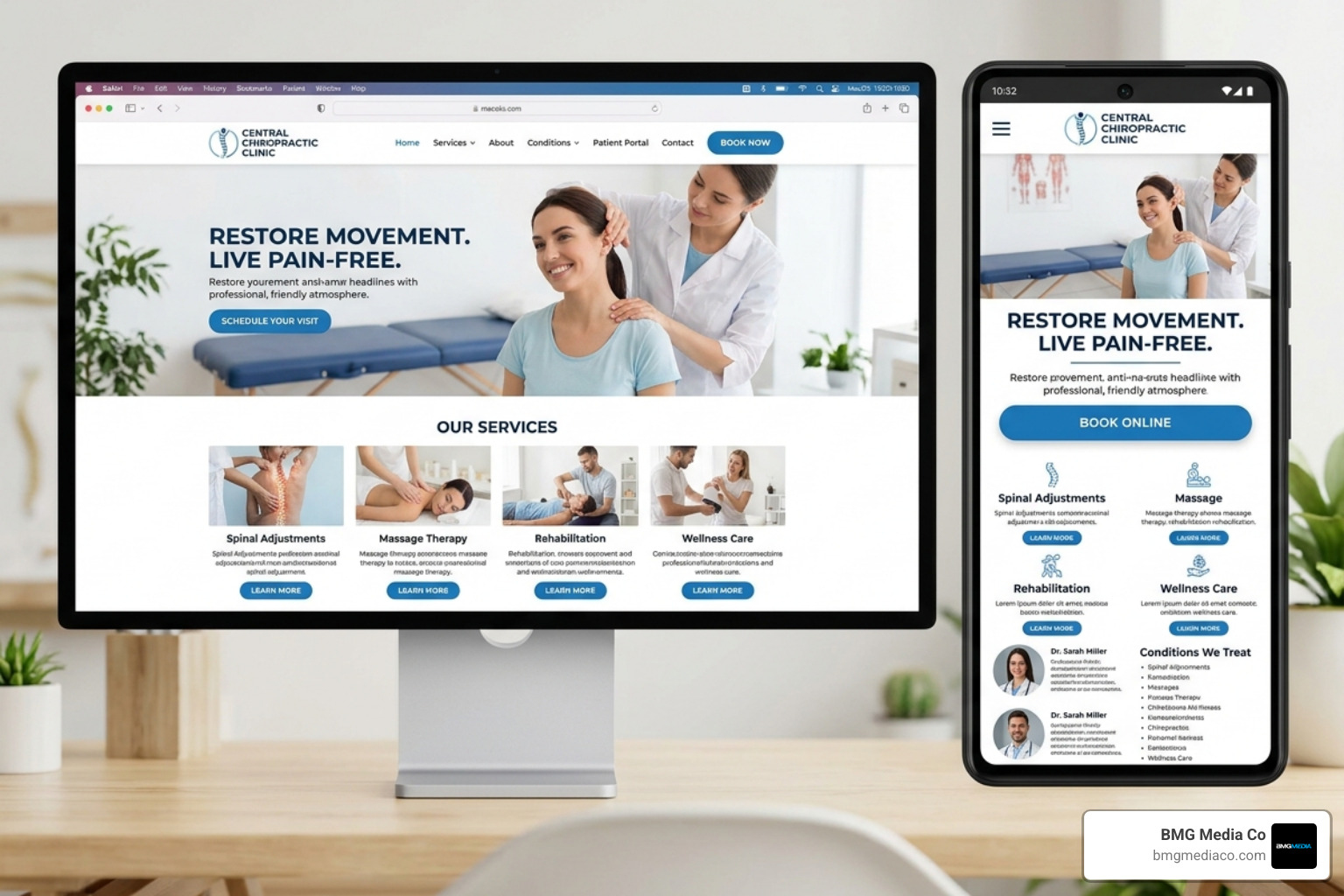
The goal of your website is to get people onto your table. In 2026, patients expect the convenience of booking an appointment without having to pick up the phone. Integrating a seamless doctor appointment booking site is one of the most effective ways to boost conversions.
By showing real-time availability, you remove the friction of the “back-and-forth” phone tag. This convenience isn’t just a perk; it’s a competitive advantage. When a patient is in pain at 10:00 PM and can secure a 9:00 AM slot for the next morning right from their phone, your website has officially done its job.
Chiropractic care is deeply personal. Patients are often apprehensive about who they trust with their spinal health. This is where social proof becomes your most powerful marketing tool.
Effective chiropractor website development must feature patient testimonials prominently. Video testimonials are particularly impactful because they allow prospective patients to see and hear the relief and success others have experienced. These trust signals act as a digital “word-of-mouth,” bridging the gap between a stranger and a loyal patient.
A beautiful website is useless if no one can find it. For chiropractors, Local SEO is the lifeblood of new patient acquisition. Most patients search for terms like “chiropractor near me” or “back pain relief in [City Name].”
Your creative medical website design must be built on a foundation of keyword research and on-page optimization. This includes optimizing meta titles, descriptions, and header tags with local intent. Furthermore, your Google Business Profile (GBP) must be perfectly synced with your website data to ensure you show up in the “Map Pack”—that coveted top-three spot on Google search results.
| Feature | Local SEO | General SEO |
|---|---|---|
| Primary Goal | Attract nearby patients | Build global/national authority |
| Key Metric | Proximity and reviews | Domain authority and backlinks |
| Content Focus | Local landmarks and service areas | Broad educational topics |
| Google Maps | Critical (Google Business Profile) | Less relevant |
Content is how you demonstrate your authority. Instead of generic “about us” pages, your site should feature dedicated condition pages (e.g., Sciatica, Migraines, Whiplash) and service descriptions. This helps Google understand exactly what you treat, which improves your rankings for specific searches.
We also recommend maintaining an active blog. If you’re worried about the technical side, learn How to Set Up Your Medical Blog Without a PhD in Tech. Regular, high-quality content—like videos explaining proper posture or blogs on the benefits of adjustments—keeps your site fresh and signals to Google that you are an active, authoritative practice.
To keep visitors on your site longer (which boosts SEO), consider adding interactive elements. Things like:
These elements transform a passive reading experience into an active engagement, much like how Optometry Practice WordPress Sites That See Clearly use visual tools to engage their patients.
When building a medical site, you can’t cut corners on the technical side. Your website must be a “healthy” environment for patient data. This means ensuring HIPAA compliance for any forms that collect patient information. Secure encryption and SSL certificates are mandatory to protect both your patients and your practice from liability.
Furthermore, ADA accessibility is essential. Your website should be usable by everyone, including those with visual or hearing impairments. Failing to meet these standards can result in significant fines and, more importantly, excludes a portion of your community from accessing your care. For more on this, see our guide on How to Build a Healthy Medical Practice Website.
At BMG Media Co, we are big believers in The Best WordPress Sites for Doctors and Why They Work. WordPress offers the perfect balance of customizability, SEO friendliness, and ease of use.
Unlike “locked” platforms that charge you a monthly fee but don’t give you ownership of your site, an open-source WordPress build ensures you own your digital asset. It allows for custom coding that can scale as your practice grows, whether you add new locations or specialized services.
One of the biggest mistakes chiropractors make is using generic templates. Templates often come with “bloated” code that slows down your site and duplicate content that Google hates. If your “About Chiropractic” page is the exact same text used by 500 other clinics, Google will ignore your site.
Other common pitfalls include:
Take a look at the Legacy Dermatology Group Portfolio to see how a custom-developed healthcare site avoids these common traps.
What does chiropractor website development actually cost in 2026? While you might see “bargain” offers for a few hundred dollars, those often lack the functionality and SEO required to actually generate leads.
Basic medical websites typically start around $4,000, while more intricate, fully custom designs can cost tens of thousands. A good rule of thumb for ongoing maintenance and SEO is to spend somewhere in the middle—usually between $200 and $500 per month. Spending less often means leaving crucial functionality, like HIPAA-compliant forms or advanced SEO, on the table.
Building a high-performing site takes time. A custom project typically requires 40 to 100+ hours of work. Here is how we break it down:
For more details on our specific approach to healthcare, visit our Industry: Medical/Healthcare Web page.
A professional, custom-built site usually takes between 4 to 8 weeks. This includes the discovery phase, custom coding, content integration, and final edits. While some services offer “one-week” designs, these are often templated and lack the deep SEO foundation needed for long-term growth.
The two big ones are HIPAA (for data privacy and secure patient communication) and ADA (for web accessibility). Additionally, you need an SSL certificate for data encryption and a clear privacy policy to comply with modern data protection laws.
Templates make your practice look generic. More importantly, Google penalizes duplicate content, which is common in templates. Custom design allows for unique branding, superior SEO, and the ability to build specific features (like custom patient intake forms) that a template simply can’t handle.
At BMG Media Co, we don’t just build websites; we build growth engines for chiropractors. Based in Birmingham, Michigan, we specialize in fully custom, high-performance sites that are as unique as the practices they represent. With over 1,000 sites completed and an award-winning design team, we know exactly what it takes to make your practice stand out in a crowded digital market.
Don’t settle for a website that just sits there. Start your high-performance chiropractor website development project with us today and let’s get your practice the visibility it deserves.
External Resources for Chiropractic Success:
Internal BMG Media Co Resources:
